Plan a trip
Language: English
Trip plannerPlan your trip on a map

Top destinations

EnglishDeutschFrançaisEspañolPortuguêsPortuguês (BR)Italiano
Travel advisory · PakistanSome governments advise against all but essential travel to Pakistan.Advice depends on your passport. Read your own government's advice before you book.Official advice
Areas with warnings
  • Balochistan province · avoid all travel · Canada, Germany, France, New Zealand, UK, US
  • Indian border, distance not specified (incl. LoC) · avoid all travel · France, New Zealand
  • Karakoram Highway, Mansehra to Chilas · avoid all travel · Canada, New Zealand, UK
  • Khyber Pakhtunkhwa province · avoid all travel · Canada, France, New Zealand, US
  • Pakistan-administered Kashmir (Azad Jammu and Kashmir) · avoid all travel · Canada, Germany, France, Italy, New Zealand, UK
  • Afghanistan border region, distance not specified · avoid non-essential travel · Italy, New Zealand
  • Former FATA tribal areas · avoid non-essential travel · France, Italy

Also named by one government: 10 km strip along the Chinese border (Canada), 10 km strip along the Indian border (Canada), 10 km strip along the Iranian border (Canada), 10 km strip along the Line of Control (Canada), 10 miles strip along the Afghan border (UK), 10 miles strip along the Line of Control (UK), 50 km strip along the Afghan border (Canada), 50 km strip along the Afghan border in Gilgit-Baltistan (New Zealand), Bajaur (UK), Bannu (UK), Buner (UK), Chārsadda (UK), Dera Ismail Khan (UK), Hangu (UK), Immediate vicinity of the Line of Control (US), Karak (UK), Khyber district (UK), Kohat (UK), Kurram (UK), Lakki Marwat (UK), Lower Dir (UK), Lower South Waziristan (UK), Mohmand (UK), N45 highway, north of Mardan ring road to edge of Chitral City, incl. Kalash valley (UK), North Waziristan (UK), Orakzai (UK), Peshawar (UK), Punjab province, excluding Faisalabad-Lahore-Islamabad zone (France), Swat (UK), Tank (UK), Upper Dir (UK), Upper South Waziristan (UK), 20 km strip along the Indian border, incl. LoC (Germany), 5 miles strip along the Indian border (UK), Chitral district (Canada), Dera Ghazi Khan (UK), Faisalabad-Lahore-Islamabad zone (France), Karachi (Canada), Land route to and from Iran and Afghanistan (Germany), Malakand (UK), Mardan (UK), Nowshera (UK), Shangla (UK), Sindh province north of and including Nawabshah (UK), Swabi (UK), Tribal areas of Balochistan (Italy)

GovernmentAdviceUpdatedRead the advice
United Kingdom (FCDO)No advice against the whole country (regional advisories)–Read the advice
United States (State Dept)Reconsider TravelJun 16, 2026Read the advice
Canada (Global Affairs)Exercise a high degree of caution (regional advisories)–Read the advice
Germany (Auswärtiges Amt)No advice against the whole country; partial warnings for named regions (regional advisories)Oct 13, 2026Read the advice
New Zealand (SafeTravel)Avoid non-essential travel–Read the advice
France (Ministry for Europe and Foreign Affairs)Le reste du territoire est déconseillé sauf raison impérative–Read the advice

Checked daily from the governments' published advice; last checked Nov 3, 2026. RoamLedger summarises official advice; it is not advice from any government.

Shah Faisal Mosque
Mosque

Shah Faisal Mosque Islamabad

Faisal Mosque in Islamabad: Pakistan's national mosque, a dome-less tent-shaped design below the Margalla Hills. Dress code, best time, tips.

Faisal Mosque is the national mosque of Pakistan, standing at the foot of the Margalla Hills on Shah Faisal Avenue in Islamabad. The Turkish architect Vedat Dalokay gave it a dome-less, eight-sided concrete form modelled on a Bedouin tent, flanked by four 90-metre minarets. Saudi Arabia funded the building, and it is named after King Faisal bin Abdul Aziz. The white structure looks best against the hills at sunrise or sunset, and again after dark when it is lit. Visitors dress modestly and leave bags outside.

A tent in concrete, 1976 to 1986
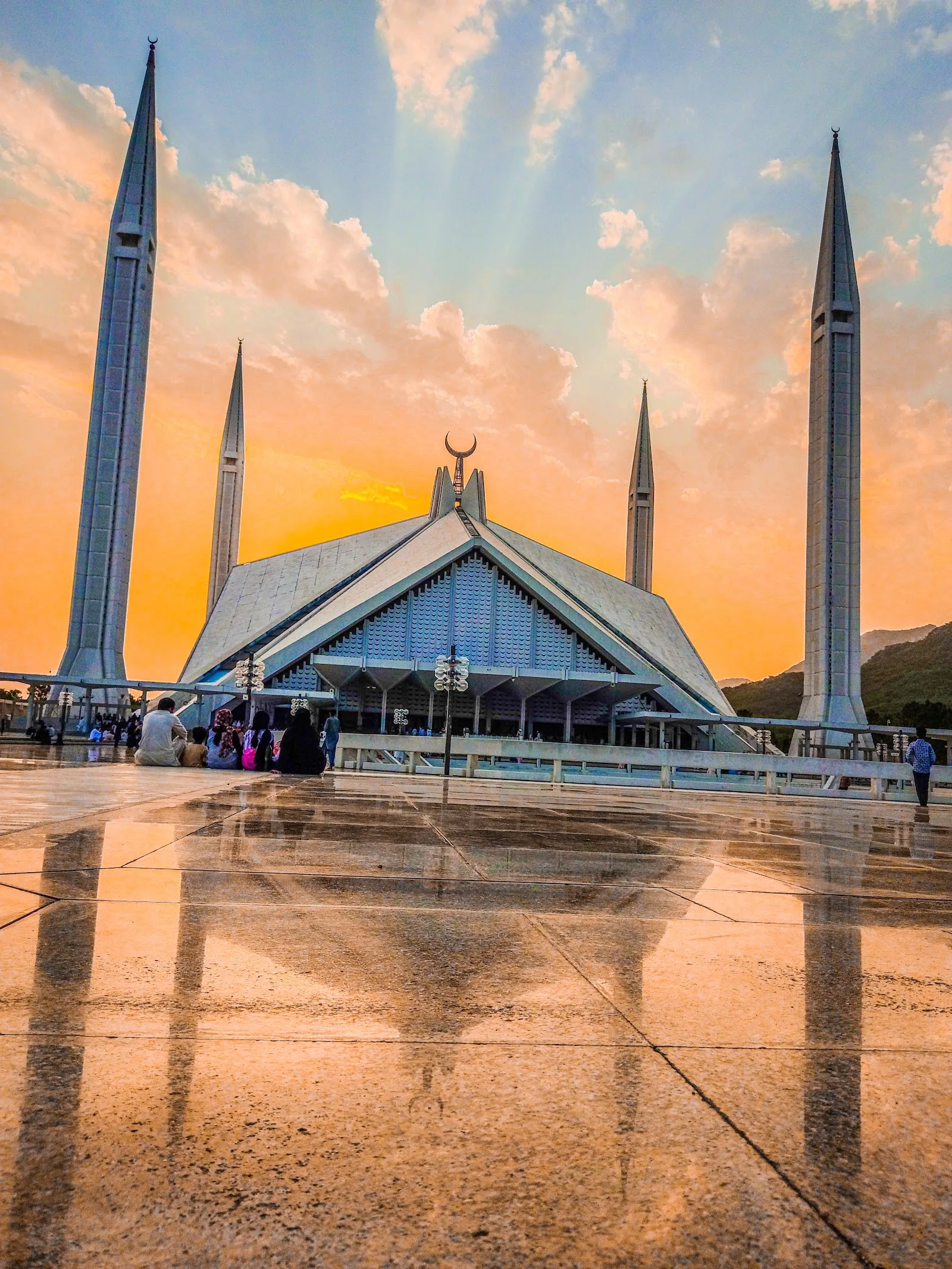
Shah Faisal Mosque Islamabad

Faisal Mosque was designed by the Turkish architect Vedat Dalokay. Instead of the usual dome, he drew an eight-sided concrete structure inspired by a Bedouin tent. Four slender minarets, each 90 metres (295 feet) tall, stand around it.

The project was largely paid for by a grant from Saudi Arabia, and the mosque carries the name of King Faisal bin Abdul Aziz. Construction began in 1976 and finished in 1986. For a few years from the late 1980s into the early 1990s it was the largest mosque in the world. It remains the largest in Pakistan and is the country's national mosque.

Inside and around the prayer halls
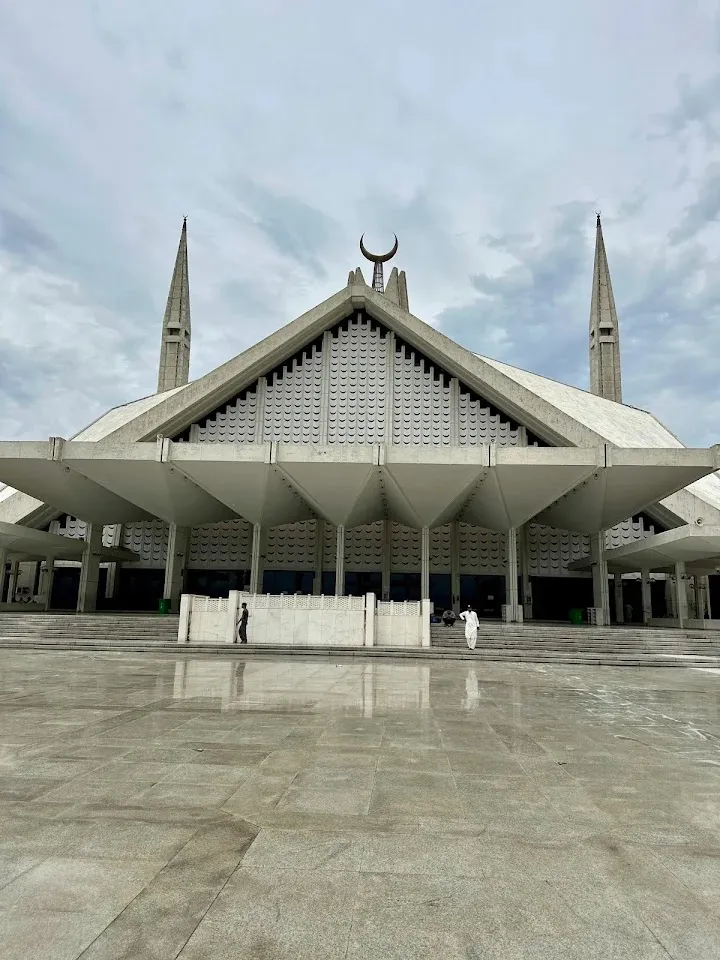
Shah Faisal Mosque Islamabad

The interior has chandeliers and calligraphy, and tile work adds detail to the modern lines. The prayer halls are large and quiet, and the acoustics carry well.

The grounds include porticoes and wide courtyards, which is where most visitors spend their time. Washrooms and a wudu area are on site, and there is a small library and museum. The entrance, restrooms and parking are wheelchair accessible, and parking is free.

The setting at the Margalla Hills

The mosque sits at the foothills of the Margalla Hills, and the green slope behind the white walls is the view most people photograph. At sunset the sky behind the building turns purple, and floodlights then pick out the main structure. Early morning is quieter and the light is softer.

The Pakistan Monument and the Daman-e-Koh viewpoint are also on the standard Islamabad route, so the mosque combines easily with them in a single day.

Before you go

Visitors come from across Pakistan and abroad, and the mosque is an active place of worship as well as a landmark. Expect more people during Friday prayers and on public holidays; a regular weekday morning is calmer.

Access to the interior can depend on prayer times and local conditions, and security closures have happened. Check the situation on the day. Staff and volunteers on site can answer questions about where visitors may go.

FAQ

Can non-Muslims visit Faisal Mosque?

Non-Muslim visitors can enter the courtyard if they are properly dressed. Access to other areas can depend on prayer times, so ask staff on site.

Are bags allowed inside Faisal Mosque?

No. Bags are not allowed inside the premises, for men or women, so bring only essentials.

What is the best time to visit Faisal Mosque?

Early morning or about an hour before sunset gives the best light. The building is also lit at night. Fridays and holidays are the busiest days.

Who designed Faisal Mosque and when was it built?

The Turkish architect Vedat Dalokay designed it. Construction began in 1976 and was completed in 1986.

Is Faisal Mosque wheelchair accessible?

Yes. The entrance, restroom and parking lot are wheelchair accessible, and parking is free.

More must-sees in Pakistan

Explore all