Pianifica un viaggio
Lingua: Italiano
Pianificatore di viaggiPianifica il tuo viaggio su una mappa

Le migliori destinazioni

EnglishDeutschFrançaisEspañolPortuguêsPortuguês (BR)Italiano
Avviso di viaggio · PakistanAlcuni governi sconsigliano di recarsi in Pakistan se non per motivi essenziali.Le indicazioni dipendono dal tuo passaporto. Leggi quelle del tuo governo prima di prenotare.Indicazioni ufficiali
Aree con avvisi
  • provincia del Belucistan · evitare ogni viaggio · Canada, Germania, Francia, Nuova Zelanda, Regno Unito, Stati Uniti
  • Confine con l'India, distanza non specificata (inclusa LoC) · evitare ogni viaggio · Francia, Nuova Zelanda
  • Karakoram Highway, da Mansehra a Chilas · evitare ogni viaggio · Canada, Nuova Zelanda, Regno Unito
  • provincia di Khyber Pakhtunkhwa · evitare ogni viaggio · Canada, Francia, Nuova Zelanda, Stati Uniti
  • Kashmir amministrato dal Pakistan (Azad Jammu e Kashmir) · evitare ogni viaggio · Canada, Germania, Francia, Italia, Nuova Zelanda, Regno Unito
  • Regione di confine con l'Afghanistan, distanza non specificata · evitare i viaggi non essenziali · Italia, Nuova Zelanda
  • Ex aree tribali della FATA · evitare i viaggi non essenziali · Francia, Italia

Segnalata anche da un solo governo: Fascia di 10 km lungo il confine con la Cina (Canada), Fascia di 10 km lungo il confine con l'India (Canada), Fascia di 10 km lungo il confine con l'Iran (Canada), Fascia di 10 km lungo la Linea di Controllo (Canada), Fascia di 10 miglia lungo il confine afghano (Regno Unito), Fascia di 10 miglia lungo la Linea di Controllo (Regno Unito), Fascia di 50 km lungo il confine afghano (Canada), Fascia di 50 km lungo il confine afghano nel Gilgit-Baltistan (Nuova Zelanda), Bajaur (Regno Unito), Bannu (Regno Unito), Buner (Regno Unito), Charsadda (Regno Unito), Dera Ismail Khan (Regno Unito), Hangu (Regno Unito), Immediate vicinanze della Linea di Controllo (Stati Uniti), Karak (Regno Unito), distretto di Khyber (Regno Unito), Kohat (Regno Unito), Kurram (Regno Unito), Lakki Marwat (Regno Unito), Dir Inferiore (Regno Unito), Waziristan Meridionale Inferiore (Regno Unito), Mohmand (Regno Unito), Strada N45, da nord della tangenziale di Mardan fino ai margini di Chitral, inclusa la valle dei Kalash (Regno Unito), Waziristan Settentrionale (Regno Unito), Orakzai (Regno Unito), Peshawar (Regno Unito), Provincia del Punjab, esclusa la zona Faisalabad-Lahore-Islamabad (Francia), Swat (Regno Unito), Tank (Regno Unito), Dir Superiore (Regno Unito), Waziristan Meridionale Superiore (Regno Unito), Fascia di 20 km lungo il confine indiano, inclusa la LoC (Germania), Fascia di 5 miglia lungo il confine indiano (Regno Unito), Distretto di Chitral (Canada), Dera Ghazi Khan (Regno Unito), Zona Faisalabad-Lahore-Islamabad (Francia), Karachi (Canada), Via di terra da e per l'Iran e l'Afghanistan (Germania), Malakand (Regno Unito), Mardan (Regno Unito), Nowshera (Regno Unito), Shangla (Regno Unito), Provincia del Sindh a nord di Nawabshah, inclusa (Regno Unito), Swabi (Regno Unito), Aree tribali del Belucistan (Italia)

GovernoConsigliAggiornatoLeggi le indicazioni
Regno Unito (FCDO)No advice against the whole country (regional advisories)–Leggi le indicazioni
Stati Uniti (Dipartimento di Stato)Reconsider Travel16 giu 2026Leggi le indicazioni
Canada (Affari globali)Exercise a high degree of caution (regional advisories)–Leggi le indicazioni
Germania (Auswärtiges Amt)No advice against the whole country; partial warnings for named regions (regional advisories)13 ott 2026Leggi le indicazioni
Nuova Zelanda (SafeTravel)Avoid non-essential travel–Leggi le indicazioni
Francia (Ministero per l'Europa e gli Affari esteri)Le reste du territoire est déconseillé sauf raison impérative–Leggi le indicazioni

Verificato ogni giorno dalle indicazioni pubblicate dai governi; ultima verifica 3 nov 2026.RoamLedger riassume le indicazioni ufficiali; non è un consiglio di alcun governo.

Shah Faisal Mosque
Moschea

Shah Faisal Mosque Islamabad

Faisal Mosque is the national mosque of Pakistan, standing at the foot of the Margalla Hills on Shah Faisal Avenue in Islamabad.

Faisal Mosque is the national mosque of Pakistan, standing at the foot of the Margalla Hills on Shah Faisal Avenue in Islamabad. The Turkish architect Vedat Dalokay gave it a dome-less, eight-sided concrete form modelled on a Bedouin tent, flanked by four 90-metre minarets. Saudi Arabia funded the building, and it is named after King Faisal bin Abdul Aziz. The white structure looks best against the hills at sunrise or sunset, and again after dark when it is lit. Visitors dress modestly and leave bags outside.

A tent in concrete, 1976 to 1986
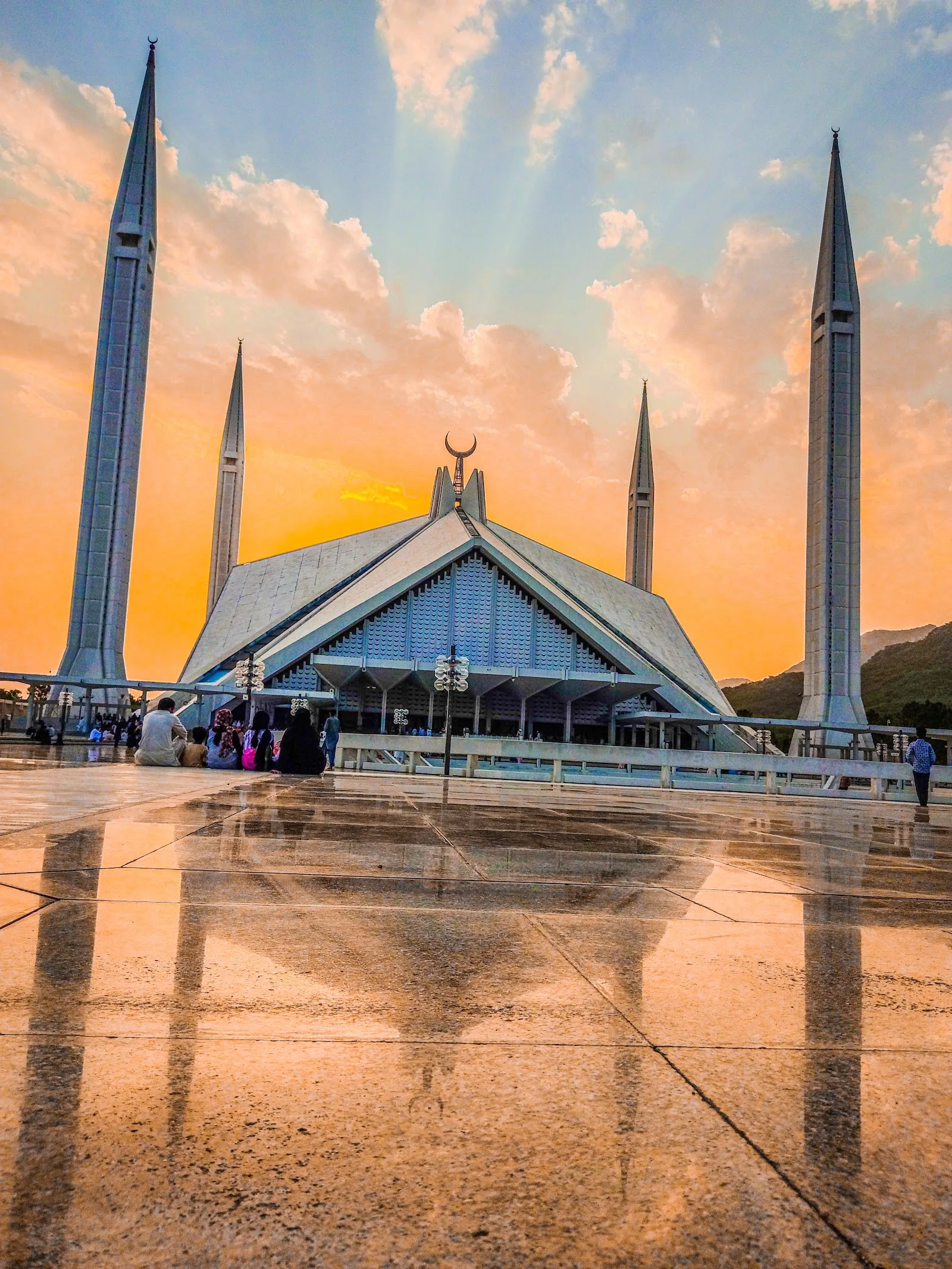
Shah Faisal Mosque Islamabad

Faisal Mosque was designed by the Turkish architect Vedat Dalokay. Instead of the usual dome, he drew an eight-sided concrete structure inspired by a Bedouin tent. Four slender minarets, each 90 metres (295 feet) tall, stand around it.

The project was largely paid for by a grant from Saudi Arabia, and the mosque carries the name of King Faisal bin Abdul Aziz. Construction began in 1976 and finished in 1986. For a few years from the late 1980s into the early 1990s it was the largest mosque in the world. It remains the largest in Pakistan and is the country's national mosque.

Inside and around the prayer halls
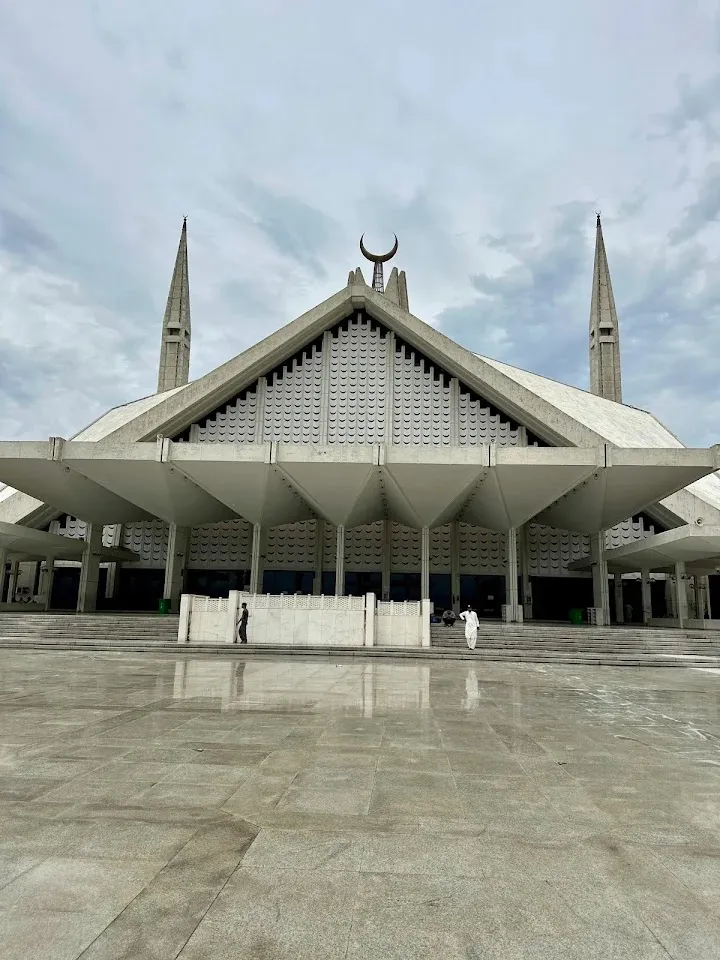
Shah Faisal Mosque Islamabad

The interior has chandeliers and calligraphy, and tile work adds detail to the modern lines. The prayer halls are large and quiet, and the acoustics carry well.

The grounds include porticoes and wide courtyards, which is where most visitors spend their time. Washrooms and a wudu area are on site, and there is a small library and museum. The entrance, restrooms and parking are wheelchair accessible, and parking is free.

The setting at the Margalla Hills

The mosque sits at the foothills of the Margalla Hills, and the green slope behind the white walls is the view most people photograph. At sunset the sky behind the building turns purple, and floodlights then pick out the main structure. Early morning is quieter and the light is softer.

The Pakistan Monument and the Daman-e-Koh viewpoint are also on the standard Islamabad route, so the mosque combines easily with them in a single day.

Before you go

Visitors come from across Pakistan and abroad, and the mosque is an active place of worship as well as a landmark. Expect more people during Friday prayers and on public holidays; a regular weekday morning is calmer.

Access to the interior can depend on prayer times and local conditions, and security closures have happened. Check the situation on the day. Staff and volunteers on site can answer questions about where visitors may go.

FAQ

Can non-Muslims visit Faisal Mosque?

Non-Muslim visitors can enter the courtyard if they are properly dressed. Access to other areas can depend on prayer times, so ask staff on site.

Are bags allowed inside Faisal Mosque?

No. Bags are not allowed inside the premises, for men or women, so bring only essentials.

What is the best time to visit Faisal Mosque?

Early morning or about an hour before sunset gives the best light. The building is also lit at night. Fridays and holidays are the busiest days.

Who designed Faisal Mosque and when was it built?

The Turkish architect Vedat Dalokay designed it. Construction began in 1976 and was completed in 1986.

Is Faisal Mosque wheelchair accessible?

Yes. The entrance, restroom and parking lot are wheelchair accessible, and parking is free.

Altre attrazioni imperdibili a Pakistan

Esplora tutto