Faisal Mosque is the national mosque of Pakistan, standing at the foot of the Margalla Hills on Shah Faisal Avenue in Islamabad. The Turkish architect Vedat Dalokay gave it a dome-less, eight-sided concrete form modelled on a Bedouin tent, flanked by four 90-metre minarets. Saudi Arabia funded the building, and it is named after King Faisal bin Abdul Aziz. The white structure looks best against the hills at sunrise or sunset, and again after dark when it is lit. Visitors dress modestly and leave bags outside.
A tent in concrete, 1976 to 1986
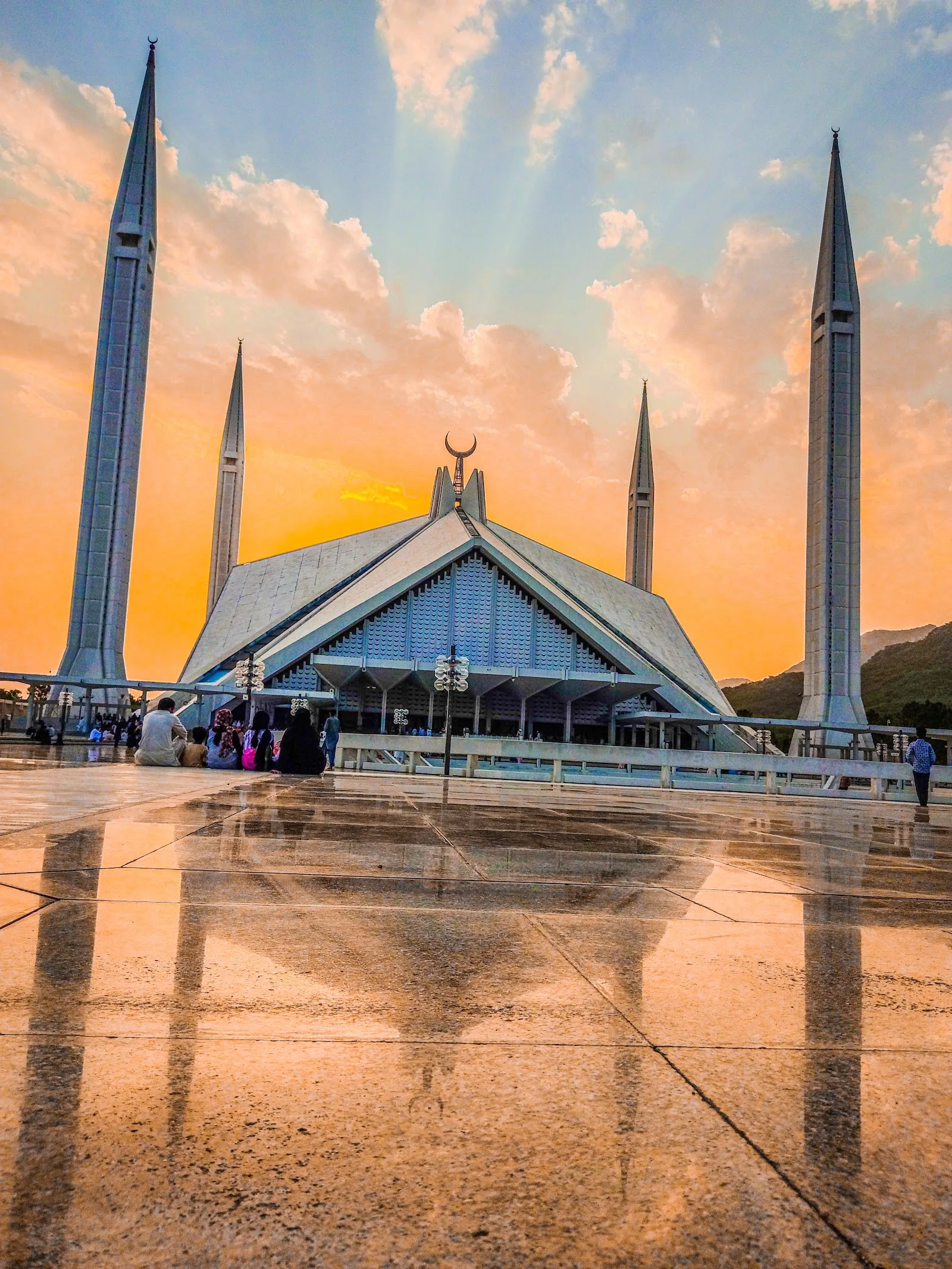
Faisal Mosque was designed by the Turkish architect Vedat Dalokay. Instead of the usual dome, he drew an eight-sided concrete structure inspired by a Bedouin tent. Four slender minarets, each 90 metres (295 feet) tall, stand around it.
The project was largely paid for by a grant from Saudi Arabia, and the mosque carries the name of King Faisal bin Abdul Aziz. Construction began in 1976 and finished in 1986. For a few years from the late 1980s into the early 1990s it was the largest mosque in the world. It remains the largest in Pakistan and is the country's national mosque.
Inside and around the prayer halls
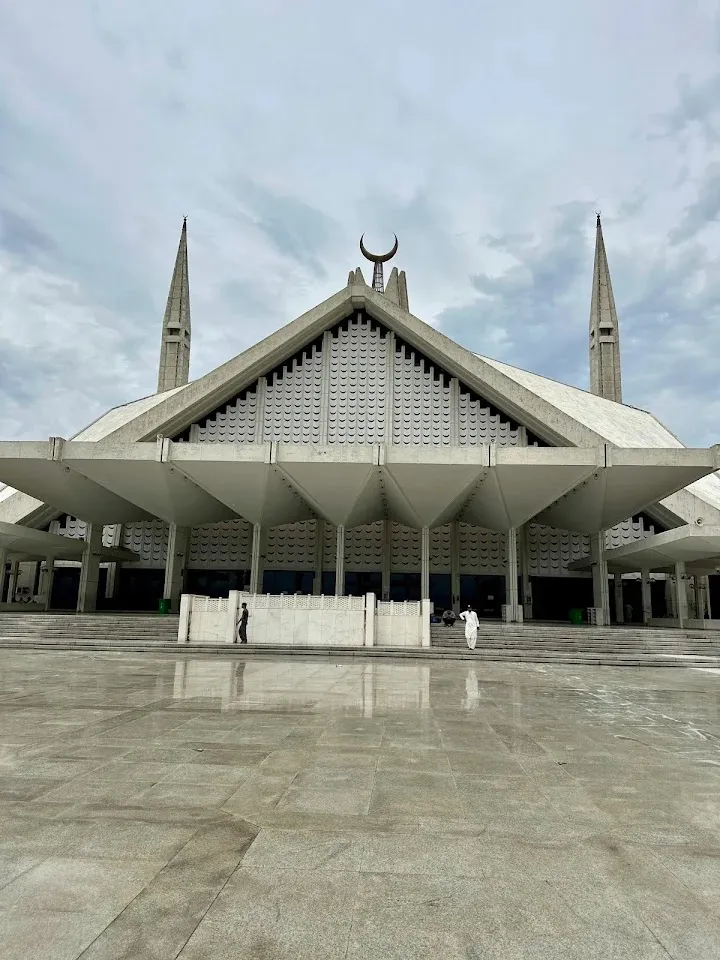
The interior has chandeliers and calligraphy, and tile work adds detail to the modern lines. The prayer halls are large and quiet, and the acoustics carry well.
The grounds include porticoes and wide courtyards, which is where most visitors spend their time. Washrooms and a wudu area are on site, and there is a small library and museum. The entrance, restrooms and parking are wheelchair accessible, and parking is free.
The setting at the Margalla Hills
The mosque sits at the foothills of the Margalla Hills, and the green slope behind the white walls is the view most people photograph. At sunset the sky behind the building turns purple, and floodlights then pick out the main structure. Early morning is quieter and the light is softer.
The Pakistan Monument and the Daman-e-Koh viewpoint are also on the standard Islamabad route, so the mosque combines easily with them in a single day.
Before you go
Visitors come from across Pakistan and abroad, and the mosque is an active place of worship as well as a landmark. Expect more people during Friday prayers and on public holidays; a regular weekday morning is calmer.
Access to the interior can depend on prayer times and local conditions, and security closures have happened. Check the situation on the day. Staff and volunteers on site can answer questions about where visitors may go.
Häufige Fragen
Can non-Muslims visit Faisal Mosque?
Non-Muslim visitors can enter the courtyard if they are properly dressed. Access to other areas can depend on prayer times, so ask staff on site.
Are bags allowed inside Faisal Mosque?
No. Bags are not allowed inside the premises, for men or women, so bring only essentials.
What is the best time to visit Faisal Mosque?
Early morning or about an hour before sunset gives the best light. The building is also lit at night. Fridays and holidays are the busiest days.
Who designed Faisal Mosque and when was it built?
The Turkish architect Vedat Dalokay designed it. Construction began in 1976 and was completed in 1986.
Is Faisal Mosque wheelchair accessible?
Yes. The entrance, restroom and parking lot are wheelchair accessible, and parking is free.