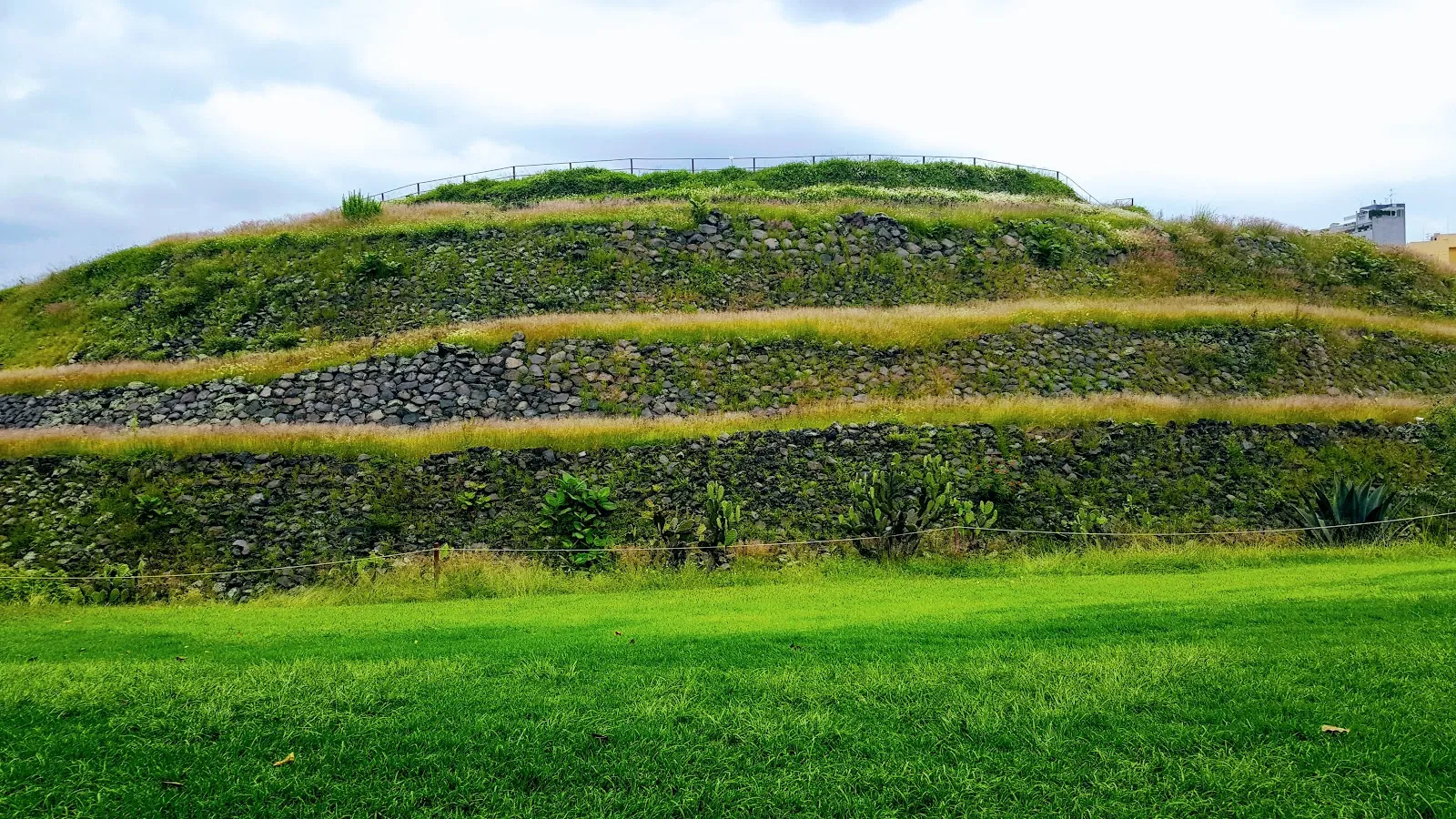
The Museo Nacional de Antropología sits in Chapultepec Park, in the Polanco area of Mexico City, and is the country's largest and most visited museum. Its galleries cover the pre-Hispanic peoples of Mexico, from the Maya and Olmecs to the Mexica, with the Sun Stone as the best-known piece. Archaeology fills the ground floor and ethnography the upper floors. Rooms open onto a large courtyard with a 25-metre umbrella-shaped fountain, and some displays continue in the gardens. The collection is too big for one visit, so choose your rooms first.
The building and the courtyard
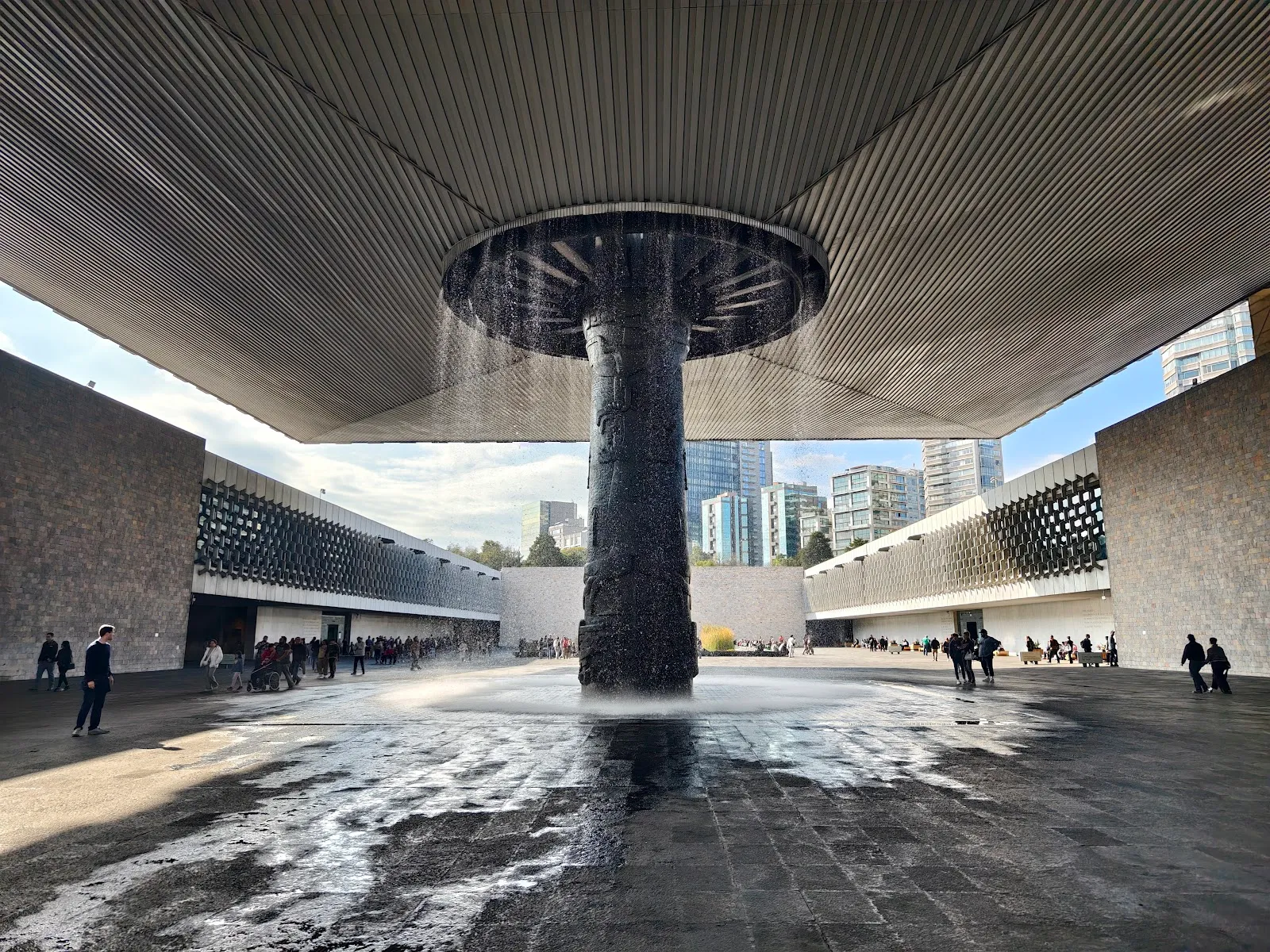
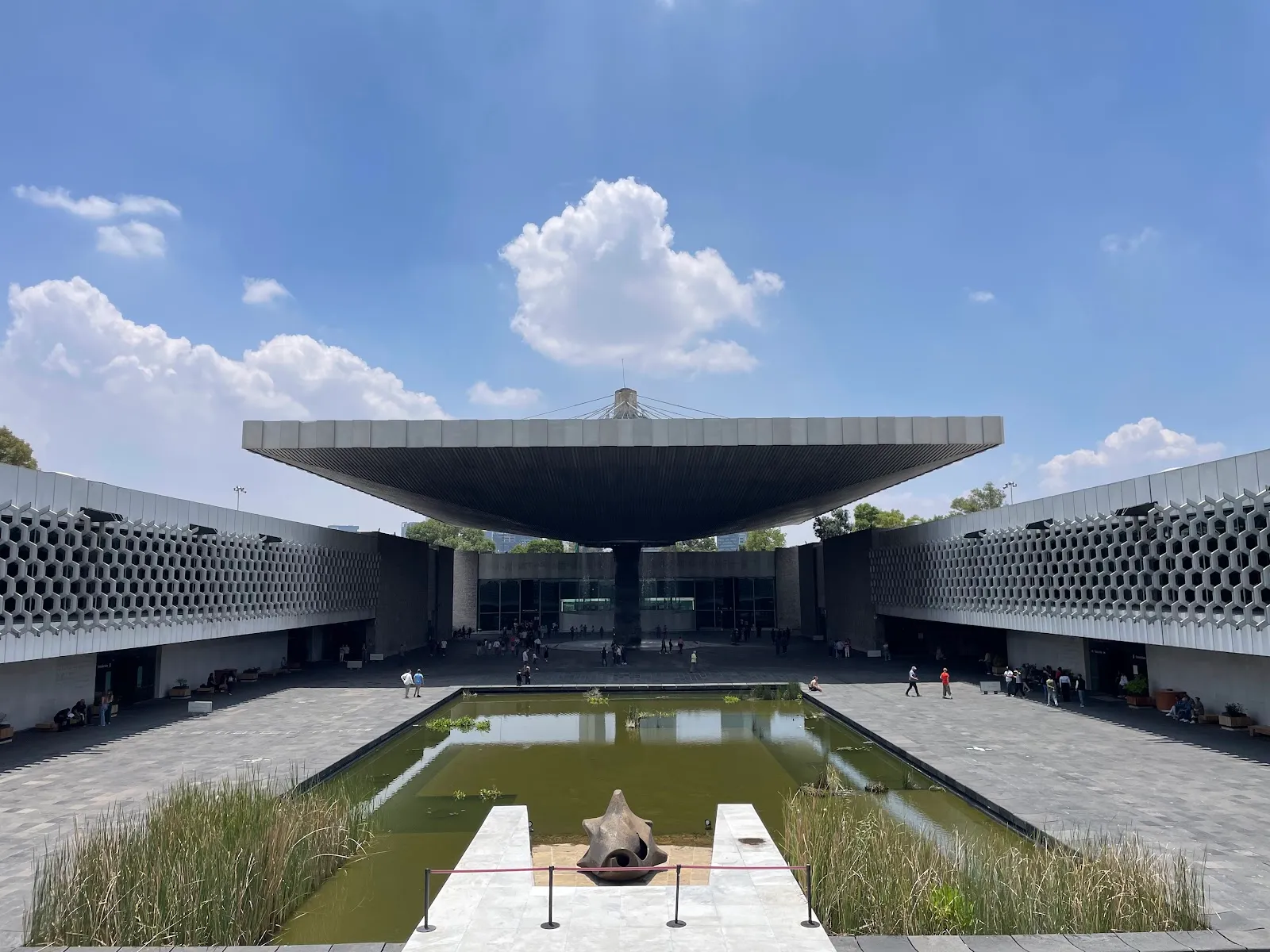
The museum stands in Chapultepec Park. Pedro Ramírez Vázquez designed it in 1964, and the large concrete structure still looks modern. Its broad roof appears to float above a pond, and some people come just to see the architecture.
The approach is part of the visit. A monolith of the god Tlaloc stands near the entrance, and a tall white wall carries the national shield. Beyond it, a fountain shaped like an enormous umbrella rises about 25 metres in the central courtyard. Water pours from its edge, and the mist cools the air around it. The exhibition rooms open off this courtyard, and a reflecting pool runs through the space.
How the galleries are arranged
The ground floor is given to archaeology and the upper floors to ethnography. On the ground floor each hall is devoted to a cultural region of Mesoamerica, the area that covered part of present-day Mexico and Central America. The story runs from the first peoples through the Maya and the Mexica. There is a strong focus on the Valley of Mexico, where the city stands, including Teotihuacan, the Toltecs and the Aztecs.
Upstairs, the ethnographic rooms show how Indigenous groups live and dress today, and contemporary Indigenous art is part of the collection. The rooms lead from one to the next, so the route is easy to follow. Part of the museum is outdoors, and the gardens hold further works among the trees.
Pieces to look for
The Sun Stone is in the Mexica room. It is the Aztec solar disk often called the Aztec calendar, and its design appears on many Mexican peso coins. The Coatlicue and the Stone of Tízoc are two other major Mexica works. The Xochipilli statue and a large sacrificial stone are also on display.
From the Gulf coast of Veracruz come the very large Olmec heads. Two big murals were restored after about five decades: The World of the Maya by Leonora Carrington, and the Map of Meso-America by Ernesto Vázquez and Luis Covarrubias. The museum holds about 600,000 pieces in total, and only part of them is on show.
Planning your visit
Labelling does not always make clear where to start or what to prioritise, so a little research before you arrive helps. Decide which cultures matter most to you and go to those halls first. If time remains, the rest can wait for a second visit.
The entrance is on Paseo de la Reforma, across from the museum itself. There is a restaurant on site, and a sandwich stand near the entrance is a quick option. The entrance, elevators and restrooms are wheelchair accessible. Parking is available, including free options.
Visiting with children
The museum suits children from about 4 years old, and the layout is easy to navigate. With young children, choose no more than two rooms for a visit, and make one of them the room on the colonial period. Younger children tend to enjoy the ceremonial and traditional clothing and the sections that recreate Aztec temples. Interest grows with age, and children who are not drawn to history may do better with a shorter, more selective visit.
FAQ
Is there an entry fee?
Yes, there is an admission fee. Entry is free for Mexicans on Sundays, which makes that day very busy.
How long do you need at the Museo Nacional de Antropología?
Plan at least 3 hours, and 2 to 4 hours is a common visit. The museum is large enough to fill a full day if you want to read everything.
Where is the Sun Stone?
It is in the Mexica room. Go there early, because it is one of the busiest parts of the museum.
Is the museum good for children?
Yes, from about age 4. With young children, pick two rooms at most, and include the colonial period room.
Are guided tours available?
Free guided tours are available. Buying tickets in advance is recommended.