
The Rocher de la Vierge is a rocky outcrop just off the Grande Plage in Biarritz, topped by a statue of the Virgin Mary. A footbridge leads out from the shore, so the walk is short and easy to fit into a stroll along the seafront. From the end you see the bay, the Basque coast and, on clear days, the Pyrenees. The spot is at its best at sunset, when the light falls across the water, though the sunrise light is also fine. In rough weather, waves can splash over the ledge, which makes the visit feel wilder.
Why the rock is called the Rock of the Virgin
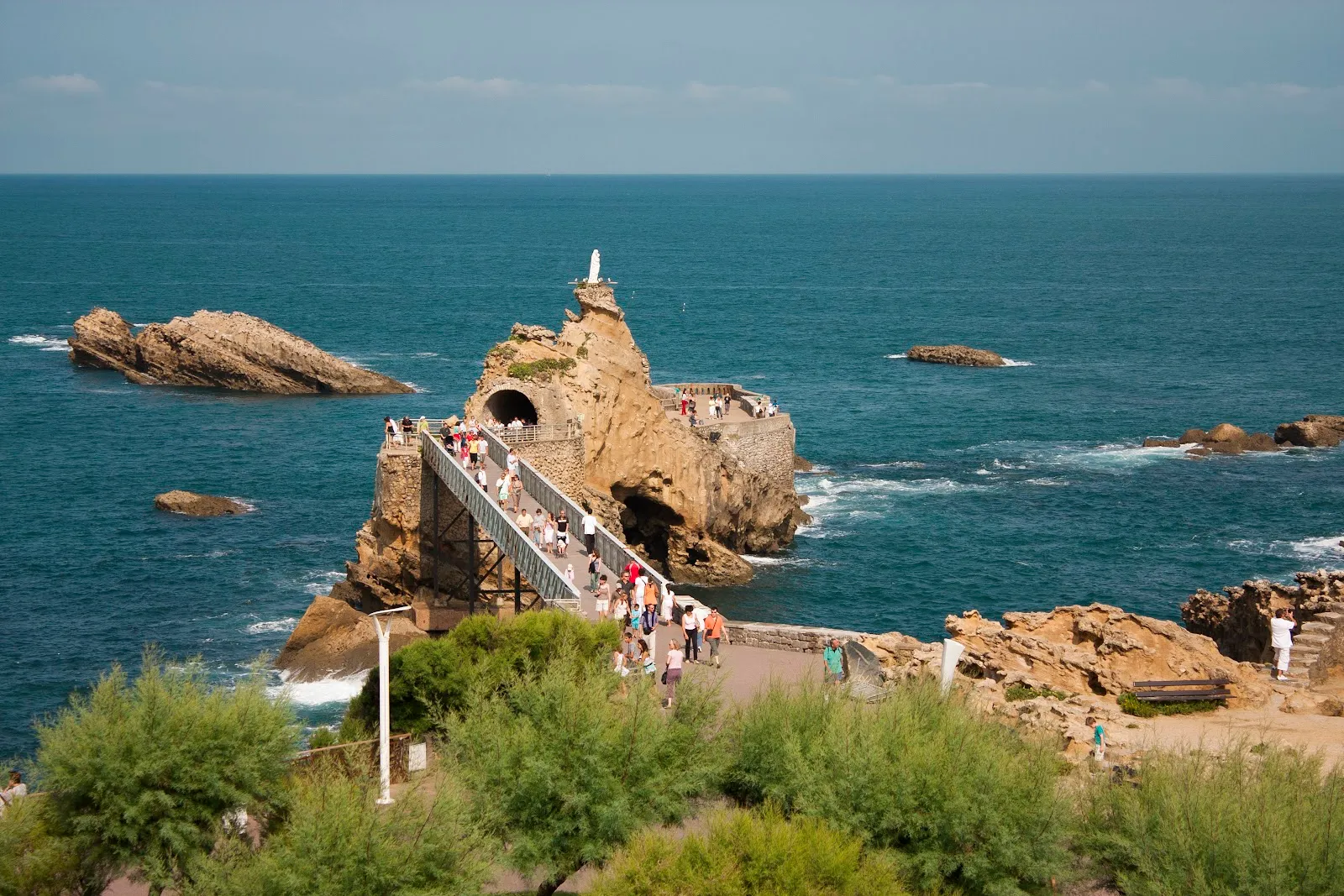
Rocher de la Vierge means Rock of the Virgin. The outcrop lies near the Grande Plage, and a statue of the Virgin Mary stands on its top. Catholic devotion has long been tied to the rock, which was a pilgrimage site for Catholics.
Old legends also tell of a sea serpent that once lived on the rock and terrorized the people of Biarritz until a knight killed it. Another story, told often in town, says a group of fishermen caught in a storm were guided back to shore by a light seen from the rock.
From whale-watching platform to footbridge
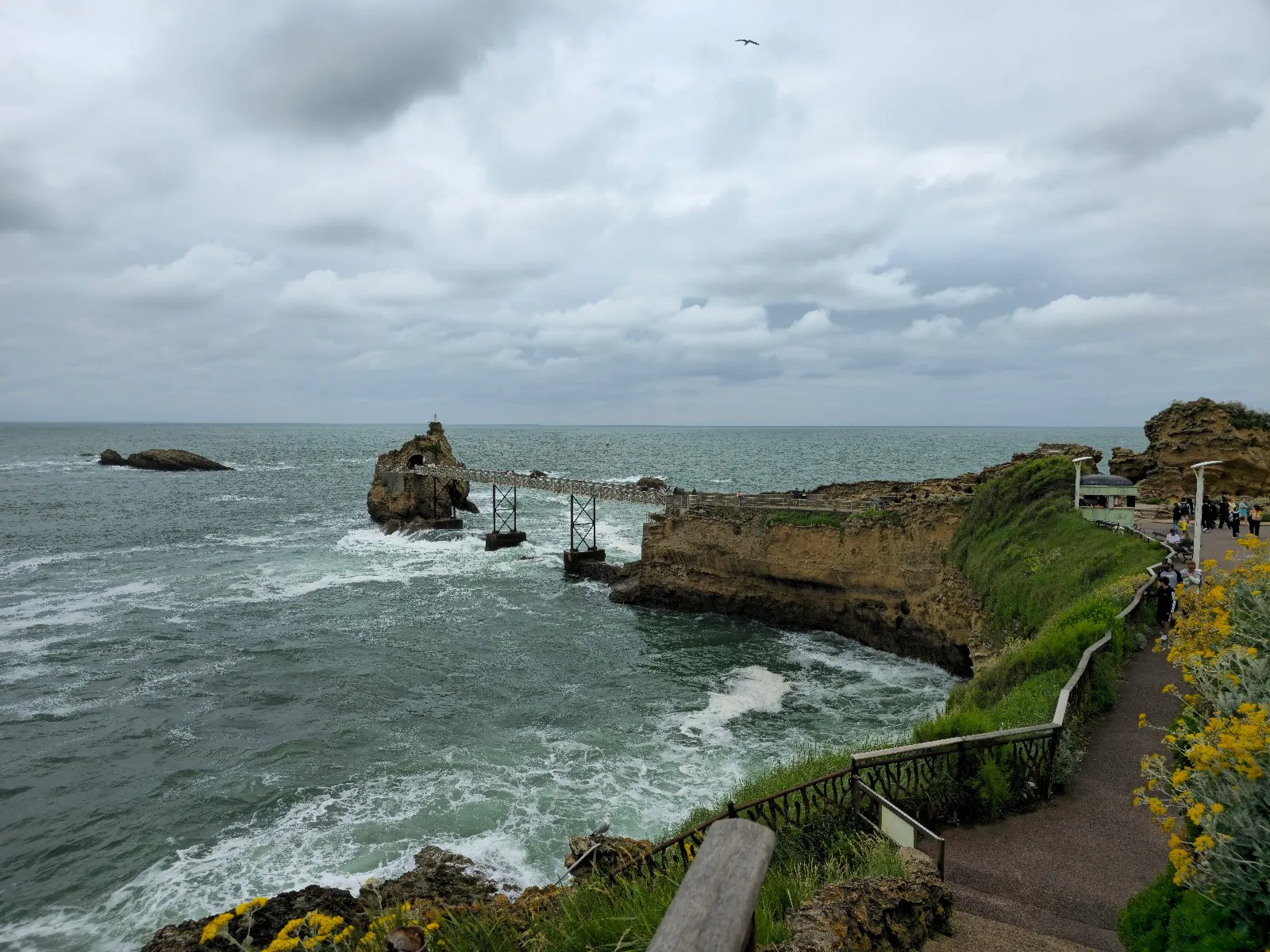
For centuries the rock served as a whale-watching platform. Napoleon III planned to use it as an anchor for a sea wall of a planned harbour of refuge, and he had it joined to the land by a wooden bridge. The harbour was never built, and the money that remained went to the fishing harbour instead.
The wooden bridge did not hold up well against the Atlantic waves, so it was replaced by a sturdier one. The current footbridge is often attributed to Gustave Eiffel. The statue was placed on the rock in 1865.
What to see from the top
From the tip of the rock you can look north over the Bay of Biarritz to the Grande Plage. Turn south and you see the Côte des Basques and the Basque coast running toward the Pyrenees. On a clear day the mountains show in the distance, and so does the Spanish coast.
Below the rock is the Port des Pêcheurs, a small fishing harbour backed by tamarisks and pink and blue hydrangeas. Further along, the Grande Plage runs as a long sweep of sand past the casino, all the way to the lighthouse on the Pointe Saint-Martin.
Around the rock
Just south of the rocks, Plage du Port-Vieux is a small, sheltered beach that is good for swimming. A few hundred metres further, the Côte des Basques is a long, exposed beach known for its surf.
The Aquarium de Biarritz, formerly the Musée de la Mer, stands close by in an Art Deco building that opened in 1935. A major renovation completed in 2011 doubled its visitor area and added displays from other seas, including the Caribbean and the Pacific.
Timing and conditions
Sunset is the most common time to visit, and the light at sunrise is also striking. Big Atlantic swells can send spray over the ledge, and the footbridge is closed in high wind. After a storm the sea is at its wildest, which some visitors find the most memorable time to come.
Summer brings large crowds to the rock and the promenade, so an early or late visit gives you more room for photos.
FAQ
How do you get to the Rocher de la Vierge?
A footbridge leads out from the shore to the rock. You can reach it on foot from the Grande Plage, or from the Pointe Atalaye, where the bridge begins.
Is the Rocher de la Vierge open all day?
The site is open 24 hours a day, so you can walk out at any time. The footbridge is closed in high wind.
When is the best time to visit?
Sunset is the most popular time, when the light over the bay is strongest. Sunrise is also a good option, and summer is busier.
Can you see the Pyrenees from the rock?
On a clear day you can see the Pyrenees in the distance, along with the Basque coast and the Spanish coastline.


