
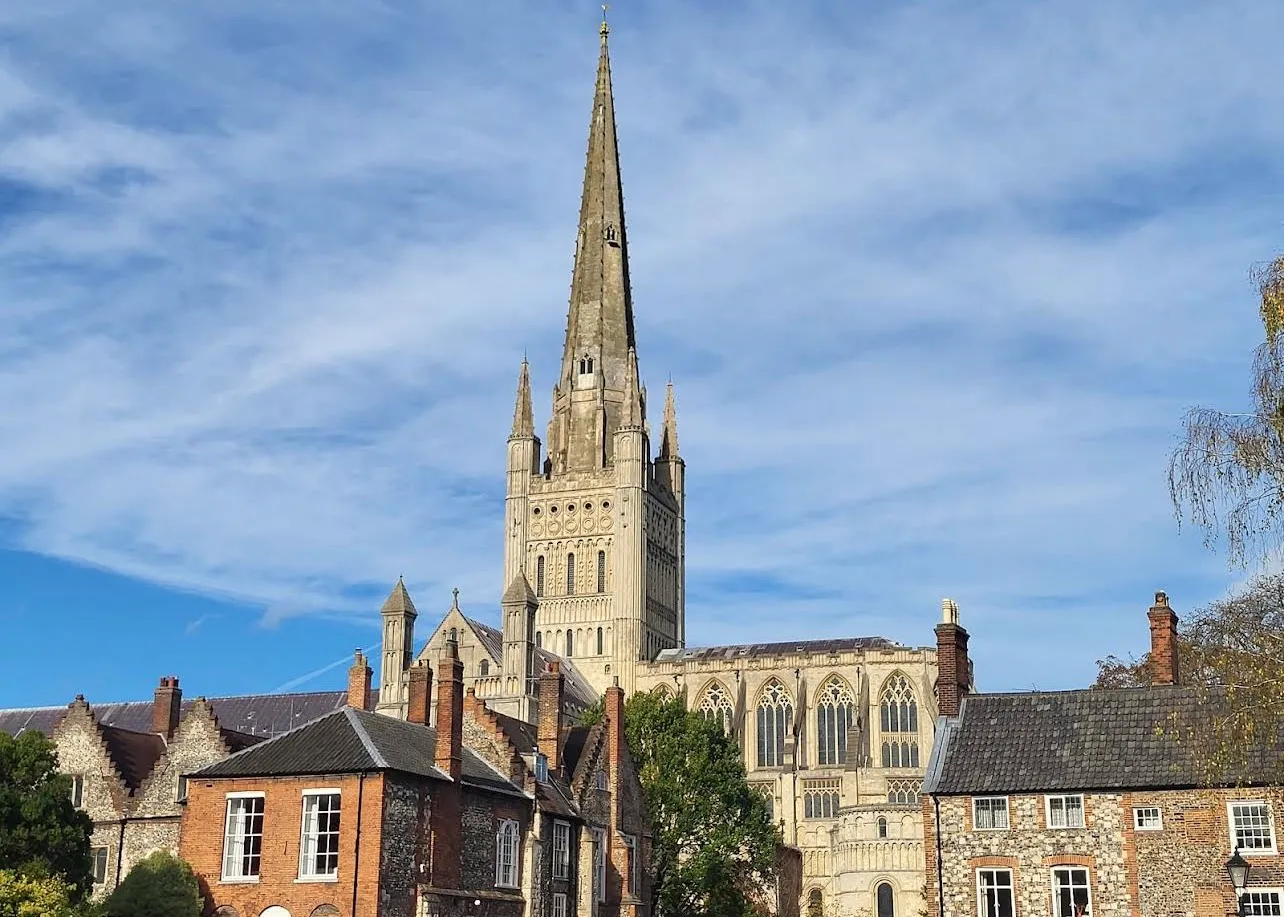
Norwich Cathedral is a Norman church in the centre of Norwich, begun in 1096 and still one of the most complete Romanesque buildings in Europe. Its spire rises about 96 metres, the second tallest in England after Salisbury's. Inside, look up at more than 1,000 carved roof bosses that illustrate Bible stories, then walk the cloisters, which have a labyrinth at their centre. Entry is free, and the grounds of the Close make a good end to the visit.
Built by the Normans
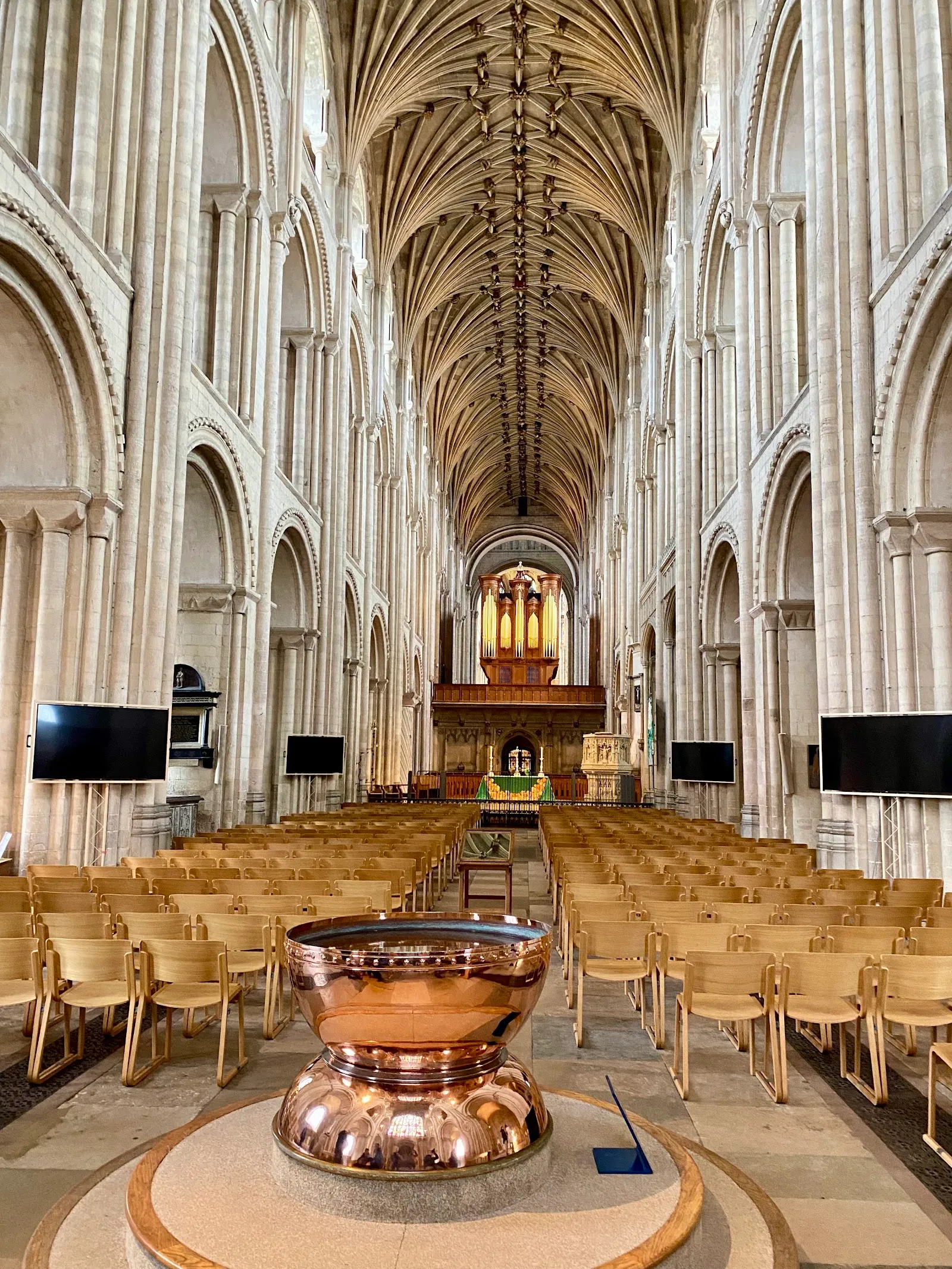
The cathedral began in 1096 as a Benedictine monastery. Herbert de Losinga, the first Bishop of Norwich, founded it after coming from Normandy in 1091. The building was largely complete by 1145, and its core is built of Norfolk flint.
The pale limestone for the outer walls came from Caen in Normandy and was carried by water. The last stretch of that journey used a short canal dug to bring the stone close to the cathedral site. Pulls Ferry, a 15th-century flint watergate on the river, marks that route.
Inside the nave and roof
The nave is long and the vaulted ceiling is high, so the carved roof bosses are hard to study without help. The cathedral holds more than 1,000 medieval bosses, and many show stories from the Bible in detail.
Near the east end, four chapels hold paintings and ornaments from the 14th to the 16th centuries. Some of the oldest stained glass in the cathedral, dating from the 14th and 15th centuries, can be seen in the ambulatory. Herbert de Losinga's tomb lies beside the high altar.
The cloisters and the labyrinth
The cloisters are double-height and surround a central courtyard. A labyrinth, created in 2002, lies at their centre. Walking the cloisters is a good way to slow down before or after the main church.
Edith Cavell and the monuments
Edith Cavell, a British nurse, is buried in the cathedral. During the First World War, German forces executed her for helping Allied soldiers escape from German-occupied Belgium.
The cathedral also has a statue and stained-glass images of Julian of Norwich, a medieval saint who chose to be walled up in a cell. The copper baptismal font was made using bowls from the former Rowntree's factory.
The Close and the falcons
The Close surrounds the cathedral with 44 acres of grounds, cobbled lanes, gardens and gabled houses. Two gates lead into the grounds from Tombland. Paddington Bear's statue stands in the Upper Close.
In summer, peregrine falcons nest in the spire, and a live camera feed shows the birds. Elm Hill, a medieval street of old merchants' houses that now hold independent shops and cafes, is a short walk away.
Visiting the cathedral
Entry is free. Volunteer-led guided tours run through the day and take just under an hour, so check the website for times.
The Refectory cafe has views through its glass walls and skylights and serves pastries. There is also a gift shop. The entrance and the restroom are wheelchair accessible, and dogs are permitted inside the cathedral.
FAQ
Is there an entry fee?
Entry to the cathedral is free. Volunteer-led guided tours are also offered, so check the website for times.
How long do you need?
A guided tour takes just under an hour. Allow 1 to 2 hours in total to see the church, the cloisters and the grounds.
Is the cathedral wheelchair accessible?
Yes. The entrance and the restroom are wheelchair accessible, and there is a wheelchair accessible parking area.
Can I bring a dog?
Dogs are permitted inside the cathedral.


