Plan a trip
Language: English
Trip plannerPlan your trip on a map

Top destinations

EnglishDeutschFrançaisEspañolPortuguêsPortuguês (BR)Italiano
Travel advisory · ColombiaSome governments advise against travel to parts of Colombia.The warnings cover only these areas: Arauca Department, Buenaventura, Caquetá Department, Catatumbo region, Cauca Department, Chocó Department, Ecuador border areas, Norte de Santander Department, Panama border areas, Tumaco, Valle del Cauca Department, Venezuela border areas, Casanare Department, Cúcuta, Guainía Department, Guaviare Department, Jamundí, Meta Department, Nariño Department, Northern Antioquia, Putumayo Department, Southern Bolívar, Southern Córdoba, Urabá region and Gulf of Urabá, Vaupés Department, Vichada Department.Advice depends on your passport. Read your own government's advice before you book.Official advice
Areas with warnings
  • Arauca Department · avoid all travel · Canada, Spain, New Zealand, UK, US
  • Buenaventura · avoid all travel · Canada, Germany, New Zealand, UK
  • Caquetá Department · avoid all travel · Canada, Spain, France, New Zealand
  • Catatumbo region · avoid all travel · Spain, New Zealand
  • Cauca Department · avoid all travel · Canada, Germany, Spain, France, Italy, New Zealand, UK, US
  • Chocó Department · avoid all travel · Canada, Germany, Spain, France, New Zealand, UK
  • Ecuador border areas · avoid all travel · France, New Zealand
  • Norte de Santander Department · avoid all travel · Canada, Germany, Spain, New Zealand, UK, US
  • Panama border areas · avoid all travel · Spain, France, New Zealand
  • Tumaco · avoid all travel · Canada, Spain, New Zealand
  • Valle del Cauca Department · avoid all travel · Canada, Germany, France, Italy, New Zealand, US
  • Venezuela border areas · avoid all travel · Germany, France, New Zealand
  • Casanare Department · avoid non-essential travel · Spain, New Zealand
  • Cúcuta · avoid non-essential travel · Canada, UK
  • Guainía Department · avoid non-essential travel · Canada, France, New Zealand
  • Guaviare Department · avoid non-essential travel · Canada, Germany, Spain, France, New Zealand, UK
  • Jamundí · avoid non-essential travel · Germany, UK
  • Meta Department · avoid non-essential travel · Canada, Spain, New Zealand
  • Nariño Department · avoid non-essential travel · Canada, Germany, Spain, France, New Zealand
  • Northern Antioquia · avoid non-essential travel · Germany, France
  • Putumayo Department · avoid non-essential travel · Canada, Germany, Spain, France, New Zealand
  • Southern Bolívar · avoid non-essential travel · Germany, France, New Zealand, UK
  • Southern Córdoba · avoid non-essential travel · Germany, France, New Zealand, UK
  • Urabá region and Gulf of Urabá · avoid non-essential travel · Spain, UK
  • Vaupés Department · avoid non-essential travel · Canada, France
  • Vichada Department · avoid non-essential travel · Canada, France, New Zealand

Also named by one government: Banks of the Río Cauca (France), Brazil border areas (France), Cali–Popayán–Pasto–Ipiales highway (France), Communes immediately south of Cali (France), Ecuador border, within 50 km (Canada), González and Río de Oro municipalities (Cesar) (Canada), Montes de María (Spain), Panama border, within 100 km (Canada), Peru border areas (France), Venezuela border, within 10 km (US), Venezuela border, within 50 km (Canada), Amazonas Department (France), Amazonas, within 20 km of Peru border (Canada), Antioquia Department (New Zealand), Antioquia, Chocó border area north of Buriticá (Canada), Ariari region of southern Meta (UK), Bahía Solano (Canada), Bajo Cauca region (UK), Capurganá (Canada), Cartagena del Chairá (UK), Communes on the flanks of Medellín (France), Earthquake-affected zone (Eje Cafetero and Suroriente) (Spain), Eastern and southern Meta (Germany), Eastern Valle del Cauca (France), Ecuador border, within 5 km (UK), El Doncello (UK), Florencia (Canada), Ipiales and Ipiales border crossing (Canada), La Montañita (UK), Nuquí (Canada), Orito (UK), Palmira (Germany), Paramillo National Natural Park (Córdoba) (Canada), Paujil (UK), Popayán (Canada), Puerto Asís (UK), Puerto Caicedo (UK), Puerto Carreño (UK), Puerto Guzmán (UK), Puerto Leguízamo (UK), Puerto Rico (Caquetá) (UK), Quibdó (France), San Jorge and La Mojana subregions of Sucre (New Zealand), San Miguel (UK), San Vicente del Caguán (UK), Sanquianga region of Nariño (UK), Santander Department (France), South Pacific region of Nariño (UK), Southern Bogotá working-class districts (France), Southern Sucre (France), Southern Tolima (incl. Ataco, Chaparral, Planadas, Rioblanco) (Germany), Sur sub-region of Cesar (New Zealand), Telembi region of Nariño (UK), Valle del Guamuez (UK), Venezuela border, within 5 km (UK), Western Valle del Cauca (incl. Buenaventura) (UK)

GovernmentAdviceUpdatedRead the advice
United Kingdom (FCDO)No advice against the whole country (regional advisories)–Read the advice
United States (State Dept)Reconsider travelMar 31, 2026Read the advice
Canada (Global Affairs)Exercise a high degree of caution (regional advisories)–Read the advice
Germany (Auswärtiges Amt)Keine Reisewarnung für das ganze Land (regional advisories)Oct 13, 2026Read the advice
New Zealand (SafeTravel)Exercise increased caution due to violent crime and the threat of terrorism (regional advisories)–Read the advice
France (Ministry for Europe and Foreign Affairs)Increased vigilance, with specific areas to avoid (regional advisories)–Read the advice

Checked daily from the governments' published advice; last checked Nov 2, 2026. RoamLedger summarises official advice; it is not advice from any government.

Puerta del Reloj
Historic site

Monumento Torre del Reloj

See Cartagena’s clock-topped gateway to the Old Town, then walk through to Plaza de los Coches and browse nearby stalls and historic streets.

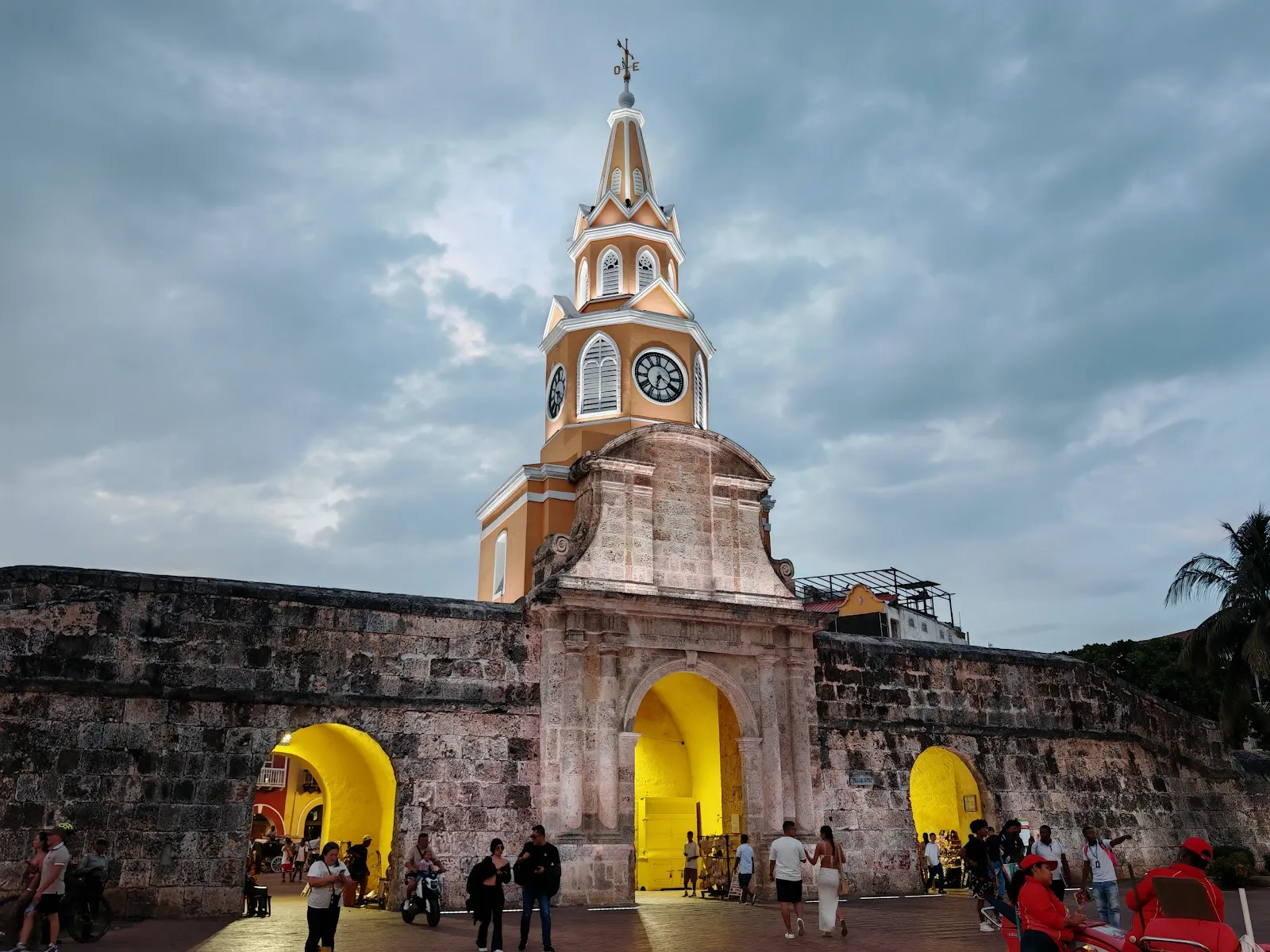
Monumento Torre del Reloj, also called Puerta del Reloj or Boca del Puente, is the historic gateway between Cartagena’s walled Old Town and Getsemaní. Its clock-topped arches mark a natural starting point for exploring the city: pass through to Plaza de los Coches, with its arcades and colorful buildings, or browse stalls beneath the gate. The entrance once formed part of Cartagena’s defenses, and nearby squares, street food and local crafts make it easy to linger before heading into the historic center.

A gateway between the Old Town and Getsemaní
Monumento Torre del Reloj

The Torre del Reloj is the main historic entrance to Cartagena’s walled center. It is also known as Puerta del Reloj, meaning Clock Gate, and Boca del Puente. The gateway stands between Plaza de la Independencia and Plaza de los Coches, linking the Old Town with Getsemaní.

The passage is an easy place to orient yourself. Walk through the arches and you reach Plaza de los Coches, a square lined with arcades and colorful buildings. From there, the historic center’s plazas and streets are close by. Getsemaní lies on the other side of the gate.

The gate’s defensive past
Monumento Torre del Reloj

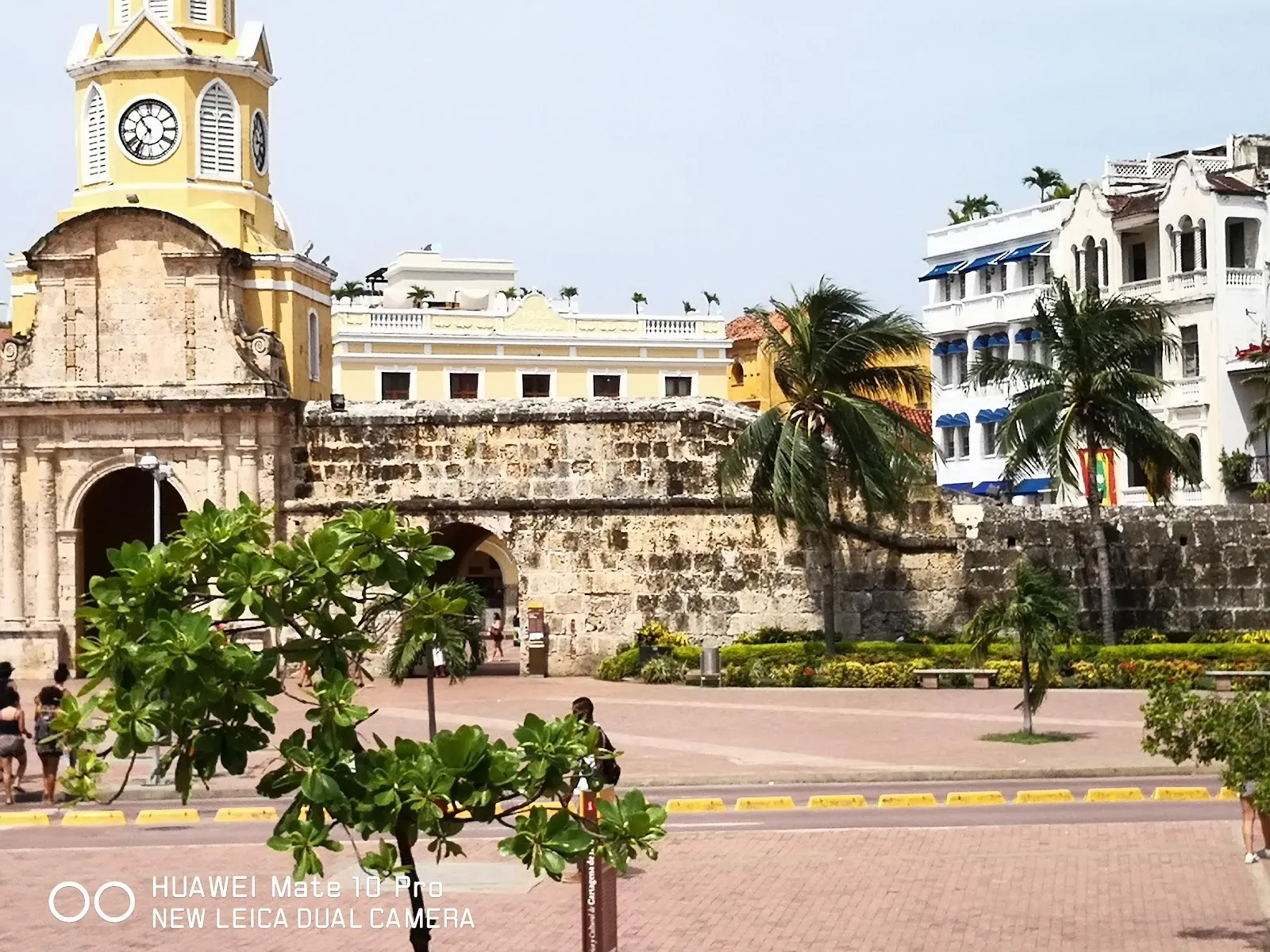
During the colonial period, a wooden drawbridge crossed a moat between the gate and Getsemaní. It helped protect the city from attack and connected the walled center with the neighborhood beyond it. The gate’s side arches had earlier uses as a chapel and an armoury; today, they form walkways through the structure.

The tower and clock were added at different points in the gate’s history. The clock was installed in the early 18th century, while accounts of the structure also date the tower’s beginnings to 1601 and describe its later reconstruction in the 19th century. Its clock-topped profile is now one of Cartagena’s recognizable city symbols.

What to see around the monument

Take time to look at the tower and the stone walls that extend from it before crossing into Plaza de los Coches. The square is a useful first stop for seeing the architecture around the entrance. Vendors beneath the passage sell items that include handmade domino sets, musical instruments, used books and wool shoulder bags made by Kogi craftspeople from the Santa Marta area.

You may also encounter street performers in the open space in front of the gate. For a longer walk, continue into the Old Town’s squares or head toward Getsemaní. The city walls nearby are a good choice around sunset; rooftop bars around the monument provide another way to take in the evening atmosphere.

FAQ

What is the Torre del Reloj?

It is Cartagena’s clock-topped historic city gate, also known as Puerta del Reloj and Boca del Puente. It marks the entrance to the walled Old Town.

What is on the other side of the gate?

Plaza de los Coches is directly beyond the passage, with arcades and colorful buildings. The gate also links the Old Town with Getsemaní.

How long should I spend at the Torre del Reloj?

The input does not give a typical visit duration. You can stop to see the gate and continue into Plaza de los Coches or nearby streets.

When is a good time to visit?

Sunset suits a walk along the nearby walls or a visit to a rooftop bar. For fewer crowds, go when no cruise ships are in port.
More must-sees in Cartagena

Explore all