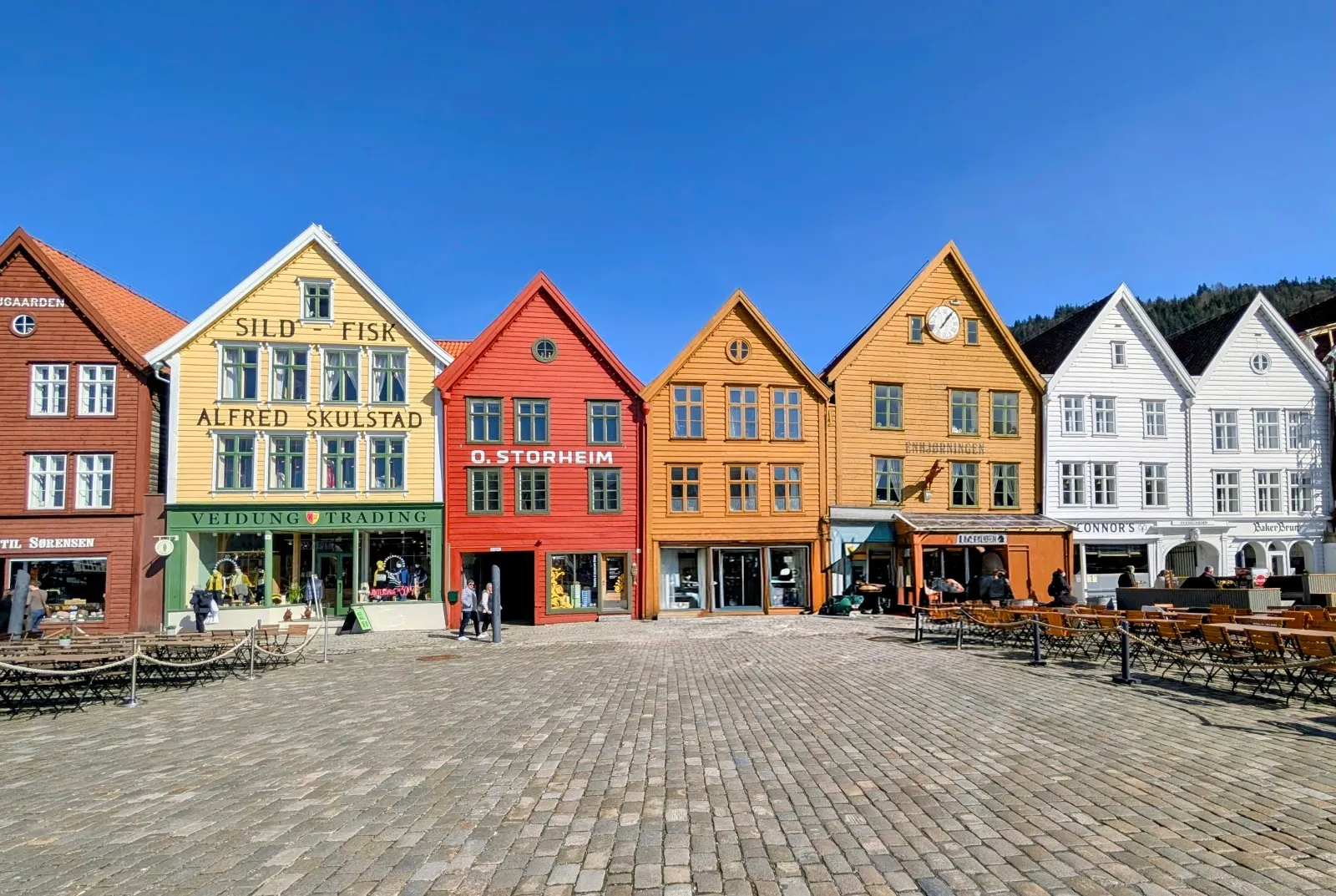
Bryggen is Bergen’s historic wharf, a row of colourful wooden merchant buildings along Vågen harbour. German Hanseatic traders established an office here in the 14th century, and the district became a centre for trading stockfish. Its UNESCO-listed lanes are as much part of the visit as the waterfront façades: wander between the buildings to find narrow passages, shops, galleries and cafés. Come for the architecture and harbour views, then browse for Norwegian knitwear or local art if you have time.
A wharf shaped by Hanseatic trade
Bryggen means “wharf” in Norwegian. The district stands along the eastern side of Vågen harbour and is closely tied to Bergen’s history as a trading port. German Hanseatic merchants established an office here in the 14th century. Their trading network linked Bergen with other European cities, and stockfish from northern Norway was a central part of the commerce.
The merchants’ buildings served as homes and workplaces, with store rooms and workshops also part of the trading enclave. Bryggen remained a centre of Hanseatic activity for centuries. The wooden buildings and lanes offer a sense of how trade shaped this part of the city, although today the district also has shops, galleries and places to eat.
Fires, rebuilding and UNESCO protection
Fires have damaged Bryggen repeatedly over the centuries. A major fire in 1702 destroyed much of the area, and another fire in 1955 affected the remaining old buildings. The structures were rebuilt over time, using traditional methods and earlier layouts. As a result, the district preserves the form of an old wooden urban area, even though the buildings have faced repeated damage and repair.
Bryggen was added to the UNESCO World Heritage List in 1979. Its significance lies in the surviving Hanseatic wharf and its role in the history of European trade. The timber buildings are not simply a row of façades: passages and walkways run between them, revealing the close arrangement of the old trading quarter.
Look beyond the waterfront façades
The bright buildings along the harbour make a natural starting point, but the narrow lanes behind them are worth exploring too. Their dark timber passages, stairways and closely set structures feel quite different from the open waterfront. Take your time as you walk through, and look at how the buildings lean and meet along the lanes.
Small shops and galleries occupy parts of the district, alongside cafés and restaurants. Bryggen Handel is a stop for Norwegian sweaters, coats and gifts. If you want to see the wharf from another angle, the harbour gives you a view back towards the buildings; Mount Fløyen is another option for a wider panorama of Bergen, reached on foot or by funicular.
FAQ
What is Bryggen in Bergen?
Bryggen is Bergen’s historic Hanseatic wharf on Vågen harbour. Its wooden buildings and lanes form part of a UNESCO World Heritage site.
Why is Bryggen a UNESCO World Heritage site?
The site preserves the old Hanseatic wharf and buildings, which are closely connected to Bergen’s history as a European trading port.
How long should you spend at Bryggen?
A short walk can take around 30 minutes. Allow longer if you want to explore the lanes, shops and galleries or stop at a café.
When is a good time to visit Bryggen?
Early morning is a good choice for a quieter walk. The lanes can also be quiet after dark.