
Piazza del Campo is Siena’s central square, a sloping, shell-shaped space framed by medieval palaces. Its nine sections of paving lead your eye towards the Palazzo Pubblico, Siena’s town hall, and the adjoining Torre del Mangia. The square is a place to pause at a café, take in the architecture or watch daily life unfold. Twice each year, it becomes the course for the Palio di Siena, a historic horse race that draws the city’s attention.
A square shaped by Siena
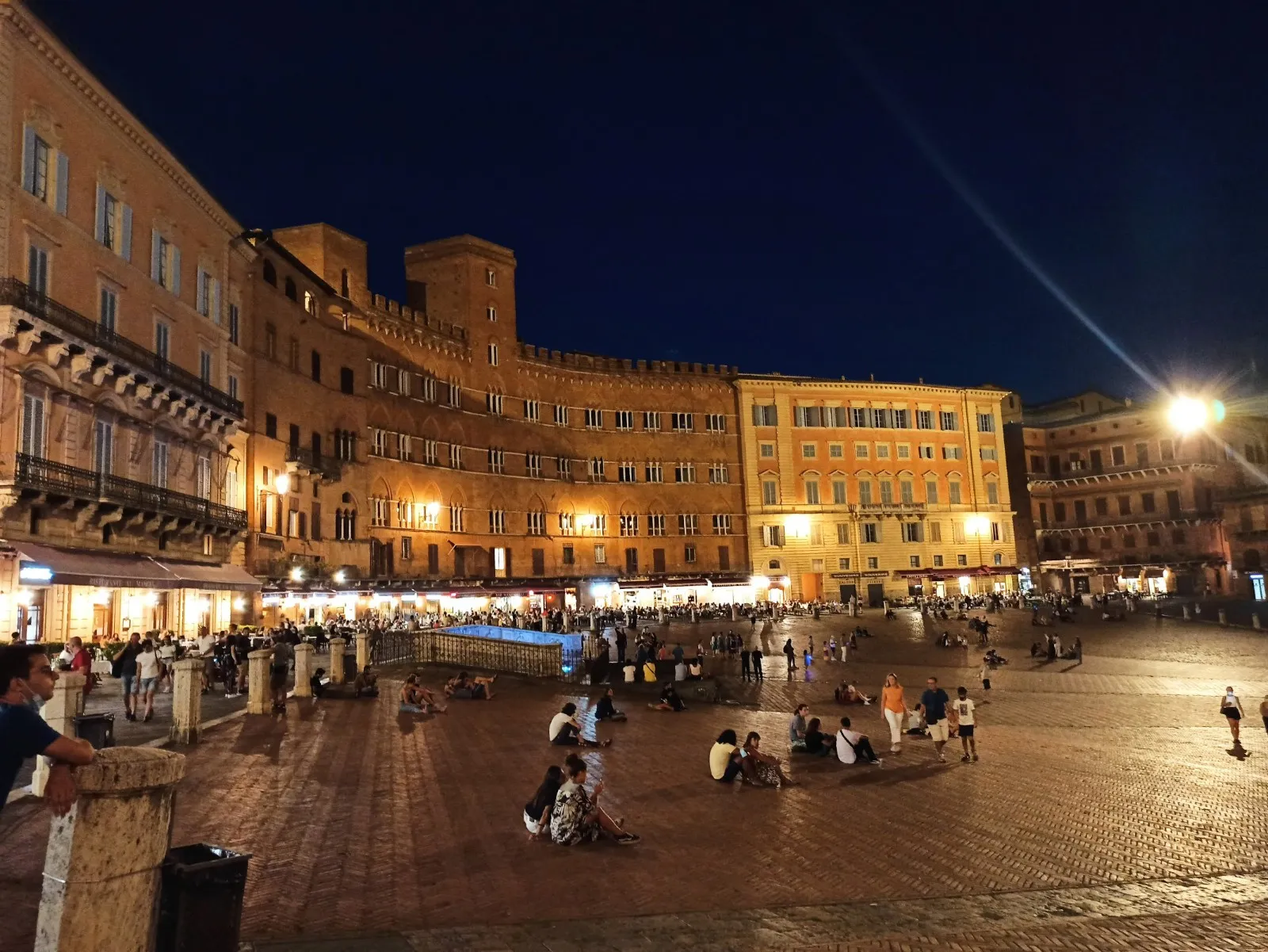
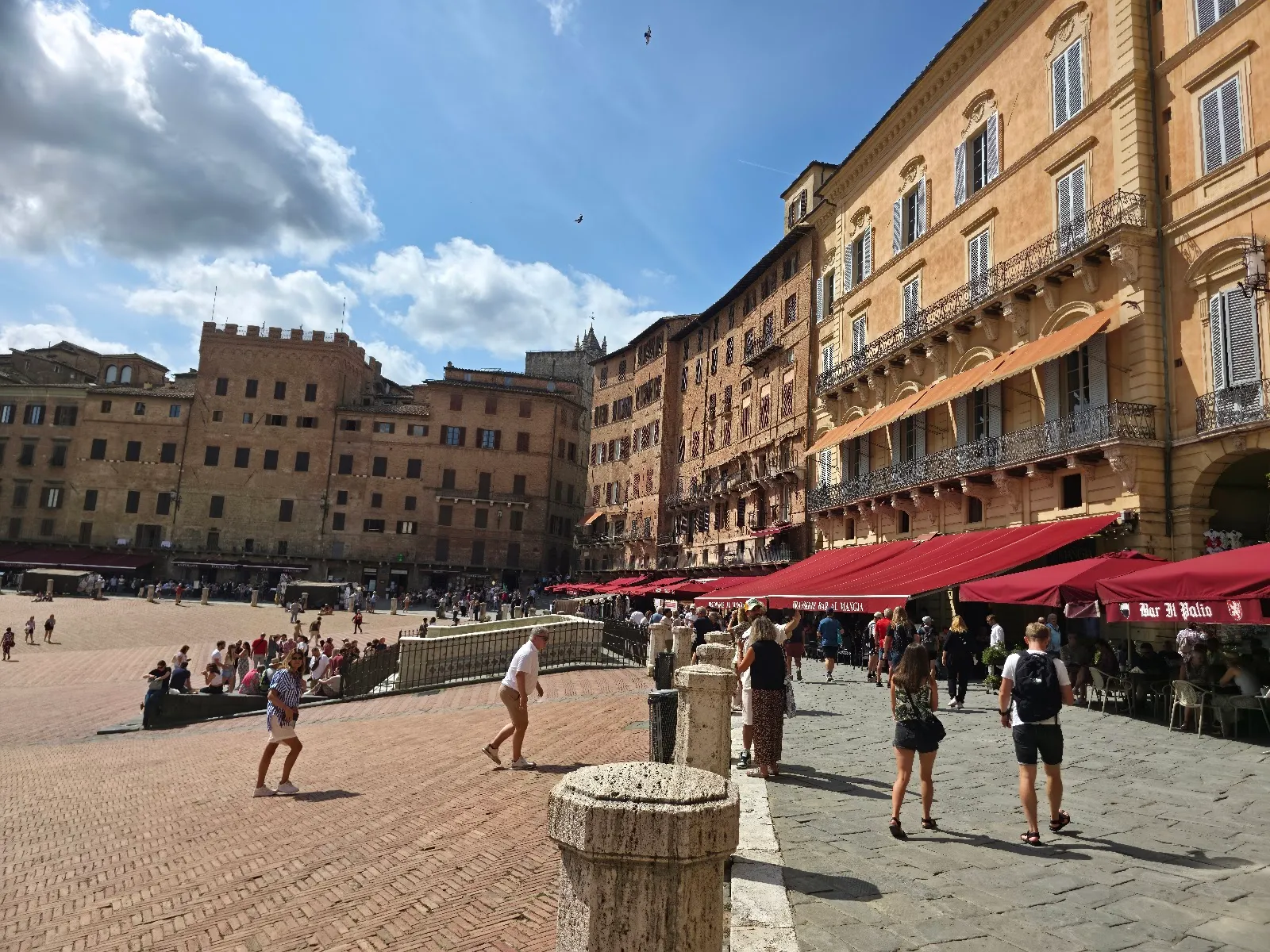
Piazza del Campo, often called Il Campo, has been Siena’s main public gathering place for centuries. The square was laid out in the 12th century and paved around 1300, when Siena was prosperous and pilgrims travelled through the city along the Via Francigena.
Its sloping outline is often compared to a shell or a fan. Nine bands of stone divide the paving, a reference to the Council of Nine, the group that governed Siena in the late 13th century. The layout draws the eye downhill towards the Palazzo Pubblico. The square is also associated with Siena’s devotion to the Virgin Mary, though the meaning behind its shape is not certain.
Palazzo Pubblico and Torre del Mangia
The Palazzo Pubblico has stood at the lower edge of the square since the late 13th century. It remains Siena’s town hall and houses the Civic Museum. Inside, the Sala del Mappamondo contains Simone Martini’s Maestà, while the Sala dei Nove has frescoes by Taddeo di Bartolo. The palace’s role as a civic building gives the square its unusual arrangement: Siena’s main piazza faces the town hall rather than the cathedral.
Beside the palace, the Torre del Mangia rises above the roofs of the historic centre. Built in the 14th century, it is named for Giovanni di Balduccio, its first bell ringer, whose nickname referred to spending his wages quickly. The tower was designed to match the height of the cathedral, expressing an intended balance between civic and religious authority. Visitors can climb it for views across Siena and the surrounding countryside. The ascent is steep and narrow, so it is a poor fit if you are uncomfortable with heights or confined spaces.
The Palio in the Campo
Twice a year, the square becomes the setting for the Palio di Siena, on July 2 and August 16. Siena’s historic districts, known as contrade, are central to the event. Ten of the city’s seventeen contrade compete in each race, which runs around the edges of the piazza.
For the race, the sloping surface is covered with sand and the course is lined with spectators. The Palio is a major event in the city’s calendar, and the square takes on a different role from its everyday life as a meeting place. Outside race time, you can walk across the paving, notice the nine divisions and take in the medieval buildings from the centre of the square.
FAQ
What is Piazza del Campo known for?
It is Siena’s central, shell-shaped medieval square, framed by the Palazzo Pubblico and Torre del Mangia. The Palio di Siena takes place here twice a year.
When is the Palio di Siena held?
The races take place on July 2 and August 16.
Can you climb the Torre del Mangia?
Yes. The tower is open to visitors who want views over Siena and the surrounding countryside. The climb is steep and narrow.
How many sections are in Piazza del Campo’s paving?
The paving is divided into nine sections, recalling the Council of Nine that governed Siena.


