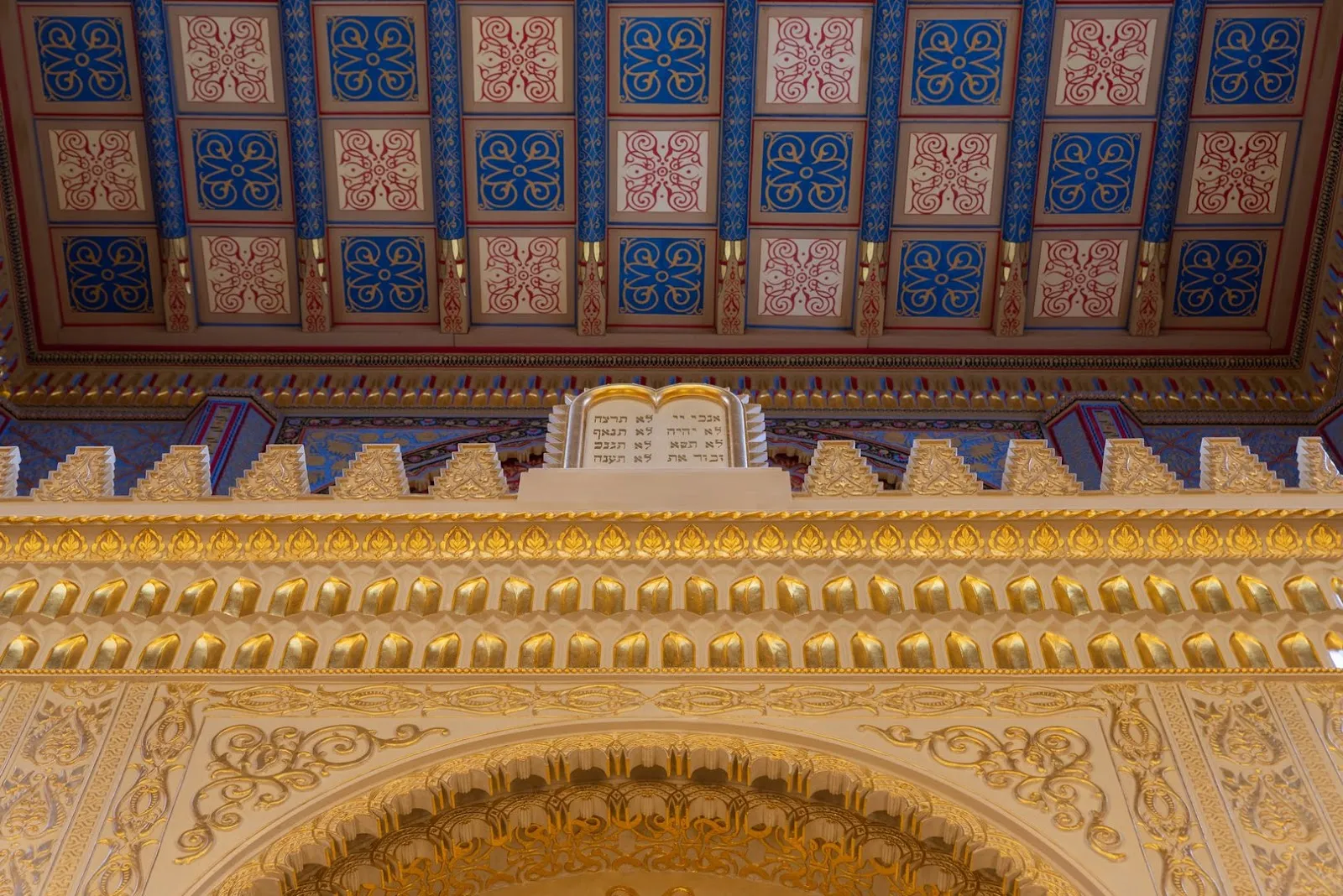
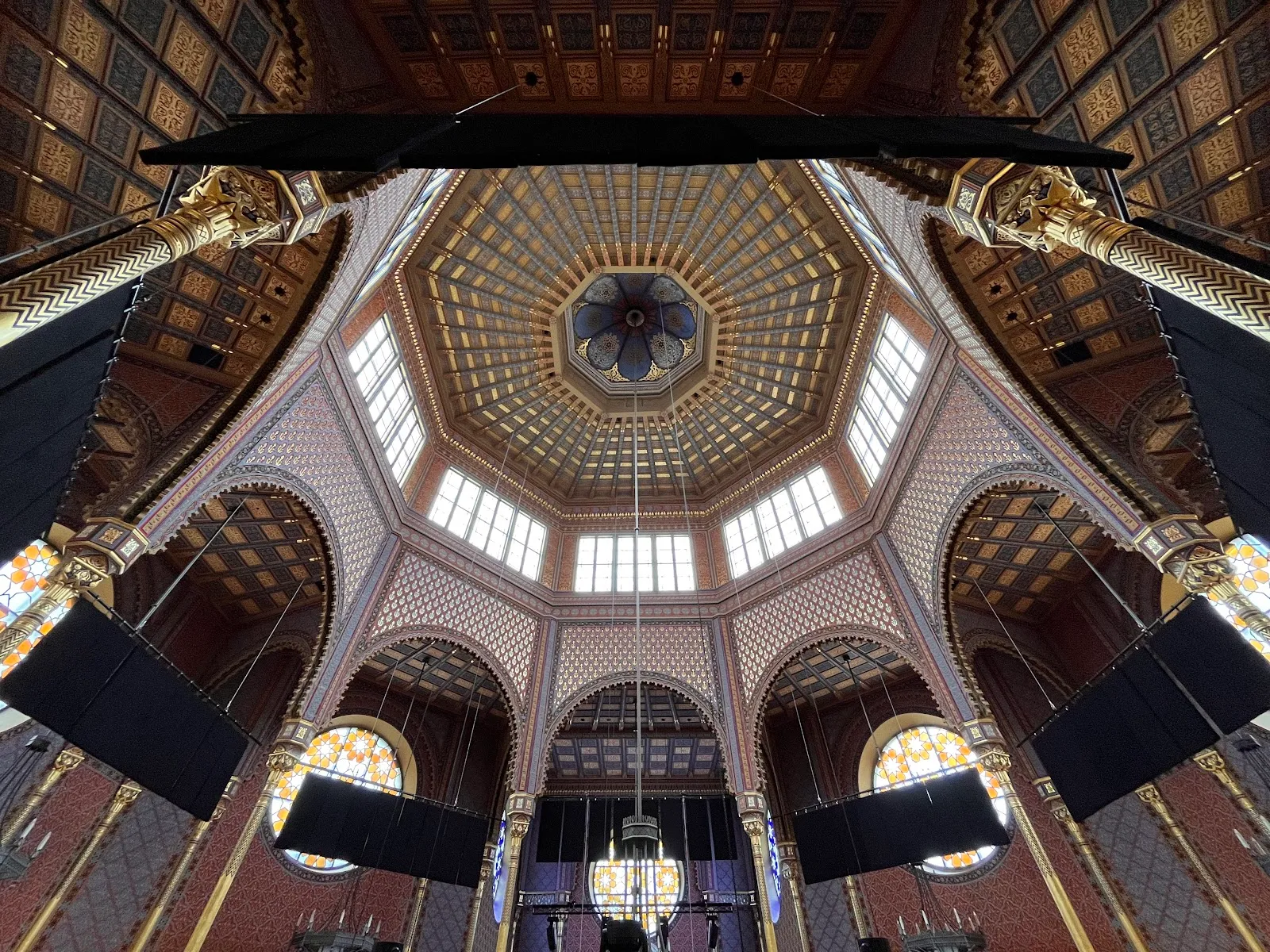
Rumbach Street Synagogue is a 19th-century synagogue in Budapest’s Jewish Quarter, designed by Otto Wagner and completed in 1872. Its Moorish Revival design continues inside, where an octagonal space, slender columns and vivid ornament draw the eye to the dome. Exhibitions on the upper floor explore Jewish life in Hungary, and a guided tour can add context on the building and the community’s history. It is a quieter stop than Budapest’s larger synagogue nearby. Check current visiting arrangements before you go, as access may be limited.
A synagogue designed by Otto Wagner
Completed in 1872, Rumbach Street Synagogue was designed by the Viennese architect Otto Wagner. It was built for Budapest’s moderately Orthodox Jewish community. Its religious outlook differed from that of the nearby Dohány Street Synagogue, which the community considered too modern, and the more Orthodox Kazinczy Street Synagogue.
The building’s Moorish Revival style is visible on the street-facing façade. Two domed towers rise above a symmetrical front, decorated with patterned brickwork, arched windows and stone tablets. Wagner later became a pioneer of modern architecture, but this synagogue’s design draws on Moorish forms and ornament.
The octagonal interior
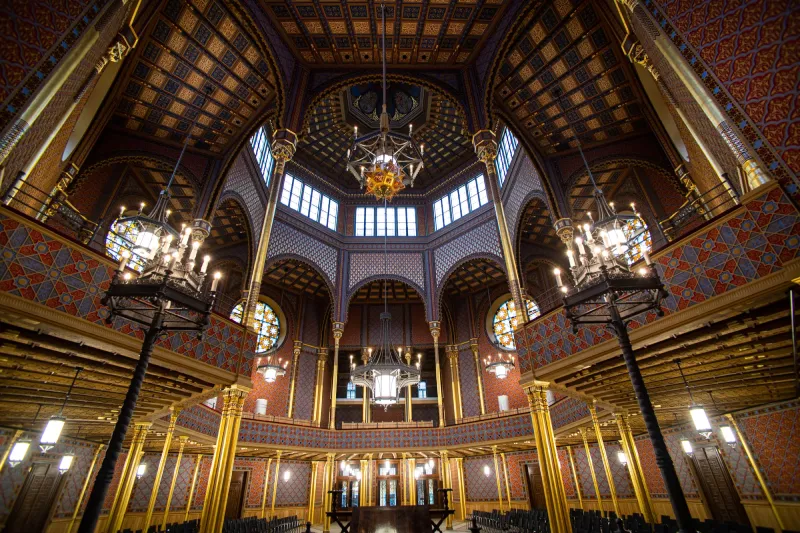
Inside, the main space is octagonal and rises to an ornate dome. Eight slender iron columns support the interior, with capitals inspired by the Alhambra. Gold, blue and red ornament adds colour to the walls, while the dome draws the eye upward.
The design rewards a look around the whole room. Notice how the columns frame the central space and how the ornament continues across the walls and ceiling. The building’s architecture is the main reason to visit, even if you also plan to explore the exhibition.
War, closure and restoration
In 1941, the synagogue was used as a deportation point for 20,000 Jews. They included refugees who had fled south after Nazi Germany invaded Poland, as well as Hungarian Jews who lacked the required documentation. They were sent to Kamianets-Podilskyi, in present-day Ukraine, where they were killed.
After the war, the building fell into disrepair. Religious life there ended in 1959, and the synagogue remained abandoned for decades. It was later returned to the Jewish community and restored, reopening in 2021. Its history is inseparable from the persecution and loss experienced by Hungarian Jews.
The exhibition and guided visits
An exhibition on the upper floor focuses on Jewish life in Hungary. It provides another way to understand the community connected to the synagogue, beyond the building’s architecture and wartime history.
Guided visits explain the synagogue’s past and the history of Jews in Budapest. If you want more than an architectural visit, ask about a tour when you arrive. The synagogue is in the Jewish Quarter, close to the Dohány Street Synagogue and the Kazinczy Street Synagogue, making it possible to include it in a wider walk through the area.
FAQ
Is Rumbach Street Synagogue open on Sundays?
Yes. It is listed as open to visitors on Sundays. Check the official website before your visit for current access information.
What can you see inside Rumbach Street Synagogue?
The synagogue has an octagonal interior, an ornate dome, iron columns and colourful wall decoration. An exhibition about Jewish life in Hungary is on the upper floor.
Can you take a guided tour?
Guided tours are available and explain the synagogue’s history and the history of Hungarian Jews. Ask about tour availability when you arrive.
Are lockers available?
Yes. Free lockers are available for bags.