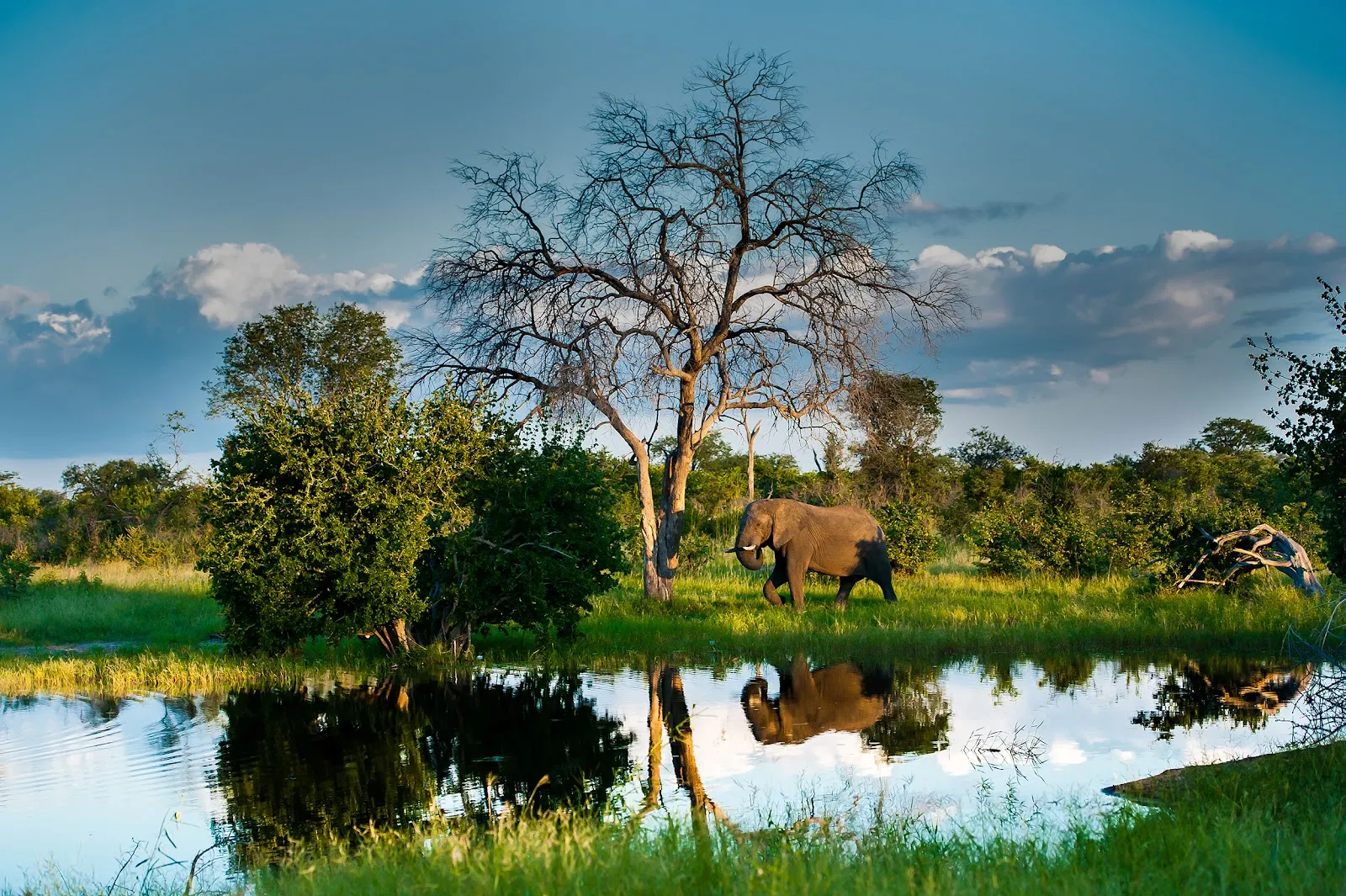
Okavango Delta
Go to the Okavango Delta for wildlife viewing in a wetland that floods each year, seen from safari vehicles, boats and small planes.
We may earn a commission. It never decides our picks.
The Okavango Delta is an inland delta in northern Botswana, where the Okavango River spreads across flat Kalahari sand and its water never flows out to the sea. Water arrives each year from the highlands of Angola and fills channels, islands and grassland, so the same ground looks different from one season to the next. Maun, the main gateway town, sits at its southern edge.
Many travelers come for wildlife and for the water itself. Elephants, buffalo, hippos, crocodiles and lions are common in the area, and many camps run game drives by vehicle and on foot. Mokoro trips, in dugout canoes poled through shallow channels, are a quieter way to see birds and the edges of the floodplain. The delta is a UNESCO World Heritage Site. Many camps are reached by light aircraft from Maun, and road transfers depend on the season. Distances between camps are long, so plan for several nights; five gives time to move between camps. The dry season, roughly June to October, is the usual choice for game viewing because animals gather near permanent water.
Okavango Delta in five
- Fly into Maun (MUB) for the DeltaMaun is the usual gateway. Most camps are reached by light aircraft from Maun's airstrip or by road transfer, so ask your camp which one it uses before you book the flight.Getting around
- Pack in soft bagsLight aircraft to the camps usually take bags in soft luggage. Hard cases can be refused or charged extra, so check the weight limit with your operator before you pack.Luggage
- Walk with staff after darkElephants, hippos and buffalo can walk through camps at night. Ask staff to escort you between your tent and the main area, and do not use the paths alone after dark.
- Load an eSIM before you reach MaunSignal stops across most of the Delta, and camps have little or none. Set up a data plan on your phone before you fly to Maun.Phones and eSIM
- Confirm park fees in the camp rateAsk the camp whether its rate includes Moremi Game Reserve and other concession fees before you pay a deposit, and keep the receipts.
Things to do in Okavango Delta
See all attractions in Okavango Delta
Need to know
- Currency
- Pula (BWP)
- Entry
- Visa-free short stays for many passports; check your nationality first
- Emergency
- Ask your camp for local emergency numbers
- Tipping
- Expected for safari guides, mokoro polers and lodge staff
- Time
- UTC+2, no daylight saving
Weather by month
- Best
- Good
- Mixed
- Poor
- JanuaryRainy season
- FebruaryRain, high grass
- MarchFloodwater arriving
- AprilWater rising
- MayDry season starts
- JuneFloods, mokoro season
- JulyHigh water, mokoro
- AugustPeak season, busy
- SeptemberWildlife at water
- OctoberHot, dry, dusty
- NovemberHeat builds
- DecemberHot, rains start
Right now in Okavango Delta
Local time, today's weather and the exchange rate, refreshed through the day.

27
- Feels like
- 24°
- Humidity
- 23%
- Wind
- 8 km/h
- Chance of rain
- 0%
Okavango Delta
12:38 AM
Tuesday, November 3
- Today39°23°0%Tuesday: Clear. High 39°, Low 23°. Chance of rain 0%.
- Wed39°25°0%Wednesday: Partly cloudy. High 39°, Low 25°. Chance of rain 0%.
- Thu40°25°6%Thursday: Drizzle. High 40°, Low 25°. Chance of rain 6%.
- Fri39°23°12%Friday: Cloudy. High 39°, Low 23°. Chance of rain 12%.
- Sat37°23°33%Saturday: Drizzle. High 37°, Low 23°. Chance of rain 33%.
- Sun35°22°27%Sunday: Thunderstorms. High 35°, Low 22°. Chance of rain 27%.
Updated 11:50 PM local time · Powered by WeatherAPI.com · Weather data by Open-Meteo.com
Money
Mid-market rate1 USD = 13.84 BWP
Rates from Nov 2, 2026 · Rates By Exchange Rate API
Before you go to Okavango Delta
Rules for Okavango Delta, checked
- Walk outside camps only with a licensed guide.
- Declare any meat, dairy or plant material at the border, because Botswana controls imports of animal and plant products.
- Do not enter the water of the channels; crocodiles and hippos live there, and swimming is not safe.
Plan around Okavango Delta
Entry rules, the wider country route and the basics
Read the guideWhere to stayCamps and lodges in and around the Delta
Read the guideGetting around the DeltaFlights into Maun and transfers out to camps
Read the guideMoney and costsPula, cards and what to budget for a camp stay
Read the guideVisas and entryEntry rules for short stays by nationality
Read the guideTravel insuranceMedical evacuation cover for remote camps
Read the guideOkavango Delta FAQ
Do I need a visa for Botswana?
Many passports get visa-free entry for short stays. Check the entry rules for your nationality on the official government site before you book.
When is the best time to visit the Okavango Delta?
July to October, the dry season. Water is high for mokoro trips, and wildlife gathers at the remaining water in September and October.
Is malaria a risk in the Okavango Delta?
Yes. Malaria occurs in the Delta, so see a travel clinic about prophylaxis before you go, and use repellent at dusk.
Can I drive myself through the Okavango Delta?
Self-driving is possible on some routes, but sandy tracks are demanding. Most first-time visitors book a camp with a guide instead.
Can I swim in the Okavango Delta?
No. Crocodiles and hippos live in the channels, so stay out of the water and use the camp's pool or the shore.
How many days do I need in the Okavango Delta?
Three nights covers one camp and a mokoro morning. Five nights gives time to move between camps.