Planifier un voyage
Langue: Français
Planificateur de voyagePlanifiez votre voyage sur une carte

Destinations incontournables

EnglishDeutschFrançaisEspañolPortuguêsPortuguês (BR)Italiano
Avis aux voyageurs · ÉgypteCertains gouvernements déconseillent de se rendre dans certaines régions de Égypte.Les avertissements ne concernent que ces zones : Bande de 50 km le long de la frontière libyenne, Bande de Gaza, Frontière libyenne (sans profondeur définie), Gouvernorat du Nord-Sinaï, Frontière soudanaise (sans profondeur définie), Désert occidental, Gouvernorat d'Ismaïlia (est du canal de Suez), Nord du Gouvernorat du Sud-Sinaï (au-delà de la route Sainte-Catherine–Nuweiba).Les conseils dépendent de votre passeport. Consultez ceux de votre propre gouvernement avant de réserver.Conseils officiels
Zones signalées
  • Bande de 50 km le long de la frontière libyenne · éviter tout voyage · Canada, Nouvelle-Zélande
  • Bande de Gaza · éviter tout voyage · Canada, France, Nouvelle-Zélande
  • Frontière libyenne (sans profondeur définie) · éviter tout voyage · Allemagne, Espagne, France, Italie
  • Gouvernorat du Nord-Sinaï · éviter tout voyage · Canada, Espagne, France, Irlande, Nouvelle-Zélande, Royaume-Uni
  • Frontière soudanaise (sans profondeur définie) · éviter tout voyage · Allemagne, Espagne, France, Italie
  • Désert occidental · éviter tout voyage · Canada, Nouvelle-Zélande, Royaume-Uni, États-Unis
  • Gouvernorat d'Ismaïlia (est du canal de Suez) · éviter les voyages non essentiels · Canada, Royaume-Uni
  • Nord du Gouvernorat du Sud-Sinaï (au-delà de la route Sainte-Catherine–Nuweiba) · éviter les voyages non essentiels · Canada, Nouvelle-Zélande, Royaume-Uni

Également signalé par un seul gouvernement : Bande de 20 km le long de la frontière libyenne (Royaume-Uni), Zones frontalières (zones militaires) (États-Unis), Zone frontalière égypto-israélienne (Allemagne), Péninsule du Sinaï nord et centre (États-Unis), Gouvernorat de Port-Saïd (est du canal de Suez) (Canada), Zone frontalière de Rafah (Espagne), Gouvernorat de Suez (est du canal de Suez) (Canada), Route Bahariya–Siwa (Royaume-Uni), Trapèze de Bir Tawil (Royaume-Uni), Désert à l'ouest de Marsa Matrouh, du Fayoum et d'Abou Simbel (France), Région du Gebel Uweinat au Gilf el-Kebir (Italie), Triangle de Halaib (Royaume-Uni), Zones désertiques non touristiques (Italie), Poste frontalier de Rafah (Irlande), Péninsule du Sinaï sud (Allemagne)

GouvernementConseilsMis à jourLire les conseils
Royaume-Uni (FCDO)No advice against the whole country (regional advisories)–Lire les conseils
États-Unis (State Dept)Exercise increased caution (regional advisories)15 juil. 2025Lire les conseils
Canada (Affaires mondiales)Exercise a high degree of caution (regional advisories)–Lire les conseils
Allemagne (Auswärtiges Amt)Besondere Vorsicht walten lassen (keine Gesamtwarnung) (regional advisories)13 oct. 2026Lire les conseils
Nouvelle-Zélande (SafeTravel)Exercise increased caution elsewhere in Egypt (regional advisories)–Lire les conseils
Irlande (ministère des Affaires étrangères)High degree of caution (regional advisories)–Lire les conseils
France (ministère de l'Europe et des Affaires étrangères)Increased vigilance for the rest of the country (regional advisories)–Lire les conseils

Vérifié quotidiennement d'après les conseils publiés par les gouvernements ; dernière vérification le 2 nov. 2026.RoamLedger résume les conseils officiels ; il ne s'agit pas de conseils émanant d'un gouvernement.

Mosque of Ibn Tulun
Mosquée

Mosque of Ibn Tulun

In the Sayyida Zeinab area of Cairo, the Mosque of Ibn Tulun is one of the city’s oldest mosques to survive in its original form and one of its largest by area.

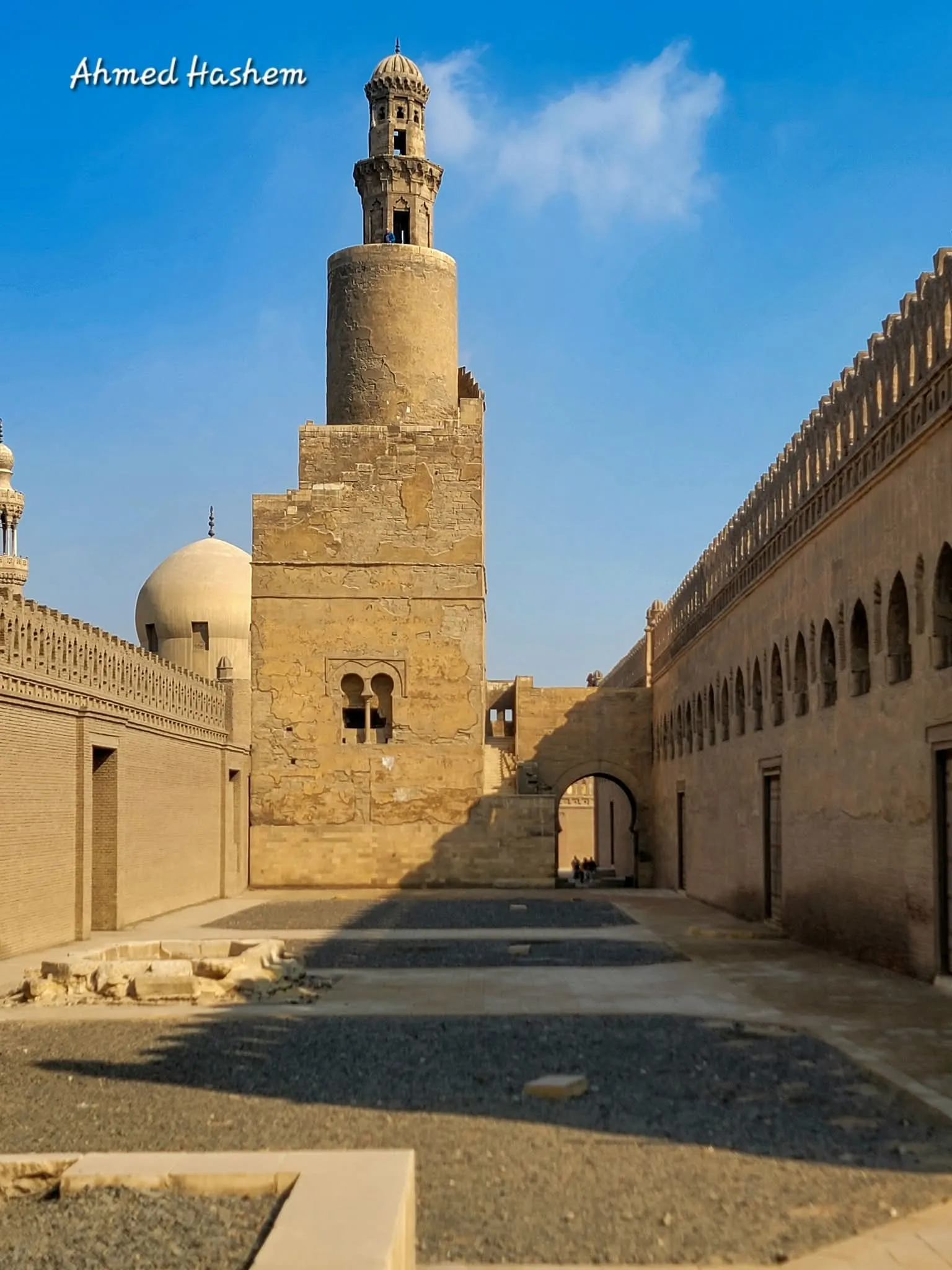
In the Sayyida Zeinab area of Cairo, the Mosque of Ibn Tulun is one of the city’s oldest mosques to survive in its original form and one of its largest by area. Ahmad ibn Tulun commissioned it for his new capital, and construction was completed in 879. Inside, a vast courtyard is framed by arcades with geometric stucco decoration. Look for the distinctive spiral minaret, whose staircase you can climb for views across the mosque and Cairo. Its open, restrained design gives the complex a calm feel.

A mosque for al-Qat’i
Mosque of Ibn Tulun
Mosque of Ibn Tulun

Ahmad ibn Tulun, the Abbasid governor of Egypt and founder of the Tulunid dynasty, commissioned the mosque for al-Qat’i, his new administrative capital. Work began in 876 and was completed in 879. The complex was intended to accommodate Ibn Tulun and his army for Friday prayers.

Al-Qat’i later disappeared, but the mosque survived. It remains one of Cairo’s oldest mosques in its original form and the last major remnant of Ibn Tulun’s capital. Its scale and straightforward layout offer a view of early Islamic architecture in Egypt, distinct from the later Mamluk and Ottoman mosques around the city.

The courtyard and its arcades
Mosque of Ibn Tulun
Mosque of Ibn Tulun

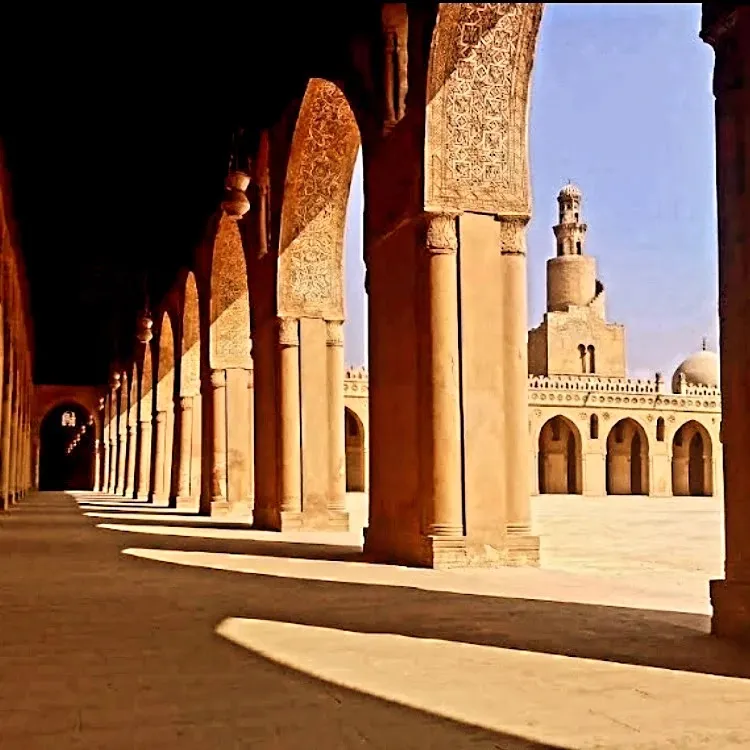
The mosque is arranged around a large, open courtyard, with arcades on all four sides. The prayer hall lies on the side facing Mecca, and its arcade is wider than the others. The open square allows daylight to reach the surfaces around it, including carved stucco and wood.

Take time to look closely at the geometric patterns in the stucco and the carved wooden details. The building’s red-brick structure, stucco finish and thick walls give it a restrained, fortress-like appearance. Its decoration is less ornate than that of some other Cairo mosques, but the repeated arches and patterns make the scale of the courtyard easier to appreciate as you walk around it.

The spiral minaret

The mosque’s minaret is distinctive for its spiral form and external staircase. Its design is associated with the Great Mosque of Samarra in Iraq, an architectural model linked to Ibn Tulun’s Abbasid background. From the top, you can look down across the courtyard and out over the surrounding city.

The minaret is one of the details that makes the mosque especially rewarding to explore slowly. View it from the courtyard before making the climb, then look back toward the mosque from above to see how the arcades and open square fit together.

FAQ

When was the Mosque of Ibn Tulun built?

Construction began in 876 and was completed in 879, under Ahmad ibn Tulun.

Can you climb the minaret?

Yes. The spiral minaret has an external staircase, and you can climb it for views over the mosque and Cairo.

Is there an entrance fee?

The available information states that entry is free. A small donation toward the mosque’s upkeep is suggested.

What should women wear to visit?

Women are advised to bring a headscarf.

Autres incontournables à Le Caire

Tout explorer