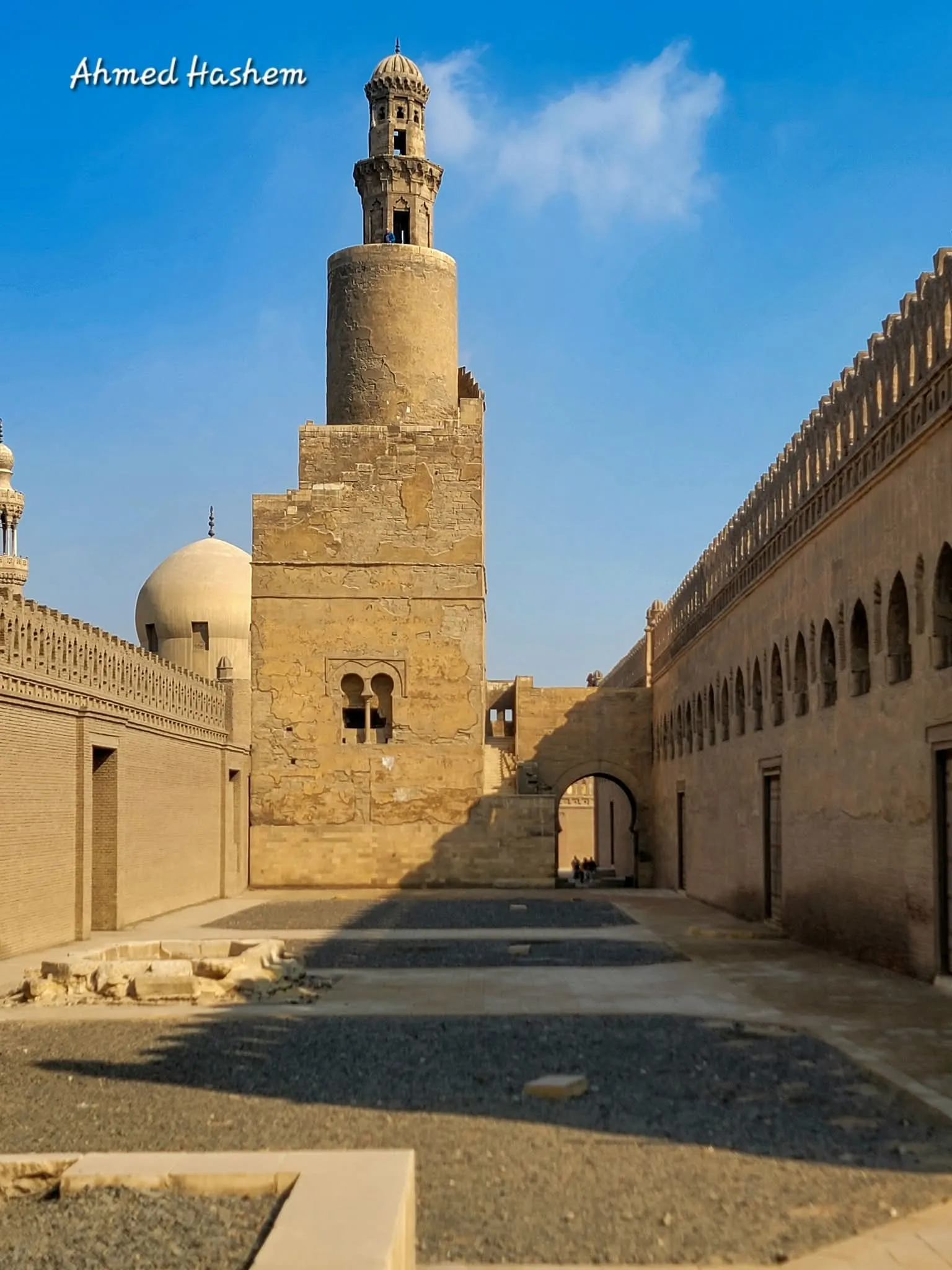
In the Sayyida Zeinab area of Cairo, the Mosque of Ibn Tulun is one of the city’s oldest mosques to survive in its original form and one of its largest by area. Ahmad ibn Tulun commissioned it for his new capital, and construction was completed in 879. Inside, a vast courtyard is framed by arcades with geometric stucco decoration. Look for the distinctive spiral minaret, whose staircase you can climb for views across the mosque and Cairo. Its open, restrained design gives the complex a calm feel.
A mosque for al-Qat’i
Ahmad ibn Tulun, the Abbasid governor of Egypt and founder of the Tulunid dynasty, commissioned the mosque for al-Qat’i, his new administrative capital. Work began in 876 and was completed in 879. The complex was intended to accommodate Ibn Tulun and his army for Friday prayers.
Al-Qat’i later disappeared, but the mosque survived. It remains one of Cairo’s oldest mosques in its original form and the last major remnant of Ibn Tulun’s capital. Its scale and straightforward layout offer a view of early Islamic architecture in Egypt, distinct from the later Mamluk and Ottoman mosques around the city.
The courtyard and its arcades
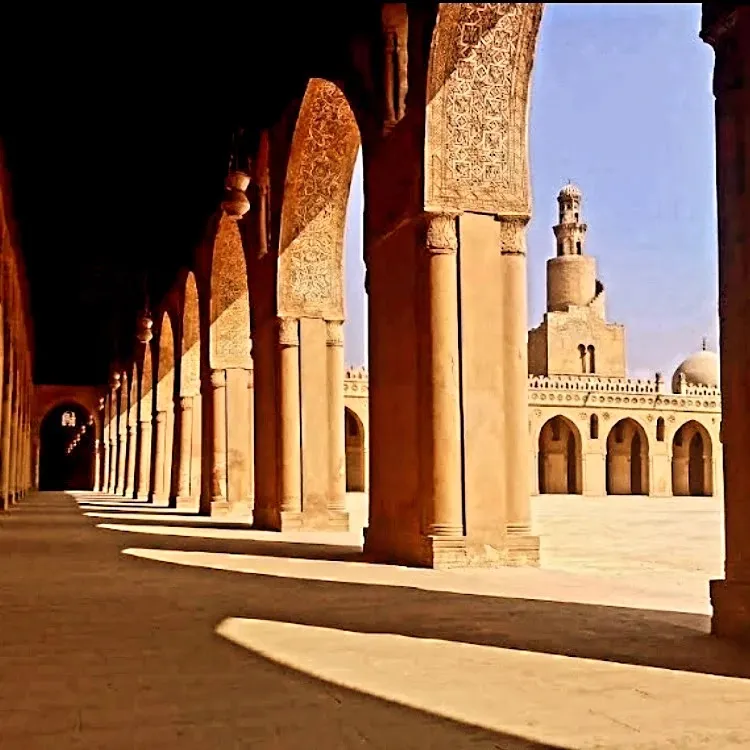
The mosque is arranged around a large, open courtyard, with arcades on all four sides. The prayer hall lies on the side facing Mecca, and its arcade is wider than the others. The open square allows daylight to reach the surfaces around it, including carved stucco and wood.
Take time to look closely at the geometric patterns in the stucco and the carved wooden details. The building’s red-brick structure, stucco finish and thick walls give it a restrained, fortress-like appearance. Its decoration is less ornate than that of some other Cairo mosques, but the repeated arches and patterns make the scale of the courtyard easier to appreciate as you walk around it.
The spiral minaret
The mosque’s minaret is distinctive for its spiral form and external staircase. Its design is associated with the Great Mosque of Samarra in Iraq, an architectural model linked to Ibn Tulun’s Abbasid background. From the top, you can look down across the courtyard and out over the surrounding city.
The minaret is one of the details that makes the mosque especially rewarding to explore slowly. View it from the courtyard before making the climb, then look back toward the mosque from above to see how the arcades and open square fit together.
Perguntas frequentes
When was the Mosque of Ibn Tulun built?
Construction began in 876 and was completed in 879, under Ahmad ibn Tulun.
Can you climb the minaret?
Yes. The spiral minaret has an external staircase, and you can climb it for views over the mosque and Cairo.
Is there an entrance fee?
The available information states that entry is free. A small donation toward the mosque’s upkeep is suggested.
What should women wear to visit?
Women are advised to bring a headscarf.