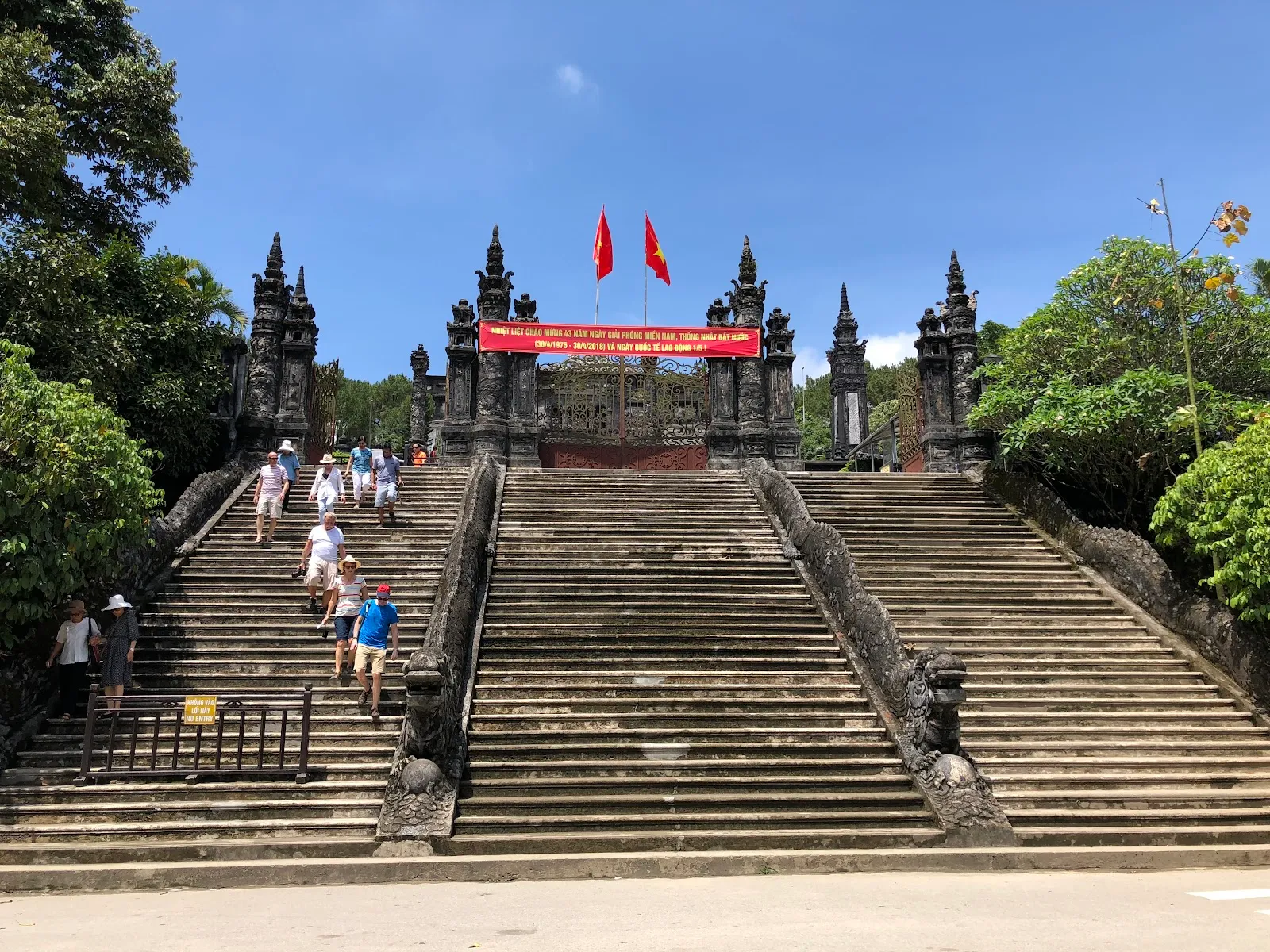
About 10 km from central Hue, the Mausoleum of Emperor Khai Dinh rises on the slope of Chau Chu Mountain. Built from 1920 to 1931 as the burial place of the Nguyen dynasty’s twelfth emperor, it combines Vietnamese design with European influences. Climb the grand stairways past dragon motifs and stone guard figures, then look closely at the porcelain and glass mosaics inside. The compact complex is more densely decorated than the expansive grounds of some other royal tombs, with views over the surrounding hills from its upper levels.
A royal tomb on Chau Chu Mountain
The mausoleum, also known as Ung Lang, stands on the slope of Chau Chu Mountain, about 10 km from central Hue. It was built for Khai Dinh, the twelfth emperor of the Nguyen dynasty. Construction began in 1920 and took 11 years, ending in 1931. Khai Dinh died in 1925; his son and successor, Bao Dai, completed the tomb.
The complex is smaller than some of Hue’s other royal tombs, but its architecture is notably elaborate. Its position on the hillside and its tiered layout give the approach a strong sense of ascent. The tomb belongs to the Hue Monuments Complex, which was recognized as a UNESCO World Cultural Heritage site in 1993.
Stairs, stone figures and mosaics
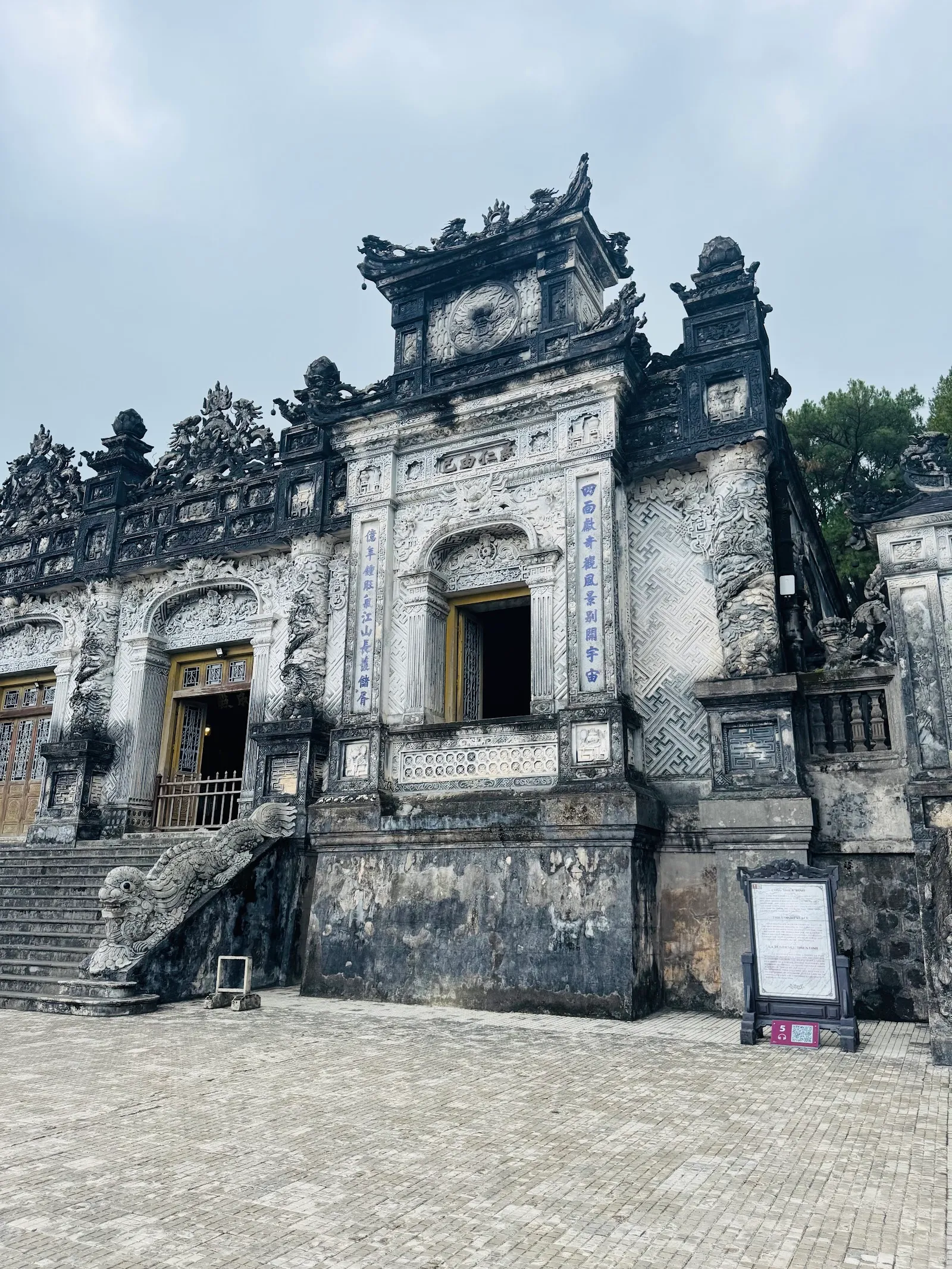
A long sequence of stairways leads up through the complex. Dragon motifs run along the stair rails, and stone elephants and imperial guard figures mark the approach. The courtyard is lined with stone statues; from the upper levels, you can look out over the surrounding hills.
The main building is the focus of the visit. Its interior is covered with detailed decoration, including mosaics made from porcelain and glass. These pieces form intricate patterns and imagery, including a painting known as “Nine Dragons Amidst Clouds.” Look across the walls and ceilings to see how extensively the mosaic work covers the interior. The vivid decoration contrasts with the darker stone exterior.
A blend of architectural influences
Khai Dinh’s tomb combines traditional Vietnamese motifs with European architectural details. Gothic arches and Roman-style columns sit alongside dragons and other East Asian decorative forms. The design also uses imported materials, including iron, steel, cement and slate tiles from France, and porcelain and glassware from Japan.
The mixture sets the mausoleum apart from Hue’s other royal tombs, whose layouts and decoration vary from one emperor to another. Khai Dinh’s close association with the French colonial administration is part of the site’s history. His rule was unpopular, and accounts of the tomb’s construction note that he sought permission to raise taxes to help fund it. The lavish materials and dense decoration offer a clear contrast with simpler royal tombs elsewhere in Hue.
FAQ
Where is Khai Dinh Mausoleum?
It is on Chau Chu Mountain, about 10 km from central Hue.
How much is the entrance fee?
The supplied information gives an approximate fee of 250,000 VND. Consider a combo ticket if you plan to visit several Hue attractions.
When is a good time to visit?
A weekday or an off-peak time, such as Monday afternoon, may mean fewer crowds.
What should I see inside the mausoleum?
Look for the porcelain and glass mosaics, including the “Nine Dragons Amidst Clouds” painting, as well as the decorated stairways and stone figures.