
Tōdai-ji is Nara's most famous temple, set in the northern part of Nara Park. Its Great Buddha Hall, the Daibutsuden, houses a bronze statue of the Buddha Vairocana about 15 meters tall, and the hall is one of the largest wooden buildings in the world. Pass through the Nandaimon Gate, with its guardian statues, to reach the main complex. Near the statue stands a pillar with a hole at its base that visitors crawl through for good luck. The grounds are free to walk, and the hall has a separate entry ticket.
From Emperor Shōmu to the present hall
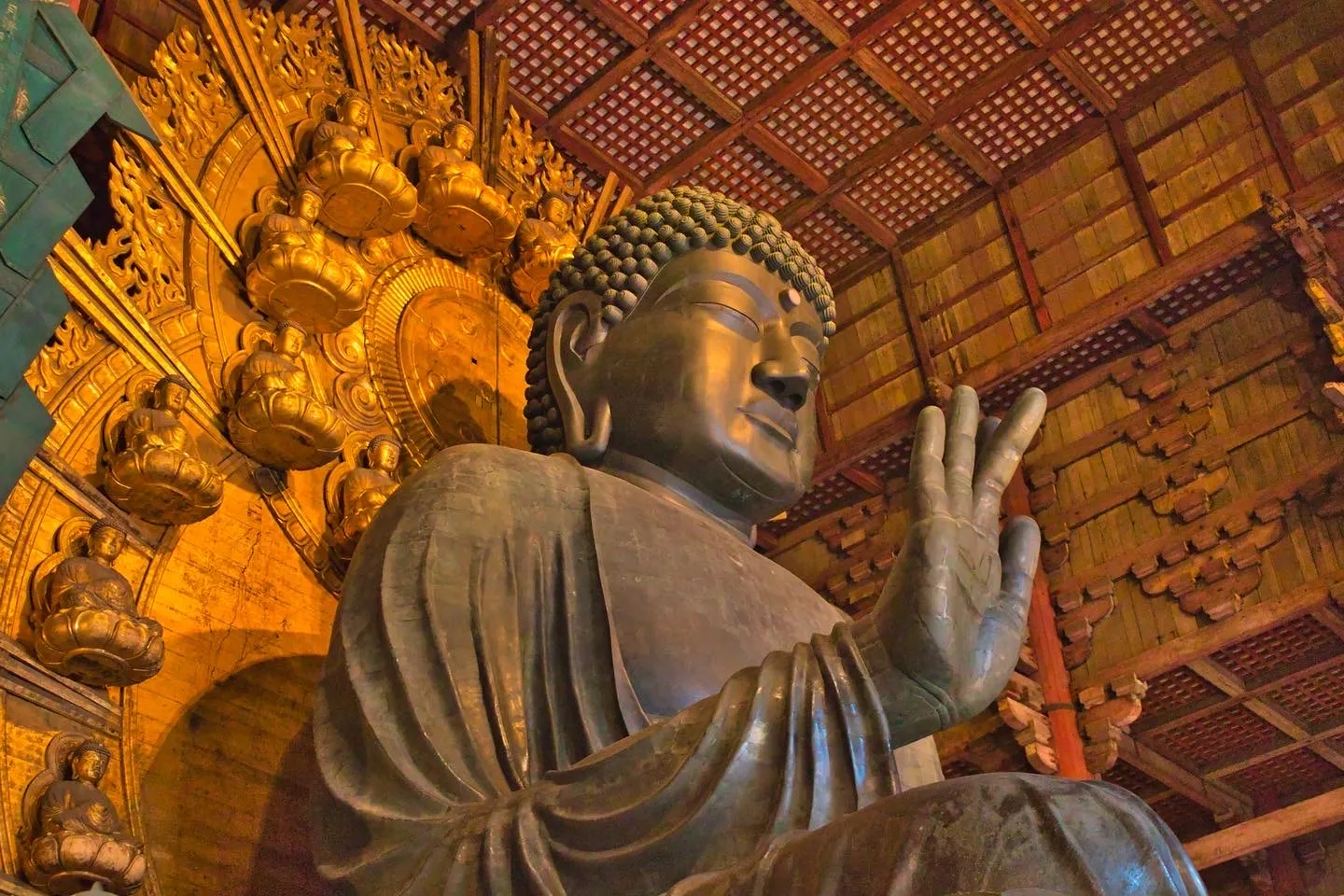
Emperor Shōmu, a devout Buddhist, backed the temple in the 8th century. Work on the great wooden hall began in 738, and the complex was completed in 752, the year the great bronze statue was unveiled. More than two and a half million people gave money toward the original temple, in line with a national belief that the Buddha would protect the country from natural disasters.
Tōdai-ji was one of the Seven Great Temples of Nara and became a major centre of Buddhist political power. Its influence grew so large that the capital had to be moved away from Nara, which had been the capital from 710 to 784. The temple declined during the Kamakura period. An earthquake damaged it in 855, and a fire in 1180 burned it to the ground. A rebuilding was lost again in the 16th-century civil wars. The present Great Buddha Hall was rebuilt in 1709 at about two-thirds of its original size.
The statue has also been repaired over the centuries. The present Buddha was recast in the Edo period.
Inside the Great Buddha Hall
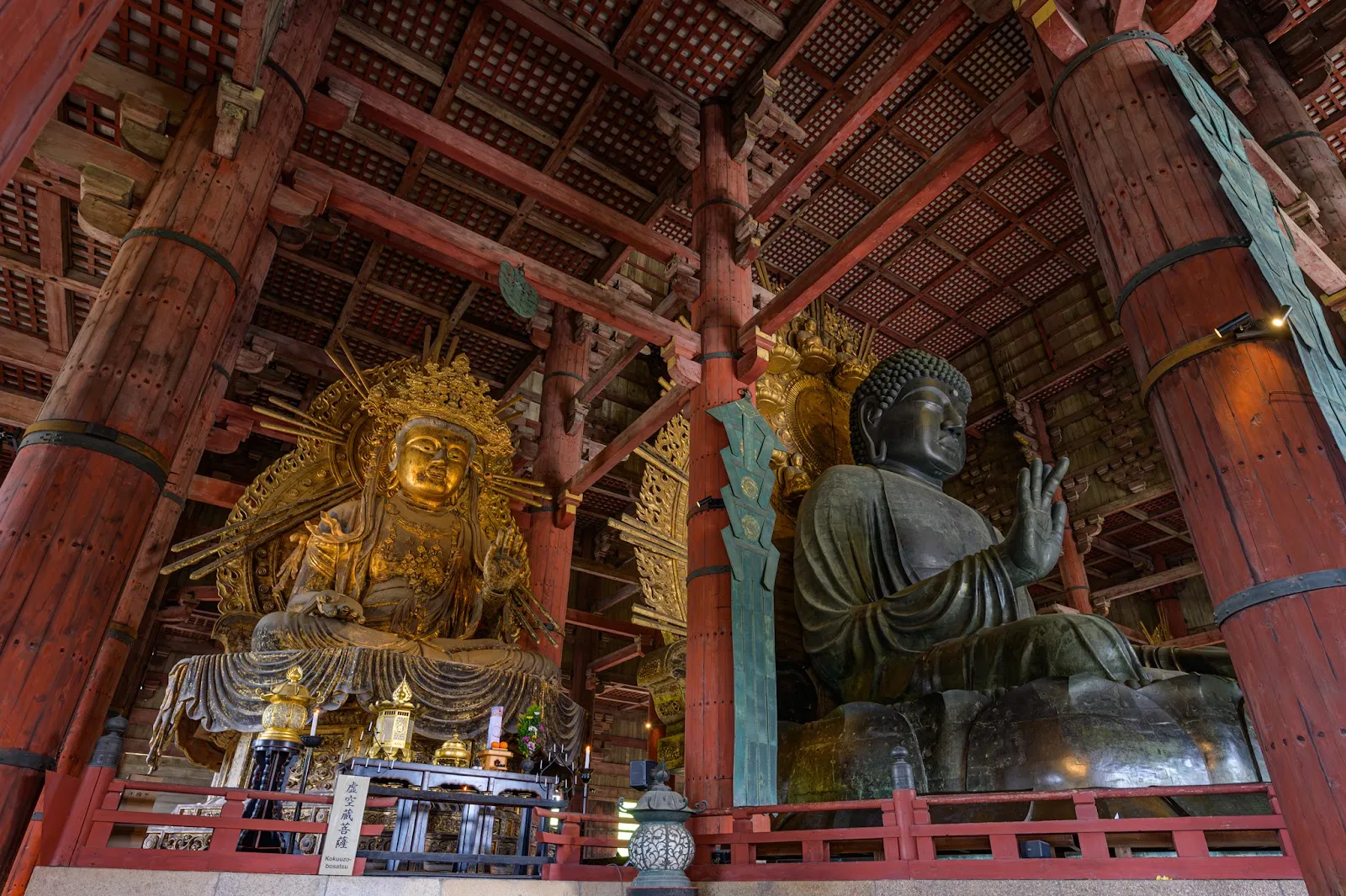
The Kondō, known as the Daibutsuden, is a monumental wooden structure of seven bays. Inside, the seated Vairocana Buddha, about 15 meters high, fills the space at the centre of the hall. Buddhist art is displayed around the hall, and models inside show how the building has changed in size and style over time.
Beside the statue stands a pillar with a hole at its base, roughly the size of one of the Buddha's nostrils. Visitors who crawl through it are said to receive good luck or enlightenment. Please keep the queue moving and go through the opening once, as a courtesy to the people behind you.
Nandaimon Gate and the grounds
Nandaimon, the Great South Gate, was destroyed during the Heian period and rebuilt at the end of the Kamakura period, which is why it has survived to the present day. Two Nio guardian statues stand inside it. They were made in 1203 and are about 8.5 meters tall. The gate and the Great Buddha Hall are both National Treasures. Eight buildings in the temple are National Treasures, and 18 more are Important Cultural Properties.
Tōdai-ji belongs to the Kegon school of Buddhism. Its grounds include several subsidiary halls, gardens, ponds, bridges and pagodas. Kagami-ike Pond lies in front of the outer wall, and its reflections of the gate and walls are a good stop for photographs.
Nigatsu-do and the spring fire festival
Nigatsu-do Hall stands on the rise east of the Daibutsuden plaza. Its wooden veranda gives a view over the tiled roofs of the city, and the temple bells can be heard in the evening.
Each year from 1 to 14 March, the monks of the temple hold the Shuni-e fire ceremony in the evenings, starting between 6:30 and 7:30 pm. They carry large flaming torches around the veranda and wave them over the edge, so embers fall on the crowd below. The most spectacular evening is 14 March, when the ceremony starts at 6:30 pm. The fire looks more alarming than it is.
Another festival, held on 2 May to honour Emperor Shōmu, includes a colourful procession at 1 pm within the temple precinct. Music, gagaku dance and Noh performances are shown for free at Kagami-ike Pond.
Planning the visit
Entry to the Great Buddha Hall costs 600 yen. Follow the signs to the ticket counter at the entrance. The temple grounds can be walked without a ticket.
The temple sits in Nara Park, where deer roam freely. Local legend says the god Takemikazuchi arrived in Nara on a deer from Kashima Shrine in Ibaraki Prefecture, and the deer are still treated as sacred messengers. Kasuga Taisha Shrine is close by, and Kōfuku-ji has a five-story pagoda. The old merchant district of Naramachi, with its traditional wooden houses, is a short walk away.
FAQ
Is there an entry fee?
Entry to the Great Buddha Hall costs 600 yen. The temple grounds can be walked without a ticket, and the museum is a separate, optional visit.
Can you crawl through the pillar near the Buddha?
Yes. Beside the statue is a pillar with a hole at its base, roughly the size of one of the Buddha's nostrils. Visitors who crawl through it are said to receive good luck or enlightenment.
Where is Tōdai-ji?
The temple is at 406-1 Zoshicho, Nara, inside Nara Park, in the northern part of the park.
Is there parking?
There is a paid parking lot on site, with a wheelchair accessible lot as well. Lots near the temple can fill by late morning on weekends and charge about 700 to 1,000 yen per session, so weekday visits are easier.
Is the temple open every day?
Yes, the temple is listed as open every day of the week.


