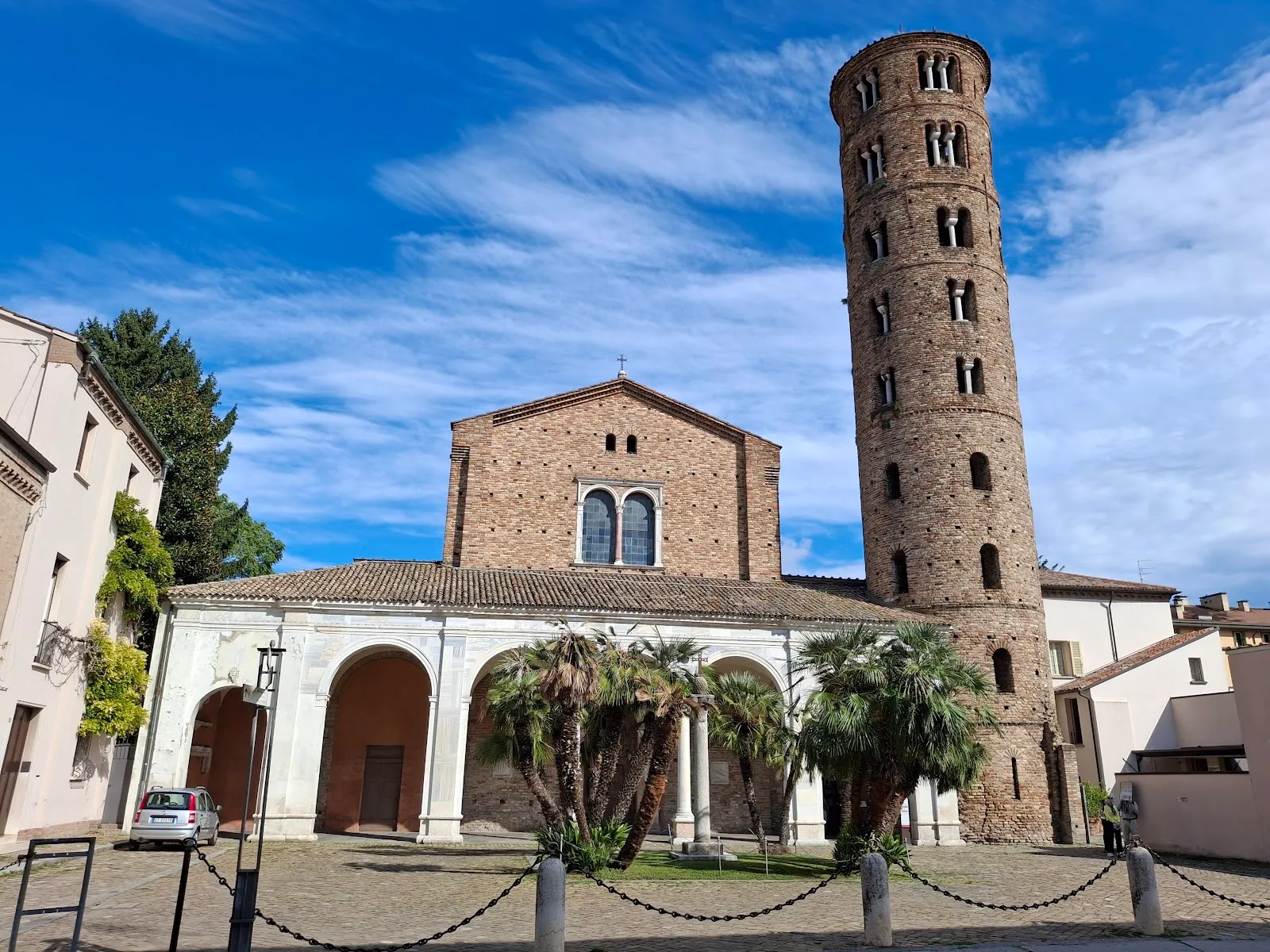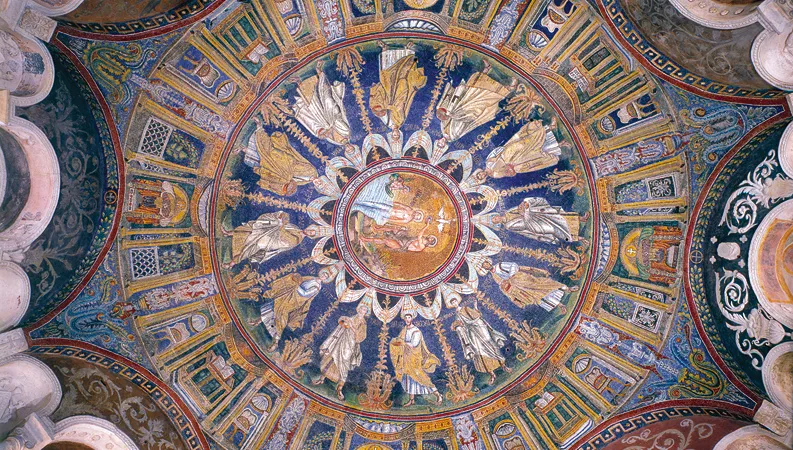
Beside Ravenna’s cathedral, the Neonian Baptistery is an octagonal early Christian building begun around the end of the 4th century. Its compact interior draws your eye upward to a dome mosaic of Christ’s baptism in the Jordan, encircled by the Twelve Apostles. Look closer for the marble and stucco details around the walls and the marble and porphyry font at the centre. The baptistery’s mosaics have a Hellenic-Roman character that sets them apart from those at some of Ravenna’s other monuments.
A baptistery beside the cathedral
The Neonian Baptistery stands beside Ravenna’s cathedral and is among the city’s oldest surviving monuments. Construction began around the end of the 4th century, when Bishop Ursus had it built alongside a cathedral that no longer survives. The building occupies the site of a Roman bath complex. Its octagonal plan is simple from the outside; the interior decoration came later.
Bishop Neon commissioned the dome and interior decoration in the 5th century, and the building takes its name from him. It is also called the Orthodox Baptistery, a name that distinguishes it from Ravenna’s Arian Baptistery. The two buildings present different ideas of Christ: the Neonian dome shows Christ being baptized, while the Arian Baptistery’s imagery differs in its depiction of him and omits the symbolic throne.
Reading the dome mosaic
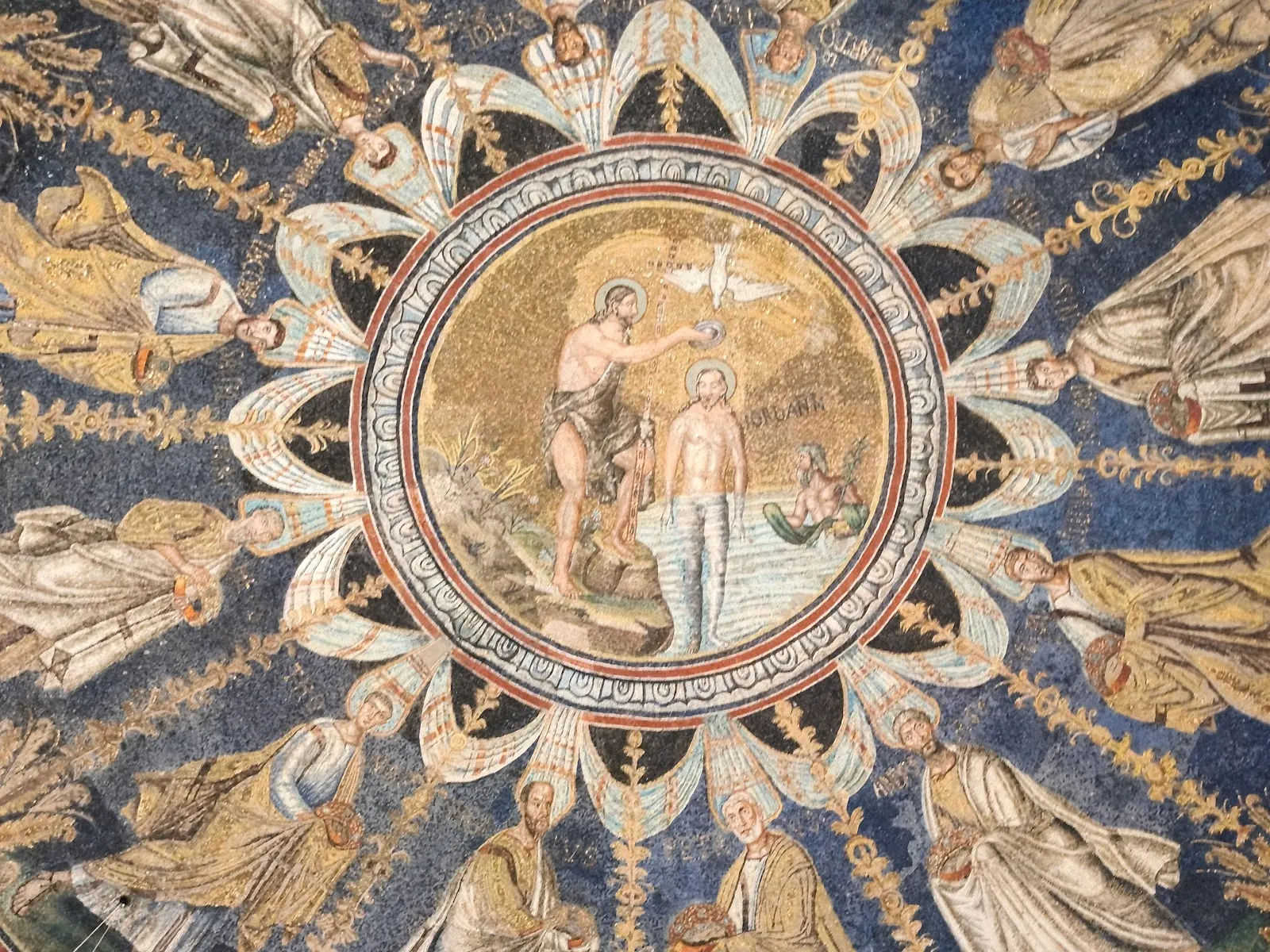
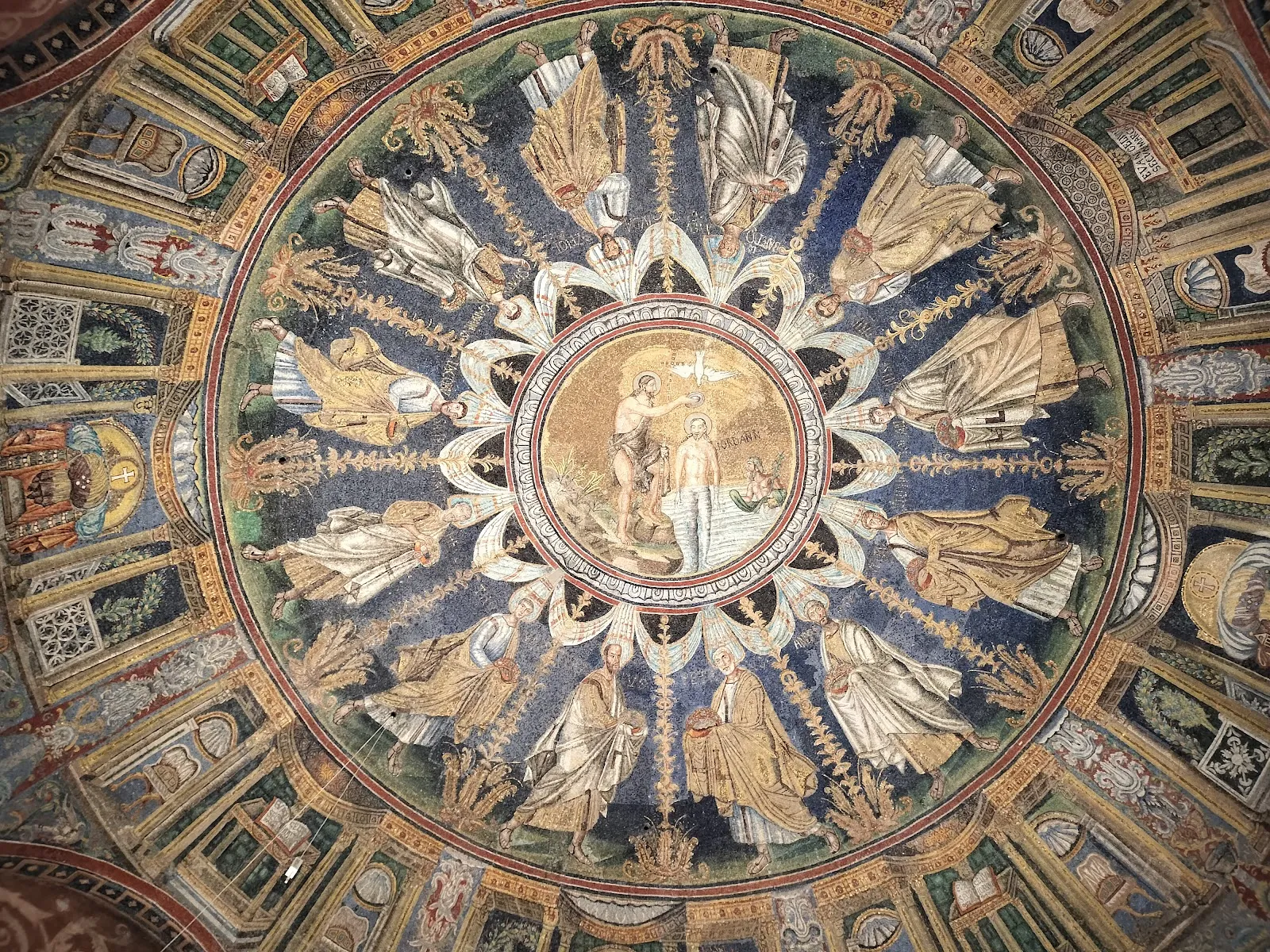
The central mosaic depicts Christ immersed in the Jordan River as John the Baptist performs the baptism. A personification of the river appears beside them, and the Holy Spirit descends above the scene. Around the central medallion, the Twelve Apostles move in procession toward a symbolic throne associated with the Second Coming.
Take in the whole composition first, then look for its separate figures and details. Blue and gold tesserae shape the scene, while the apostles form a ring around it. The imagery presents Christian beliefs about baptism and orthodox theology in the building where baptisms took place. The dome is the main focus, but the prophets and decorative motifs on the walls repay a closer look too.
Details at eye level
The baptistery’s interior combines mosaics with marble and stucco work. Marble surfaces and stucco arcades frame the decoration, and the walls include prophets and ornamental designs. The marble and porphyry font at the centre follows the building’s octagonal plan; the present font dates from the 16th century.
The mosaics have a Hellenic-Roman influence, which gives them a different character from the Byzantine-style decoration found at some other Ravenna monuments. Their colours and figures reward a slow look, even though the room itself is small. If you are visiting several sites for their mosaics, the Neonian Baptistery can be considered alongside Ravenna’s other monuments; a combined ticket is available for multiple sites.
FAQ
What does the Neonian Baptistery dome show?
Its central mosaic depicts Christ being baptized in the Jordan by John the Baptist, with the Twelve Apostles arranged around the scene.
How old is the Neonian Baptistery?
Construction began around the end of the 4th century. Bishop Neon commissioned the dome and interior decoration in the 5th century.
Should I book tickets in advance?
Booking ahead is recommended. In high season, visits to the small interior may be limited to five minutes.
Can I use a combined ticket?
Yes. A multi-site ticket is available for the Neonian Baptistery and other Ravenna mosaic sites.