
Sanssouci Park is the royal garden of Potsdam, laid out around Frederick the Great's summer palace and part of a UNESCO World Heritage Site since 1990. It covers close to 300 hectares of terraces, fountains, groves, statues and historic buildings, including the Chinese House, the Roman Baths, the Orangery Palace and the New Palace. Walking in is free, and the palace exteriors can be seen without a ticket. Paths climb and descend, so the park suits slow, long walks. Plan at least half a day, and a full day if you want to cover the palaces as well.
Frederick the Great's summer retreat
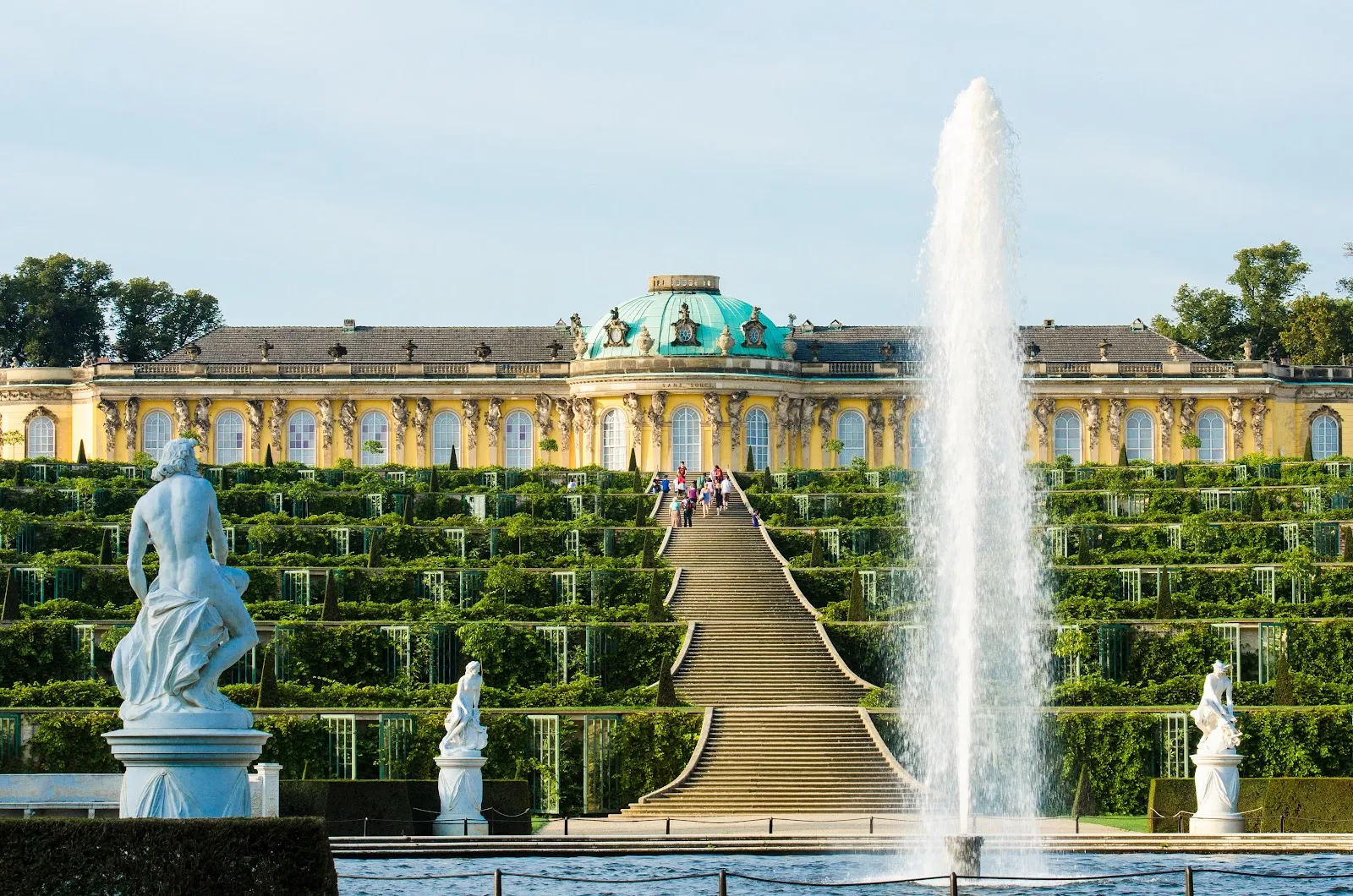
The park grew around Sanssouci Palace, a name that means "without a care" in German. The palace was built in the 1740s from sketches by Frederick the Great, who used it as a favourite retreat. It is a single-storey rococo building with an elliptical dome in the centre and a round room at each end. On the garden side the facade has rich plaster decoration. The rear opens onto the Grand Courtyard, enclosed by colonnades of Corinthian columns.
The palace is fairly small, and one explanation is that the king wanted the outdoor space to count for more. In front of it, the vineyard terraces were planted with vines from France, Italy and Portugal on his orders. Below them lies a baroque parterre modelled on Versailles, with conical boxwood topiaries and marble figures from mythology.
Frederick died here in 1786. Since 1991 he has rested in a crypt on the grounds.
Gardens, fountains and sculpture
The baroque garden at the foot of the terraces is organised around a large central fountain. In the nineteenth century Peter Joseph Lenné, the leading landscape gardener in Prussia, was commissioned to lay out the wider park grounds. Beyond the formal garden the park opens into ponds, groves of tall mature trees and long avenues.
Smaller buildings and monuments are placed along the way. Among them are the Neptune Grotto by Knobelsdorff and the small round Temple of Friendship, which Frederick had built in memory of his favourite sister. The park also has a botanical garden, a rose garden and more than 1,000 sculptures. Cleared sight lines run along several axes, so from certain points you look straight down to a major building.
The network of paths adds up to about 70 kilometres.
Palaces and pavilions to look for
The New Palace was built between 1763 and 1769 at the western end of the park. Schloss Charlottenhof, designed by Karl Friedrich Schinkel, is another of the three main palaces on the grounds. The Orangery Palace has an Italian character and the longest facade of any palace in Potsdam, at 300 metres. It has a central guest palace with a wing on each side that once housed plant halls.
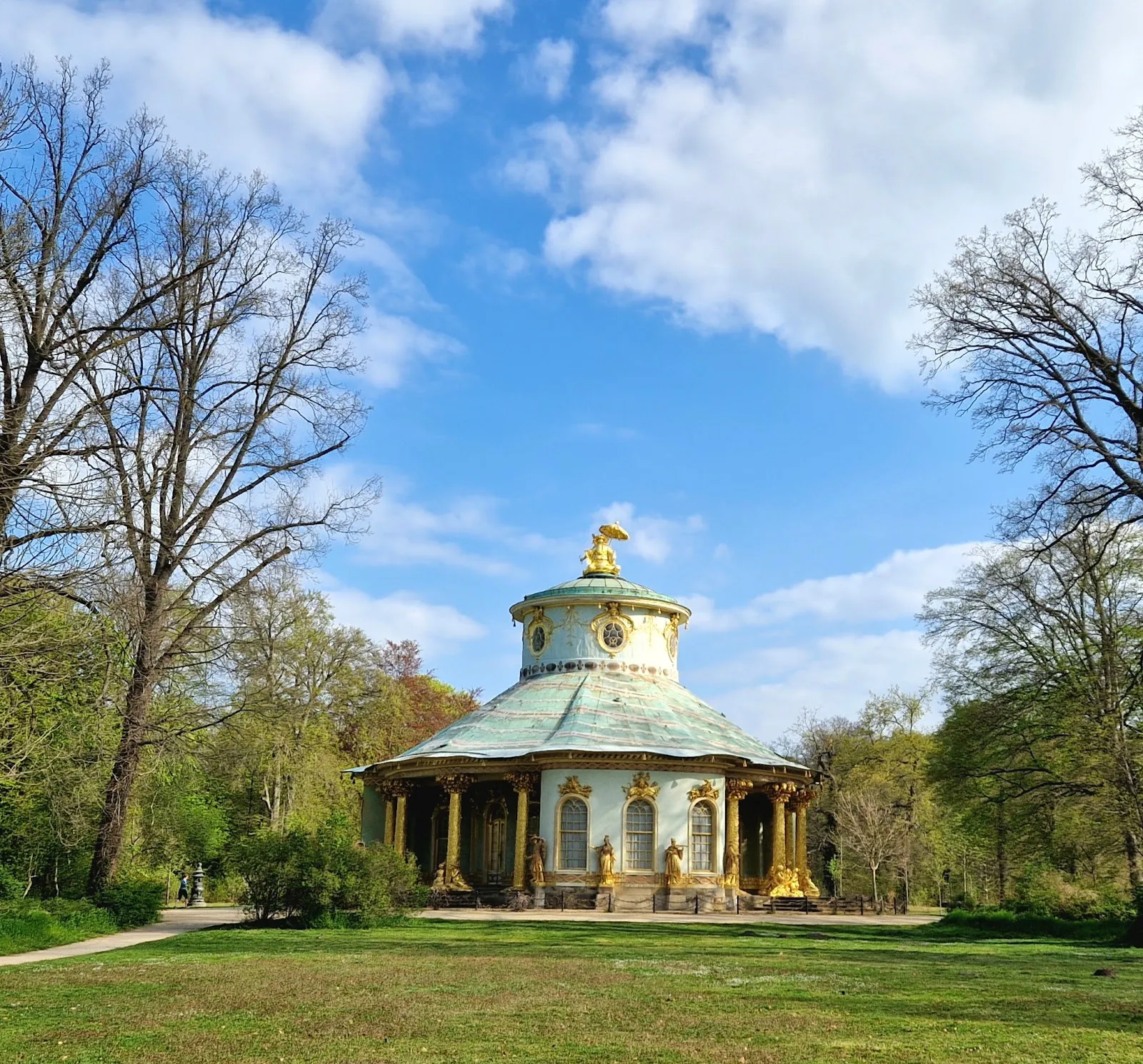
Other stops include the Chinese House tea pavilion, the Roman Baths, the Antique Temple, the Dragon House, the New Chambers, the Historic Mill and the Picture Gallery. All of these are signposted. Each building charges its own admission, and if you pay for only one interior, the Picture Gallery is a sensible choice. The exteriors of Sanssouci Palace, the New Palace and the Chinese House can be admired from the paths at no cost.
The whole property is part of the UNESCO site Palaces and Parks of Potsdam and Berlin, inscribed in 1990. It includes about 150 buildings built between 1730 and 1916 across roughly 500 hectares in Potsdam and Berlin.
Planning your route
A common way in is from Luisenplatz, then along Allee nach Sanssouci to the main entrance. The first view is Sanssouci Palace on its vineyard terraces. Near the entrance there is an information centre with restrooms and a gift shop.
Distances are longer than the map suggests. Sanssouci Palace is about 2.5 km from the New Palace, so a visit to both ends is a real walk. Cycling is allowed, but the routes open to bikes are limited. A guided cycle tour with rental bikes also links the park with Neuer Garten and Babelsberg Park.
Neuer Garten is a good second stop. It covers 102 hectares and was created in 1787 by Friedrich Wilhelm II as a contrast to the baroque Sanssouci. It borders two lakes and holds the Marble Palace and Cecilienhof, where Churchill, Stalin and Truman met for the Potsdam Conference at the end of World War II. Entry is free, with a suggested donation of €2. A pass covering both the park and Cecilienhof can be bought online from the Prussian Palaces and Gardens Foundation.
FAQ
Is there an entry fee for Sanssouci Park?
No, the park is free to enter and walk through. The palaces and other buildings inside charge their own admission.
How long do you need at Sanssouci Park?
Allow three to four hours for the main sights. The park is large, and even four hours can leave parts unseen, so plan a full day if you also want to enter palaces.
When is the best time to visit Sanssouci Park?
May and June bring the flower displays, and autumn turns the trees gold, red and brown. The grounds are also pleasant in winter, though the fountains run only in season.
Can you cycle in Sanssouci Park?
Yes, cycling is allowed, but only some paths are open to bikes. Dogs are also permitted.
Is there food inside the park?
Options are limited, and decent cafes are hard to find within the grounds. Bring a picnic, and use the picnic tables if you need a break.


