
Aachen Cathedral stands at Domhof 1 in the old town and began as the palace chapel of Charlemagne, at the end of the 8th century. The domed octagon of the Palatine Chapel is the oldest part, with later Gothic additions around it. Inside you find gold mosaics, stained glass, Charlemagne's plain stone throne and his gilded shrine. For centuries German kings were crowned here, and it was among the first sites on the UNESCO World Heritage List, in 1978. Entry to the main areas is free. The Treasury and guided tours are ticketed.
Charlemagne's palace chapel
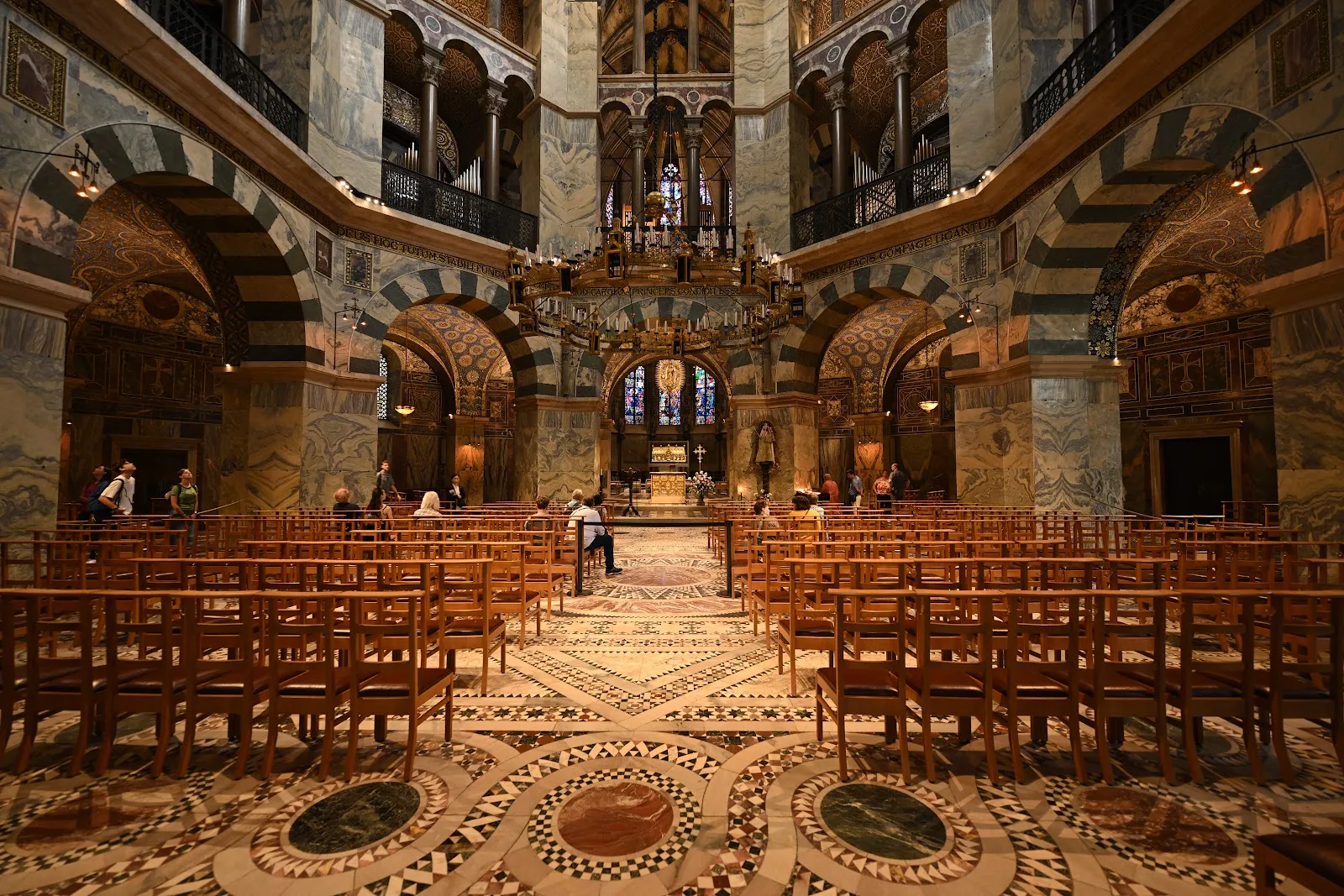
The cathedral grew from the chapel of Charlemagne's palace in Aachen, begun at the end of the 8th century. Charlemagne favoured Aachen as a residence, and the chapel is all that remains of his palace complex. Its builders took Byzantine churches as models, among them buildings in Ravenna and Istanbul, and that influence is still visible inside.
The oldest part of the building is the domed octagon, which contains the Palatine Chapel. Over some 1,200 years the church has changed and expanded, so the original chapel is the core of a much larger structure. Carolingian, Ottonian, Gothic and Baroque elements sit side by side. The Gothic choir and the Gothic chapels to the north and south date from the 14th and 15th centuries.
The cathedral was among the first places placed on the UNESCO World Heritage List, in 1978, and is often named as the first German site to be listed.
Coronations from 936 to 1531
From 936 until 1531, the Palatine Chapel was the setting for the coronation of 31 German kings and 12 queens. The throne used for those ceremonies is still here. It is a simple stairway leading to an unadorned seat and dates to 796. Many visitors expect something more ornate. Its plainness is part of what makes it memorable.
Above the centre of the octagon hangs the Barbarossa chandelier, a large ring of light that is one of the first things to look up at when you enter the inner room.
At the main doors, a lion-headed handle has a local legend attached. It says the devil's thumb is locked inside it. Centuries of hands reaching to touch it have polished the metal bright.
Mosaics, choir and Charlemagne's shrine
Gold mosaics cover much of the arched ceilings, and in the Palatine Chapel they sit above marble columns and bronze railings. Bring a moment to simply stand and look up. The octagon is lit by glass and gold rather than by large windows.
The Gothic choir lies beyond the chapel. Its tall stained-glass windows give the space a blue cast, and its structure resembles that of the Sainte-Chapelle in Paris, although it is heavier and less airy than its model. Charlemagne's remains rest here in a gilded shrine, the Karlsschrein, a golden sarcophagus set among the windows. He died in 814, and he is buried in the church he built.
Because the building mixes so many periods, it does not read as one clean style. A guided tour helps here, since a guide can explain which parts belong to which century.
The Treasury and the Charlemagne Centre
The cathedral Treasury, the Domschatzkammer, is a museum of the Diocese of Aachen. It holds one of the most important collections of medieval church art in Europe, with relics, gold work and liturgical objects. It needs a separate ticket and a treasury tour can be booked in advance.
For the wider story of the city, the Charlemagne Centre explains Aachen's history, more than that of the king himself. An app gives the exhibition's story in English. The Route Charlemagne, a walking route through the old town, begins at the centre.
Heavy bombing in the Second World War damaged the cathedral. A restoration lasting about 30 years and costing around 40 million euros was completed in 2011.
Around the cathedral
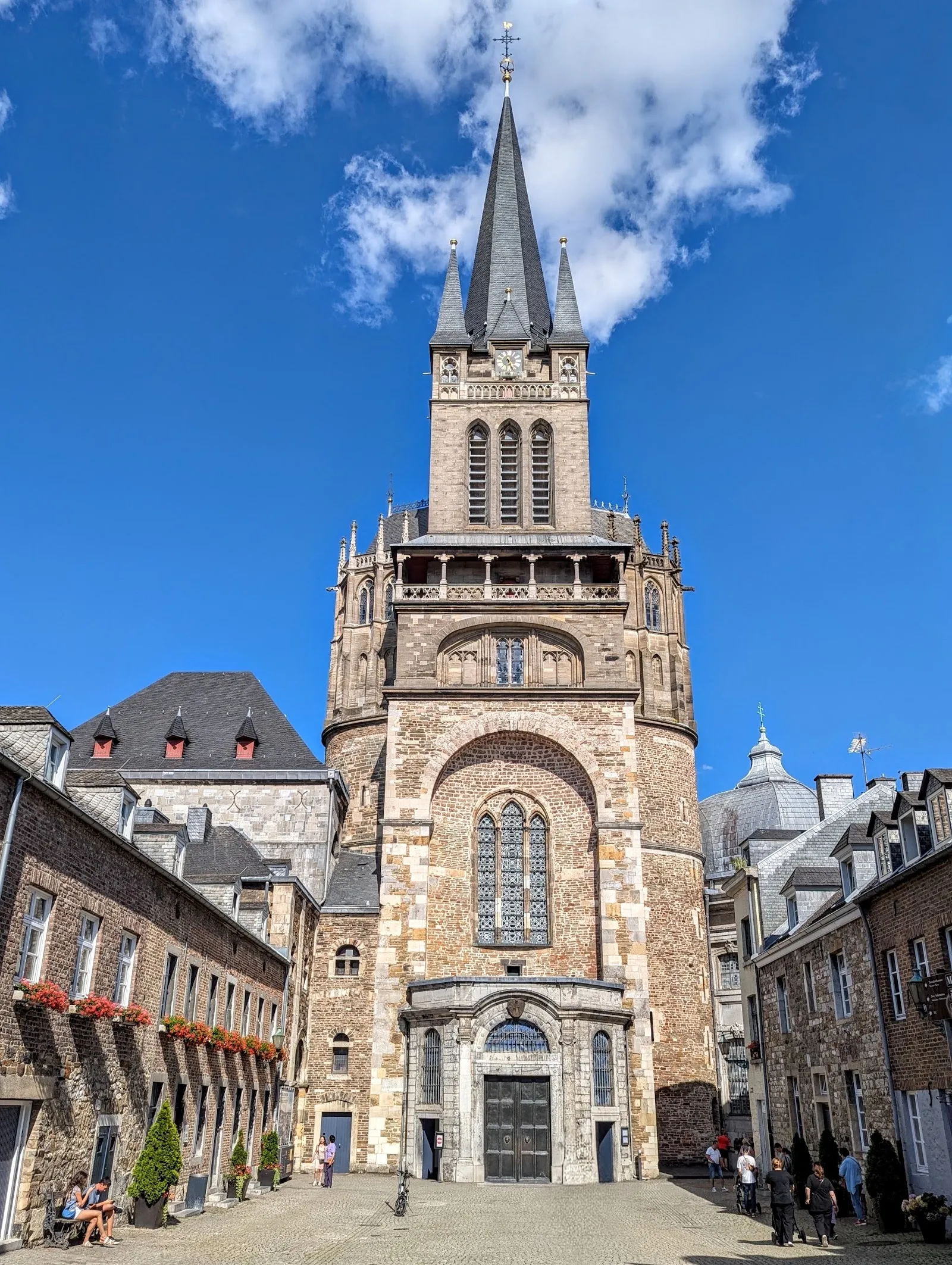
You approach from Domhof, the square in front of the entrance, where the original Carolingian facade can be seen. Just beside the cathedral lies the Katschhof, a small square between the cathedral and the Town Hall. In the festive season, much of Aachen's Christmas market takes place here and in the streets around the cathedral.
The Town Hall next door was built on the foundations of Charlemagne's palace, and the old town around both buildings is easy to explore on foot. Restaurants and small shops line the streets nearby.
FAQ
Is there an entry fee for Aachen Cathedral?
You can enter the main areas for free. Guided tours and the Treasury require tickets, and booking ahead is recommended.
Who is buried in Aachen Cathedral?
Charlemagne is buried here. His remains are in a gilded shrine in the Gothic choir.
Is a guided tour worth taking?
A tour takes you to parts of the building that the free visit does not reach, and a guide can explain the different building periods. The church grew over some 1,200 years, so the explanation helps.
Is there a dress code?
Yes, a dress code applies to this place of worship. Check the cathedral's website before your visit.
Can I visit during mass?
During mass, access is limited to people attending the service. Visit outside service times if you want to look around.
Is Aachen Cathedral wheelchair accessible?
The entrance is wheelchair accessible, and there is a restroom on site.


