
Arco da Porta Nova is the old gate into Braga's historic centre, on Rua Dom Diogo de Sousa. It began as a door opened in 1512 under Archbishop Diogo de Sousa, and the arch you see today was designed in the 18th century by André Soares, a local sculptor and architect. Walk under it to reach narrow streets, cafes, restaurants and the cathedral area. Admission is free, and the arch is open at all hours, so it makes an easy first stop after arriving by train.
From a door to an arch
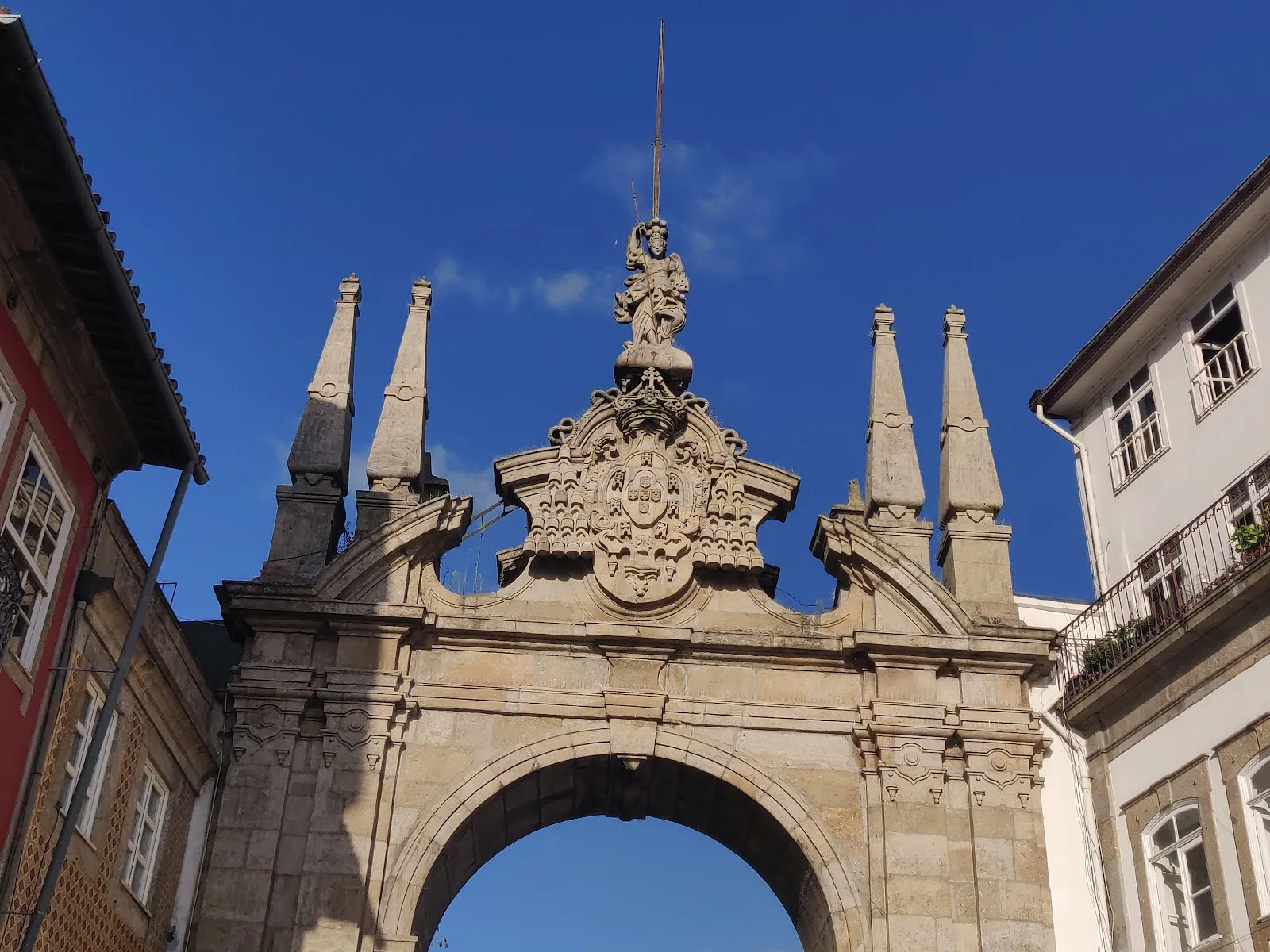
The arch began as a door. Archbishop Diogo de Sousa had the city's gate opened in 1512, when Braga was no longer in danger of invasion. The name Porta Nova means new door in Portuguese.
The opening was later rebuilt as an arch. In the 18th century, André Soares, a locally born sculptor and architect, designed the arch that stands today. Its design combines Baroque and Neoclassical styles.
In earlier times the gate was the route by which important visitors entered the city, and it was one of the main ways into Braga's walled medieval core.
Reading the carvings
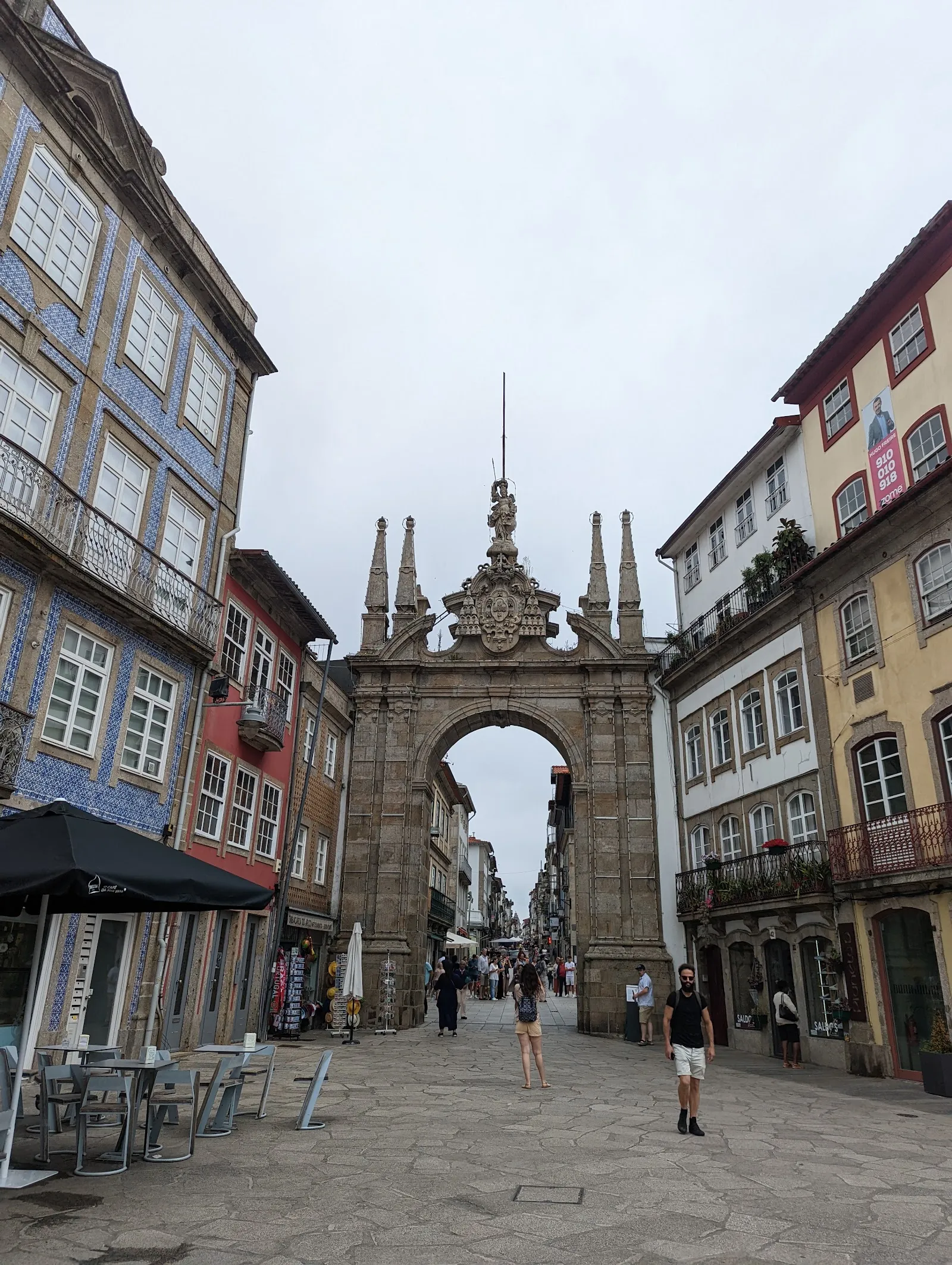
On top of the arch stands a female figure. She holds a church, a symbol of religion, in one hand and a spear, a symbol of military power, in the other. One local guide identifies her with Minerva, the Roman goddess of the arts and of war.
The arch also carries a coat of arms and several statues. One face has a recessed niche with a statue of Nossa Senhora da Nazaré, Our Lady of Nazareth. The two faces look quite different, so it helps to walk around the arch and compare them.
Why the arch never had a door
Despite its name, the arch never held a door. Some say that the open gateway gave rise to a local saying about people who leave a door open. The expression is tied to Braga, and the story is part of how the arch is remembered in the city.
The arch is still the gate, but in a symbolic sense. It is the point where the old town begins.
Around the arch
Rua Dom Diogo de Sousa is pedestrianised and lined with cafes and restaurants. Rua do Souto leads to the arch and passes several of the city's main landmarks, including the cathedral, the Misericórdia church and the entrance to the Episcopal Palace.
The Museu da Imagem stands opposite the arch. The Jardim de Santa Bárbara and the Praça do Município lie nearby, and a free walking tour starts at Campo das Hortas and passes through the arch.
Visiting in practice
The arch is at R. Dom Diogo de Sousa 127, in the historic centre. It is open at all hours, so you can see it by day or at night.
Walking under it takes only a few minutes. Most of the visit happens in the streets beyond it, where the older buildings and the cafes are.
FAQ
Is there an entry fee?
No. Arco da Porta Nova is free to visit, and you can walk under it at any time.
Is it open at night?
Yes. The arch is open at all hours, so you can walk past it or photograph it in the evening.
Where is Arco da Porta Nova?
It is at R. Dom Diogo de Sousa 127, 4700-424 Braga, Portugal, at the entrance to the historic centre.
What does the name mean?
Porta Nova means new door in Portuguese. The arch began as a door opened in 1512.


