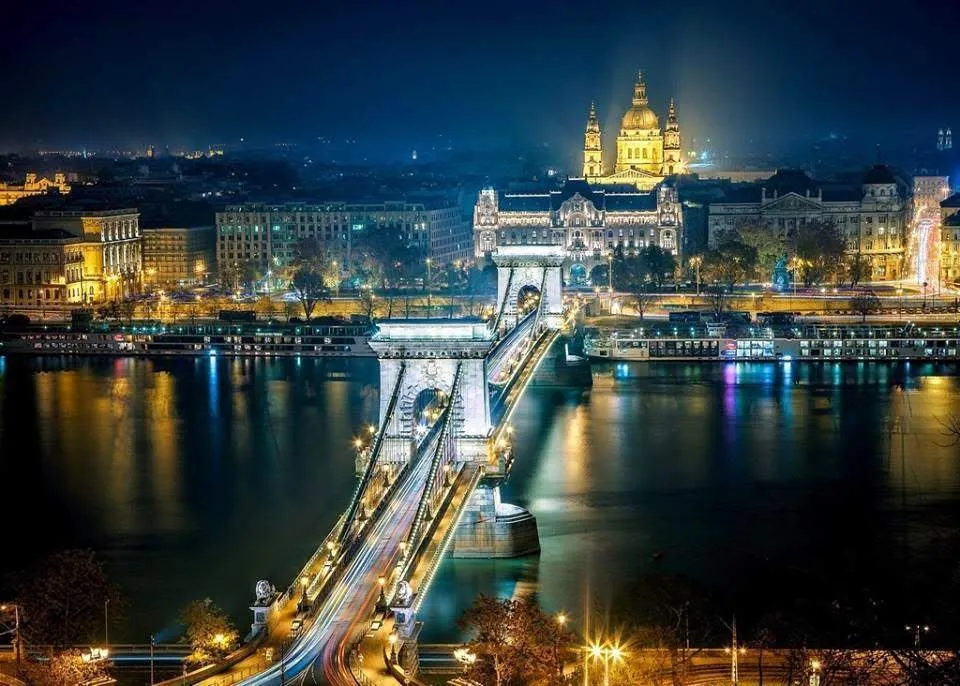
Széchenyi Chain Bridge links Buda and Pest across the Danube, joining the area around Széchenyi Square on the Pest side with Adam Clark Square beneath Castle Hill. Opened in 1849, it was the first permanent bridge across the river in Budapest. Walk across to see its chain-and-stone structure up close and take in views towards Buda Castle and the Parliament. The stone lions at the entrances are a detail to look for; after dark, the illuminated bridge makes a striking sight from the riverbanks.
The first permanent link across the Danube
Before the Chain Bridge, crossing the Danube between Buda and Pest depended on boats or temporary crossings. In winter, people could sometimes walk over the frozen river, but that route was not dependable. A permanent bridge promised a more reliable connection between the two settlements.
Count István Széchenyi championed the project. English engineer William Tierney Clark designed the bridge, and Scottish engineer Adam Clark oversaw its construction. It opened in 1849 as the first permanent bridge across the Danube in Budapest. Its completion helped connect Buda and Pest, which later joined with Óbuda to form Budapest in 1873.
The bridge’s design and its lions
The bridge’s suspension structure uses chains, stone towers and substantial stonework at its approaches. At each end, stone lions stand guard over the entrances. They are among the easiest details to spot on a walk across the bridge, and they also make a useful point of reference when framing a photograph.
A local legend says the lions have no tongues. Look closely and you can judge for yourself; the story is part of the bridge’s local lore, not a reason to miss the sculptures. For a view along the bridge with the lions in front and Buda Castle beyond, stand on the Pest side at Széchenyi Square.
A walk between the riverbanks
Crossing on foot gives you time to notice the bridge’s structure and see the Danube from the span. Look upstream and downstream as you go: the city’s riverfront and landmarks appear from different angles, with the Parliament and Buda Castle among the sights visible from the bridge and its surroundings.
The bridge connects Széchenyi Square in Pest with Adam Clark Square on the Buda side, below Castle Hill and the funicular. That makes it a practical route between the riverfront and the Castle District. You can pair the crossing with a walk towards Buda Castle or Fisherman’s Bastion, or see the bridge from the water on an evening river cruise.
Seeing the bridge after dark
Daylight is useful for picking out the stonework and taking in the views across the river. At night, the bridge is illuminated, changing the look of its chains and towers against the Danube. Dusk is a good time to photograph the bridge with Buda Castle, as the city’s lights come on.
For a photograph that takes in the whole span, use Széchenyi Square on the Pest side. From the Buda side, the bridge and Pest appear together across the water. If you want a quieter walk, go early in the morning or later at night. The bridge is also worth seeing from the riverbanks, where you can take in its full outline rather than just the view from the crossing.
FAQ
What does Széchenyi Chain Bridge connect?
It crosses the Danube between Buda and Pest, linking Széchenyi Square on the Pest side with Adam Clark Square on the Buda side.
Why is the Chain Bridge historically important?
Opened in 1849, it was the first permanent bridge across the Danube in Budapest.
What can you see from the bridge?
The bridge gives views along the Danube towards landmarks including Buda Castle and the Parliament. Its stone lions stand at the entrances.
When is a good time to visit Széchenyi Chain Bridge?
Go early in the morning or late at night for a quieter walk. After dark, the bridge is illuminated.