
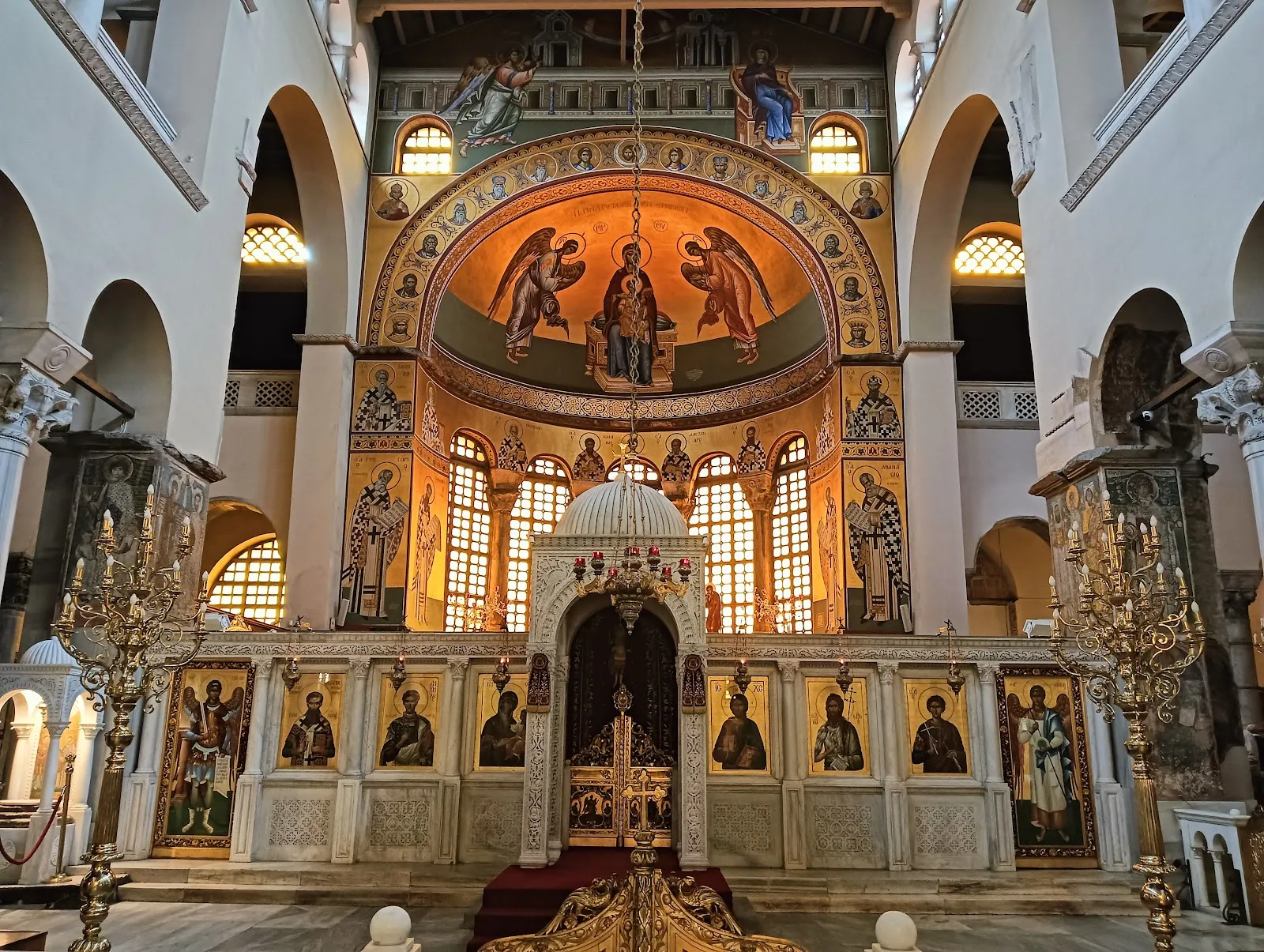
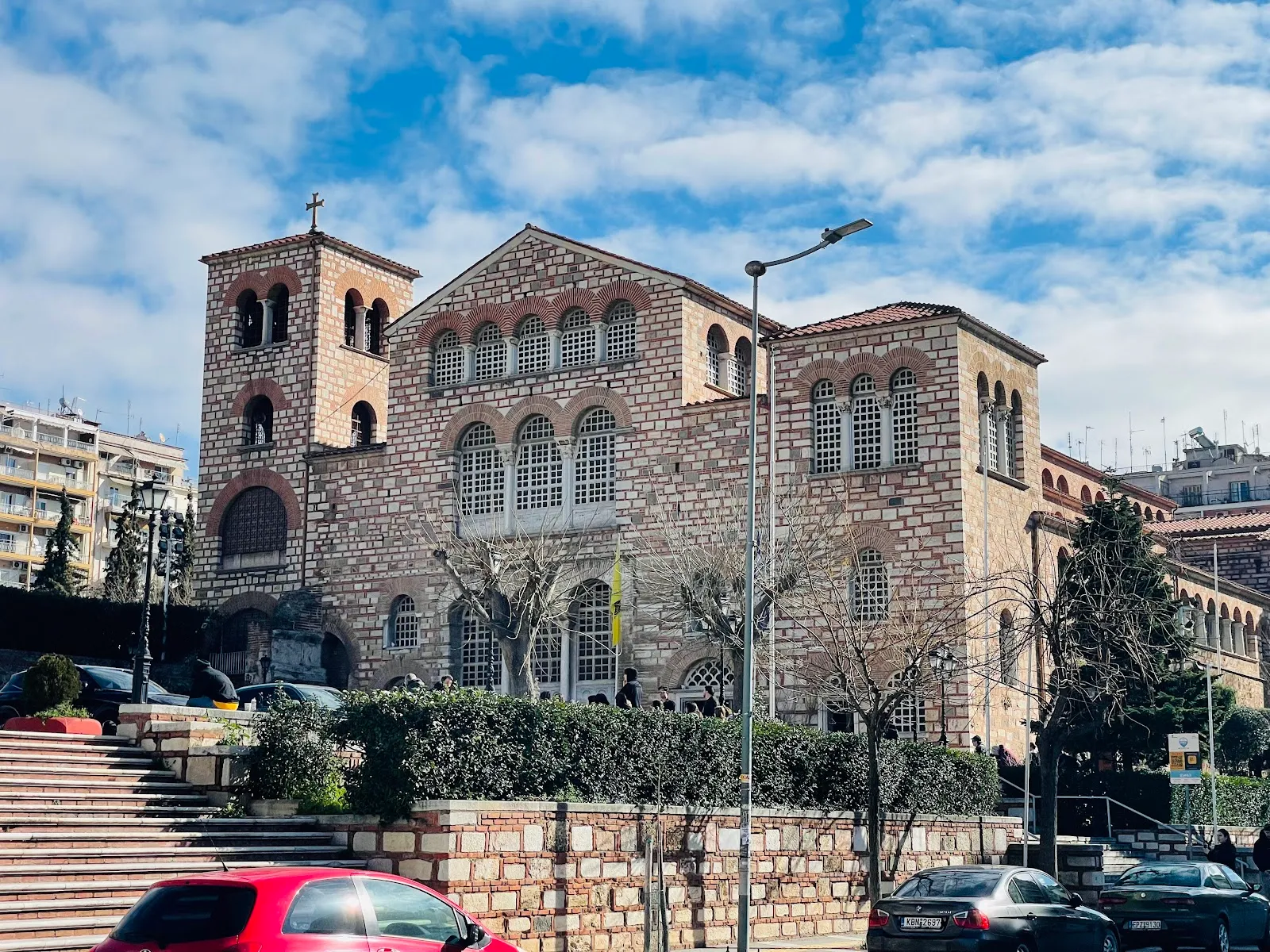
Saint Demetrius Church is Thessaloniki's main church for the city's patron saint, and it is still an active place of worship. The five-aisled basilica has Byzantine mosaics that survived the fires that damaged the building, including the 1917 fire. Many visitors consider the underground crypt the highlight. Tradition places the saint's imprisonment and martyrdom there, among remains of Roman baths. Entry is free, and the church is a short walk from Ano Poli and the Roman Forum.
The saint and the early church
Saint Demetrius was a Roman soldier who, according to tradition, was killed around AD 306 on the order of Emperor Galerius, who persecuted Christians. The site was a former Roman bath, and a church was first built there in the early 4th century.
The first structure was damaged by several fires in its early centuries. The five-aisled basilica that stands today was largely built in the 630s. Its mosaic panels were added over roughly a century from 630, and they are part of what gives the church its distinctive design.
The church is also dedicated to the city's protector, which explains why it holds a central place in Thessaloniki's religious life. It is one of the Paleochristian and Byzantine monuments of Thessaloniki that were added to the UNESCO World Heritage List in 1988.
The crypt
The crypt lies below the church and is linked by tradition to the place where the saint was held and martyred. Its dim corridors pass remnants of ancient Roman baths, and the air is cool and hushed.
The saint's relics are kept in a silver reliquary in the church above. Informational displays are present in the crypt, but reading about the site beforehand or joining a guided tour makes the visit clearer.
The crypt has shorter opening hours than the church, so plan to see it earlier in the day.
Mosaics, the Ottoman years and the 1917 fire
During the Ottoman period the church was turned into a mosque, and its frescoes were plastered over. After the Greek reconquest of the city in 1913, the frescoes were uncovered again.
The fire of 1917 caused serious damage. A number of mosaics survived, including panels around the altar. One well-known panel shows the saint with children and the builders of the church.
After the fire, the church was rebuilt in the 1940s. Some of the reconstruction used pieces of tombstones from the Jewish cemetery. The church was reconsecrated in 1949.
Visiting and what is nearby
Entry is free, and donations are welcome. A small shop sells religious items, and candles can be bought for a donation. The entrance, restroom and seating are wheelchair accessible, and so is the parking lot.
The church is close to the Roman Forum. Ano Poli, the upper town, is a short walk away, with paved streets, Ottoman-era houses and views over the city and the Aegean Sea. Many visitors combine the two in one walk.
The church is large, so visitors can usually find a quiet corner for prayer or reflection, even when tour groups are present.
FAQ
Is there an entry fee?
Entry is free. Donations are welcome, and candles and religious items can be bought at the shop.
How long do you need?
Plan at least 30 minutes for the church and crypt. Many visitors spend around an hour.
What should I wear?
Cover your shoulders and knees. It is an active place of worship, so dress modestly.
When is it busiest?
Sundays and the saint's feast day on 26 October draw the largest crowds. Early morning is quieter.
Is it wheelchair accessible?
The entrance, restroom and seating are wheelchair accessible, and there is a wheelchair accessible parking lot.


