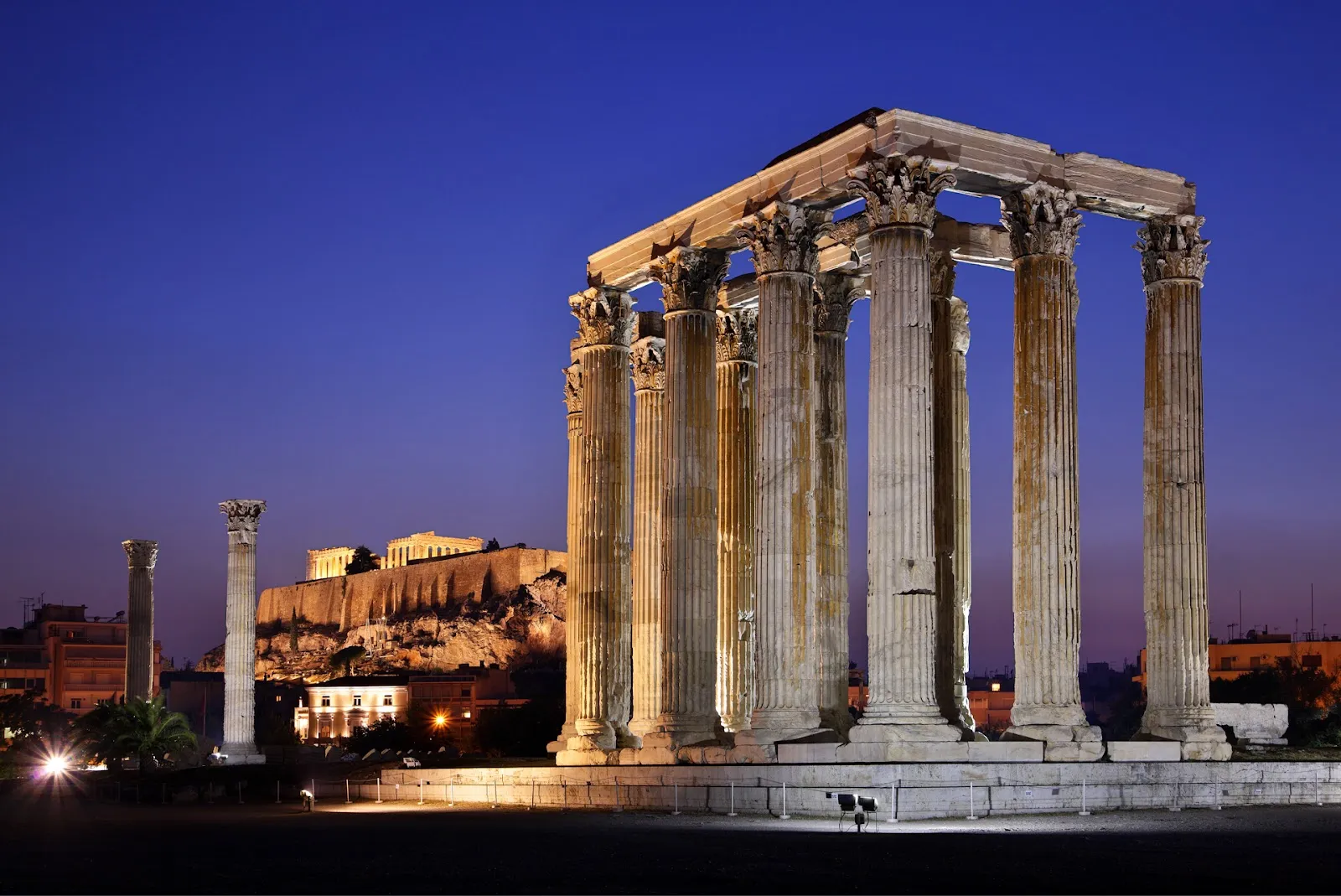
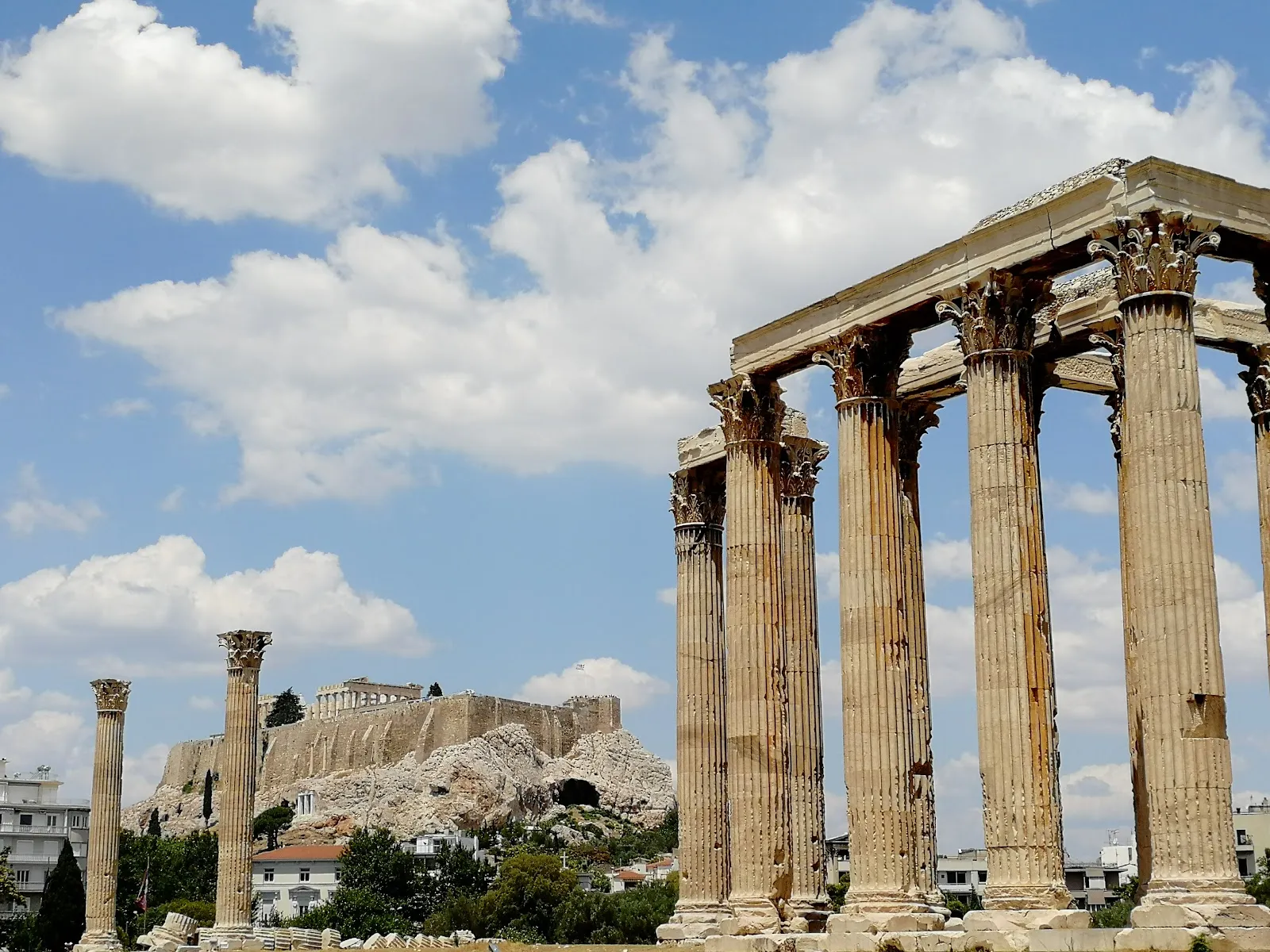
The Temple of Olympian Zeus, or the Olympieion, is a vast ancient sanctuary in central Athens, at the foot of the Acropolis. Its 15 surviving Corinthian columns give a sense of the scale of a temple once planned with more than 100. Look across the site toward the Acropolis, and include Hadrian’s Arch just outside the grounds. The ruins make a worthwhile short stop on a walk between Athens’ archaeological landmarks; if you would rather not pay for entry, the columns can also be seen from outside.
A temple built across centuries
The Olympieion was dedicated to Zeus, king of the Olympian gods. Work began in the sixth century BC under the Athenian tyrants, who planned a temple on an enormous scale. Construction stopped and restarted under different rulers; the project was completed in the second century AD during the reign of the Roman emperor Hadrian.
The long building history reflects changes in who ruled Athens. Hadrian’s completion of the temple connected the sanctuary with the Roman emperor as well as with Zeus. In antiquity, the building housed a statue of the god. Worshippers gathered in the surrounding area, where an altar stood, rather than inside the temple as in many modern places of worship.
Reading the ruins
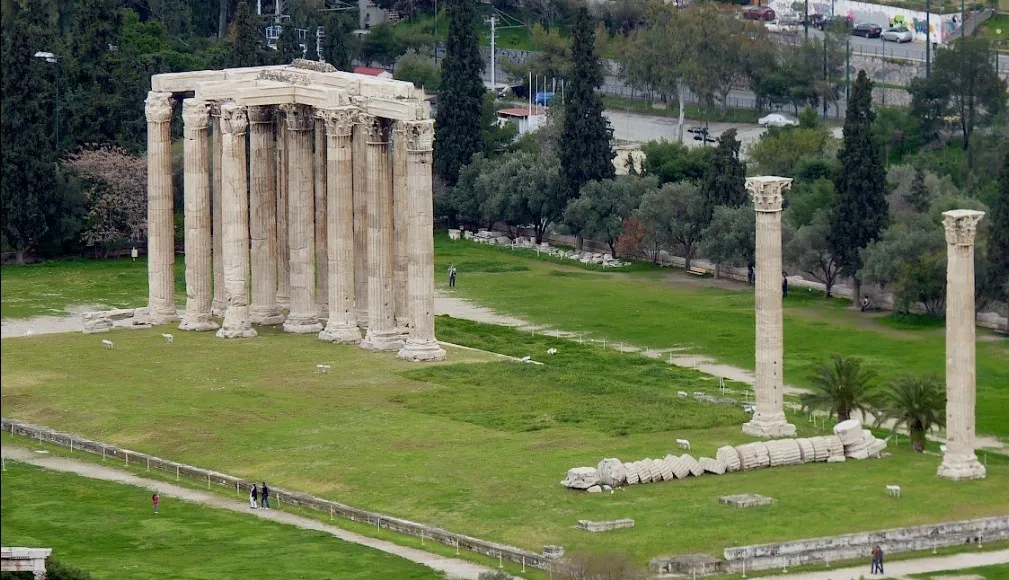
The temple once had more than 100 Corinthian columns. Fifteen remain standing, their height and spacing making the scale of the original structure easier to imagine. The open site leaves room to see the columns from different angles and notice how they dominate the grounds even in their ruined state.
The surviving columns are the main focus, but the Olympieion archaeological site also contains traces of Roman baths, Classical residences, a fifth-century basilica and part of the city’s fortification wall. These remains offer a wider view of how the area changed over time. The temple itself was damaged after its completion and was later pillaged; much of its original architecture is gone.
Hadrian’s Arch and the wider walk
Hadrian’s Arch stands just outside the temple grounds. Its well-preserved marble structure makes a natural companion stop, and the two landmarks are close to the Acropolis Museum. Together they fit easily into a longer walk through central Athens.
The temple is also a useful point on a route linking the National Garden, the Acropolis slopes and other ancient sites. From here, Dionysiou Areopagitou leads past the Theatre of Dionysus and the Odeon of Herodes Atticus. The site works well as one stop on that route, especially if you want to see the surviving columns and the arch without planning a separate, lengthy visit.
FAQ
How long do you need at the Temple of Olympian Zeus?
Allow about 30 to 60 minutes to explore the grounds and see the columns.
Can you see the Temple of Olympian Zeus without entering?
Yes. The temple can be viewed from outside the grounds, including near Hadrian’s Arch.
What remains of the Temple of Olympian Zeus?
Fifteen Corinthian columns still stand. The archaeological site also includes remains of Roman baths, Classical residences, a fifth-century basilica and part of a city wall.
When was the Temple of Olympian Zeus built?
Construction began in the sixth century BC and was completed in the second century AD under the Roman emperor Hadrian.