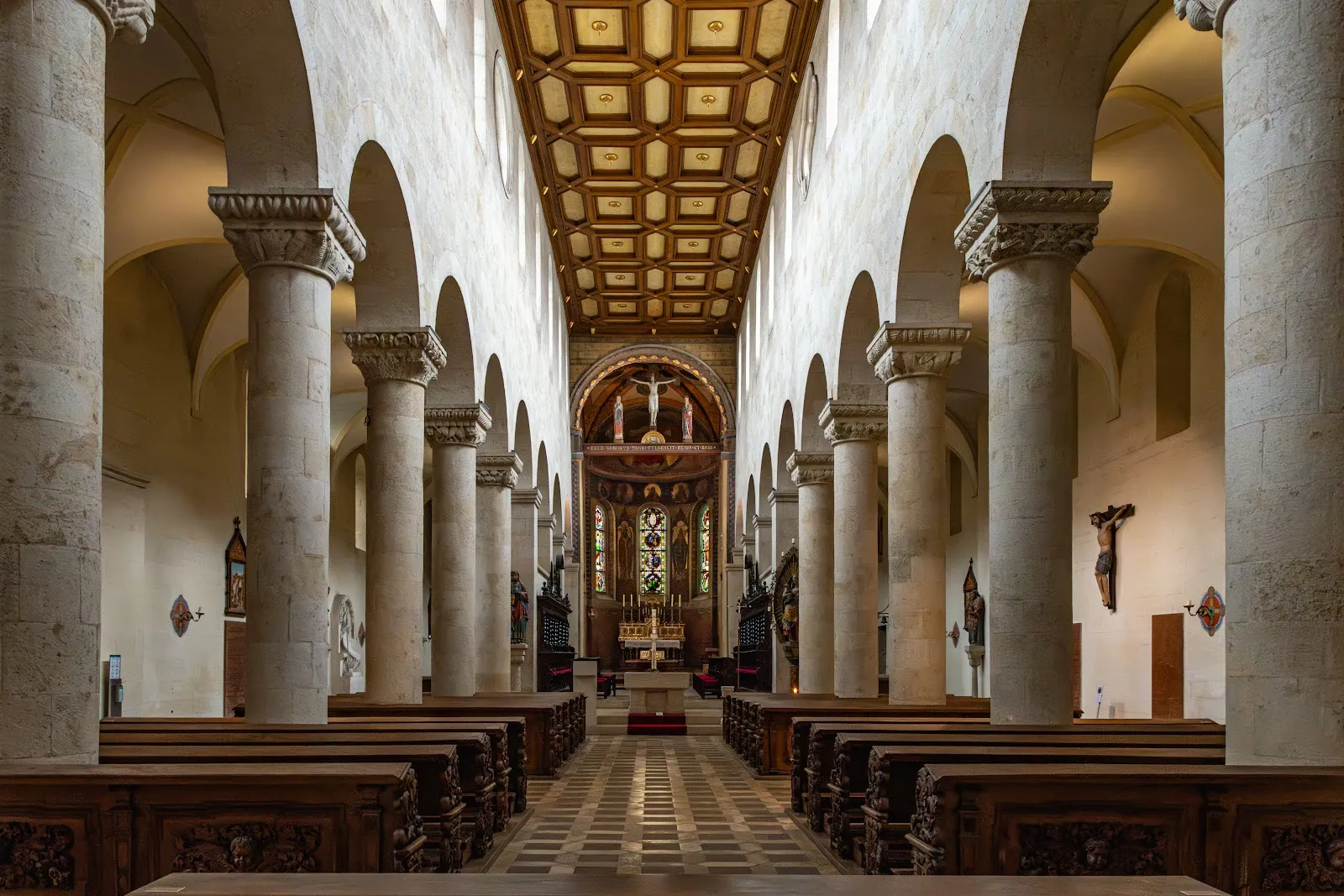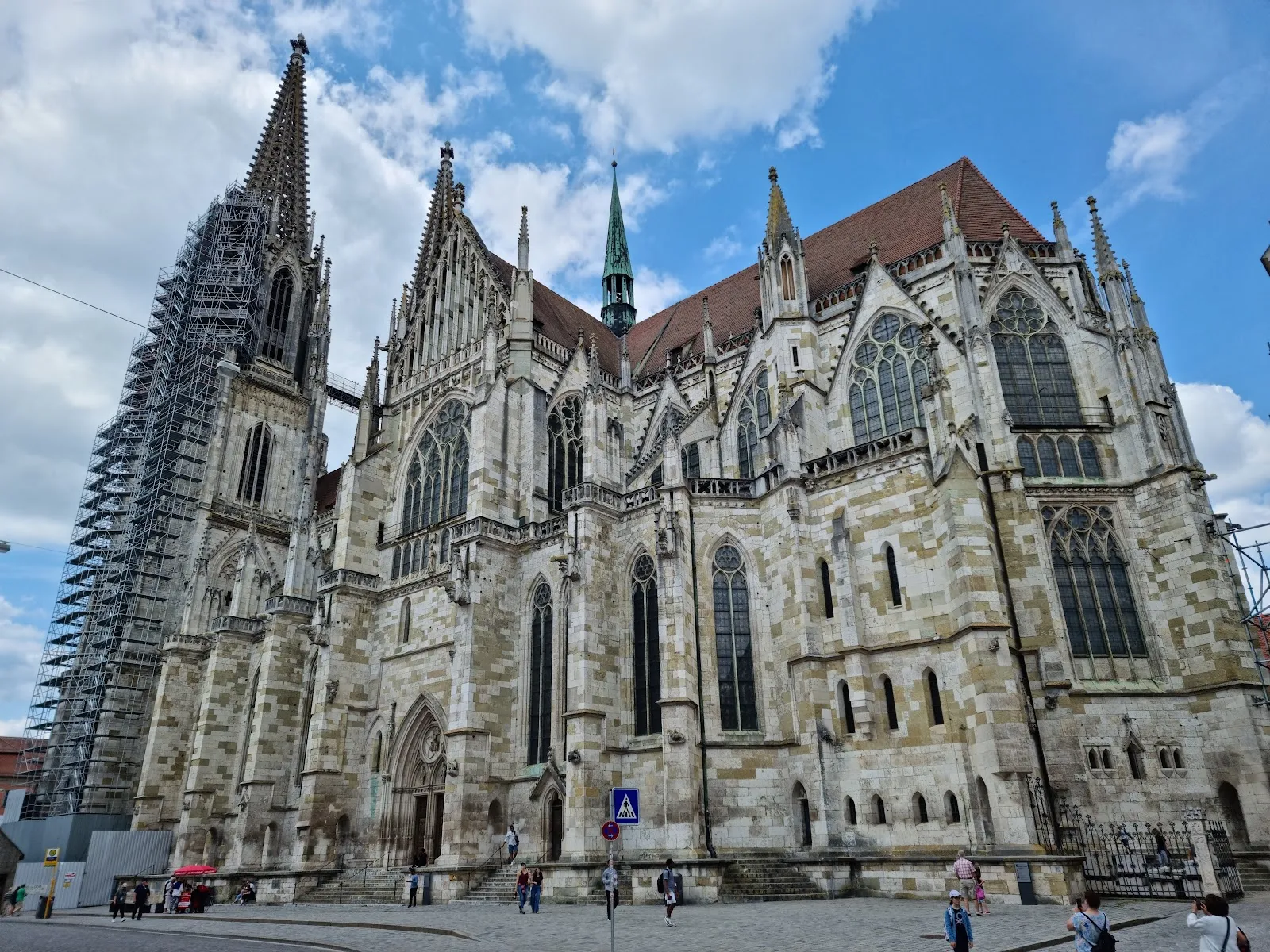
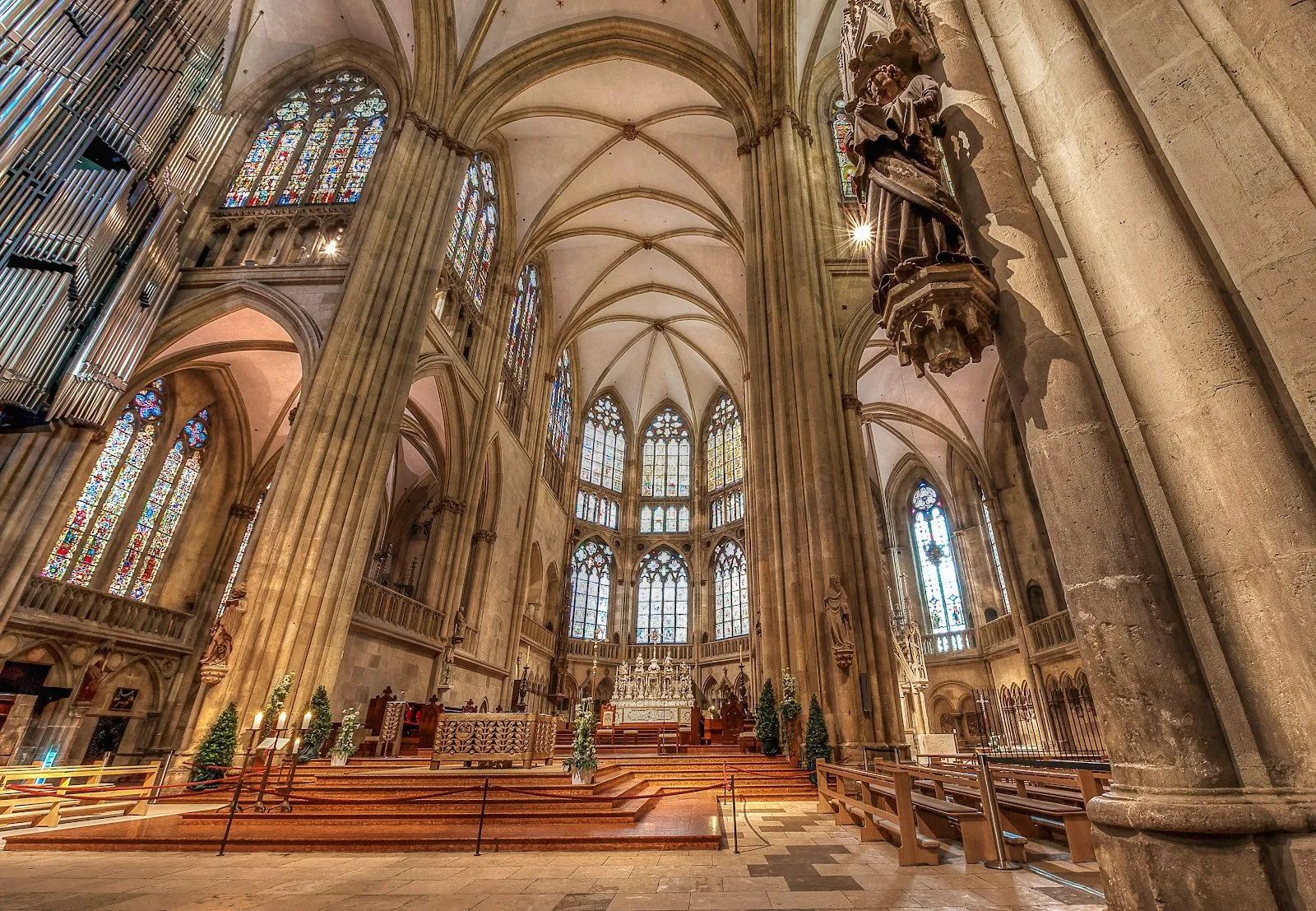
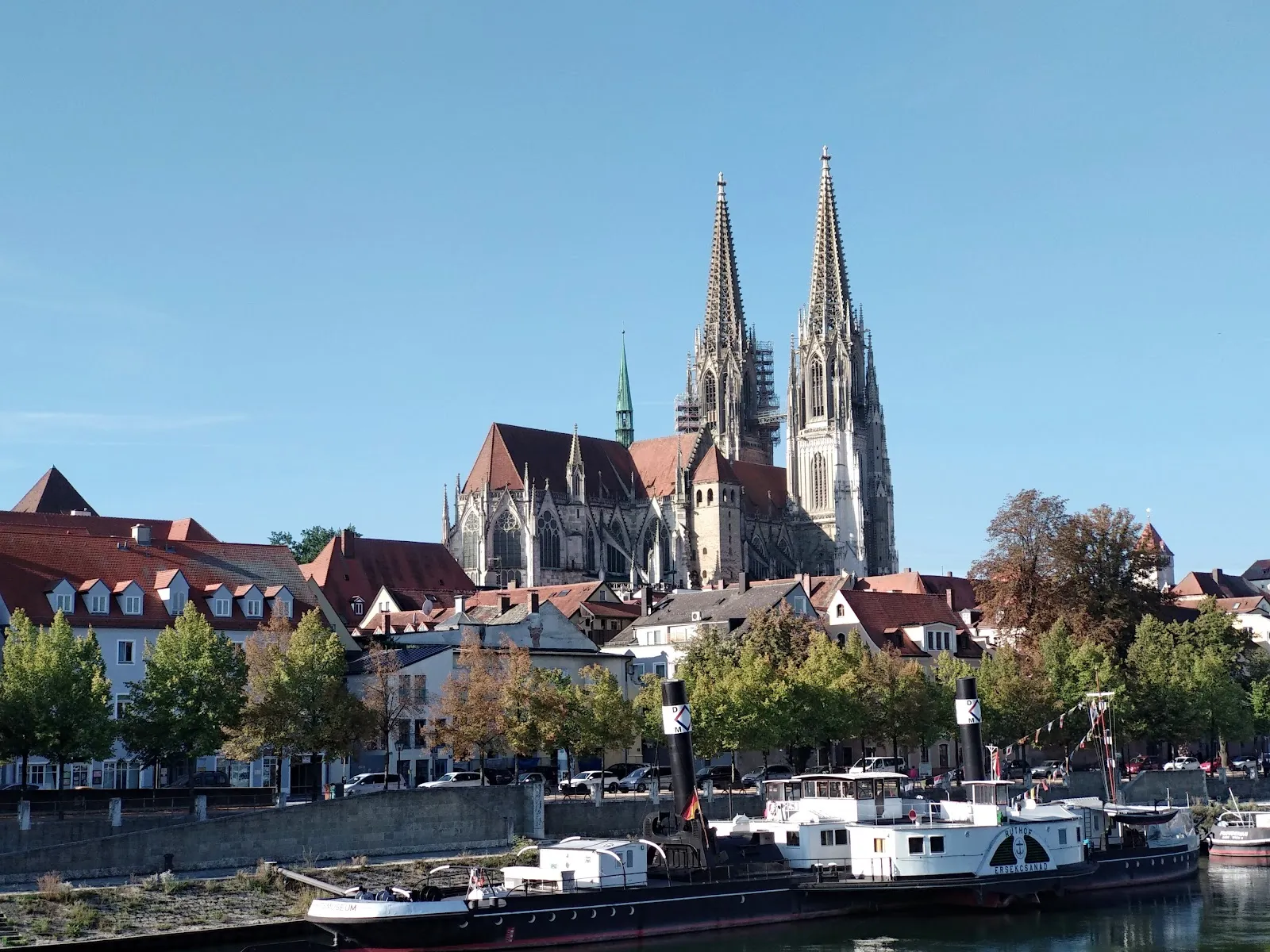
St. Peter Cathedral, also known as Regensburg Cathedral, is the Gothic church at the center of the old town in Bavaria. Its twin spires can be seen from much of the city, and they help you find your way back through the narrow lanes. Inside, the medieval stained glass from the 13th and 14th centuries and the silver-sheathed main altar are the highlights. Entry to the church is free. Walk around the outside first, then go in.
From an early church to the Gothic cathedral
An early church stood on this site, and it is recorded as built around the year 700. It was later destroyed by fire. Work on the Gothic cathedral began in 1275, and construction continued for about two centuries, into the 1500s. The two tall towers were added later, in the 19th century, and were finished in the 1860s.
The Gothic style was not the only one to leave a mark. Baroque features were added in the 17th century, and Neo-Gothic restorations were carried out under King Ludwig I. A small tower from the earlier Romanesque cathedral survives on the north side. It has a greenish roof and is called the Eselsturm.
Today the cathedral is the seat of the Catholic Diocese of Regensburg, and it remains an active place of worship.
The outside: facade, statues and towers
The facade is a patchwork of two stones: pale limestone and greenish sandstone. The mix is one of the first things to notice from the square. The main portal, the facade and the towers carry a large amount of statues and ornament. Look up for kings on horseback, the foolish virgins, and gargoyles with animal and human faces.
The cloister is older than the current church, and it is not connected to it. Behind the cathedral, a maintenance yard holds stone pieces from the building's long history.
Inside the church
The interior is dim, so your eyes need a few moments to adjust. Then the windows take over. The stained glass from the 13th and 14th centuries is the most extensive preserved collection of medieval stained glass in the German-speaking world. The main altar is sheathed in silver. Some of the columns still show a reddish tint, a hint of how brightly the Gothic interior was once decorated.
The church is a triple-nave building about 82 meters long and 32 meters wide, and it can hold around 6,000 people. Inside, a large well with a hoist and bucket once supplied water to the clergy, cathedral staff and cleaners. It is one of the less expected details in the building.
The Romanesque All Saints' Chapel and the Carolingian Stephanskapelle in the cloister area can only be seen on a guided tour.
Music and the midday pause
The cathedral has a pipe organ that is considered one of the finest in the world. In summer, it plays at noon every day, and the sound fills the whole church.
The Domspatzen boys' choir has a very long history. It sings at the 10am Sunday service during the school year. At noon on other days, a 15-minute meditation closes the church for a short time before it reopens.
Visiting in practice
Entry to the church is free. The entrance and the parking lot are both wheelchair accessible. The cathedral treasury, the Domschatzmuseum, is a separate museum with monstrances, tapestries and other church treasures.
The Alte Kapelle, south of the cathedral, has a plain exterior and a rich rococo interior, so it works well as a next stop.
FAQ
Is there an entry fee for St. Peter Cathedral?
Entry to the church is free. The cathedral treasury, the Domschatzmuseum, is a separate museum.
Can you visit the cathedral during Sunday mass?
Visitors cannot enter from noon to 1pm on Sundays during mass, unless they are attending the service.
Is St. Peter Cathedral wheelchair accessible?
Yes. The entrance and the parking lot are both wheelchair accessible.
What is the cathedral's most famous feature?
The stained glass from the 13th and 14th centuries is the most extensive preserved medieval collection in the German-speaking world.