Zugspitze is Germany's highest mountain, at 2,962 metres above Garmisch-Partenkirchen in the Bavarian Alps. Its summit lies on the border with Austria, so you can stand in both countries during one visit. Routes to the top combine a cogwheel train with a cable car, and the journey is scenic in its own right. On a clear day the views reach across Austria, Switzerland and Italy. The glacier below the summit has snow, ski runs and sledding, in winter and summer alike.
The border and the first railway
The border between Germany and Austria has run across the western summit since 1766. By the end of the nineteenth century, people were already discussing a railway to the top of the mountain. The Bavarian Zugspitzbahn was not finished until 1930.
That line is a rack railway. It climbs to a glacier station at 2,588 metres on the Zugspitzplatt. From there, a gondola of the Gletscherbahn carries riders to the top station.
Getting to the top
From Germany, the usual route combines the cogwheel train with a cable car. Trains from Garmisch-Partenkirchen reach Lake Eibsee, and the Eibsee cable car climbs from there to the summit. The cable car ride takes about 10 minutes. Riders who want a longer route can take the cogwheel train to the glacier station and continue by the Gletscherbahn gondola.
From Austria, the cable car starts at a station just outside the village of Ehrwald. This is the less crowded way up, which makes it a good choice for a visit that begins across the border. Round trip tickets help you plan the day, and it is worth buying them in advance during peak season.
On the summit
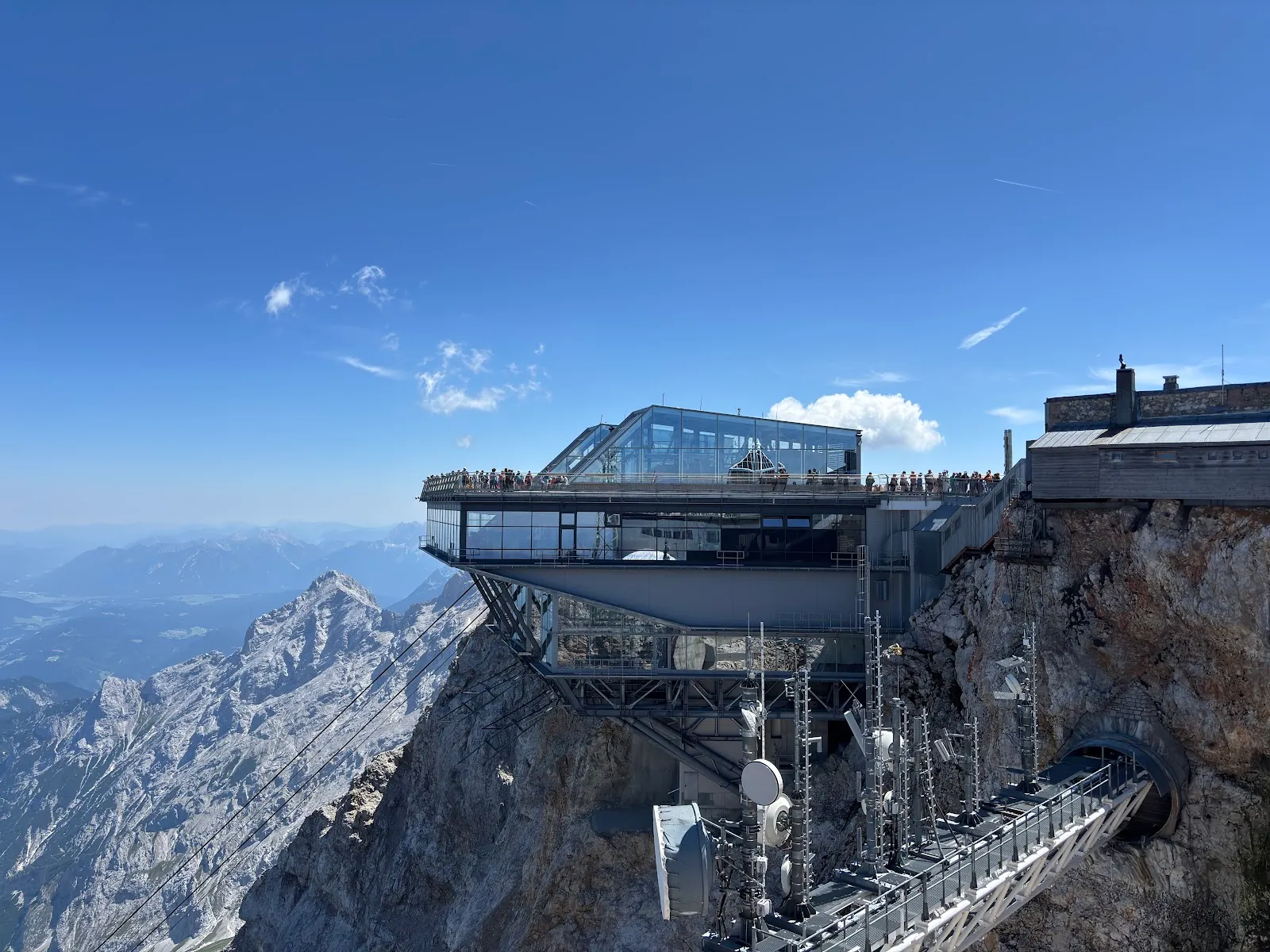
The summit building has several observation decks. From them you can look across into Austria, since the summit platform sits on the border. The building also has a weather station and a small museum. Its tower-like section was built by Adolf Wenz in 1900, and it was once a royal high observatory. Memorial plaques honour Wenz and Josef Enzensperger.
Restaurants at the top serve meals with the view. On the mountain you will also find an old border control post, where skiers once had to show their passports to reach the German slopes. A passport stamp is available at the summit, so bring your passport if you want one.
Views and conditions
On a clear day you can see more than 400 mountain peaks in four countries. Cloud often covers the summit, so check the forecast before you set out. The views depend on the weather at the top, not at the valley.
The summit is cold even in summer. A warm layer and a windproof jacket make the time at the observation decks more comfortable.
The glacier in winter and summer
The glacier area sits at about 2,600 metres. It has more than 20 km of pistes with natural snow, which lasts for about six months of the year. The slopes are groomed, and there are ski lessons and rental stations. Intermediate skiers will find challenging runs here.
In summer, the glacier has sledding runs, and children play in the snow. Sun terraces and a restaurant on the Zugspitzplatt make a good stop between the trains and the summit.
FAQ
How do you get to the top of Zugspitze?
From Garmisch-Partenkirchen, take a cogwheel train to Lake Eibsee and then the Eibsee cable car to the summit, or ride the cogwheel train to the glacier station and continue by the Gletscherbahn gondola. From Austria, a cable car starts near the village of Ehrwald.
How long do you need at Zugspitze?
Plan at least a couple of hours, and allow more if you want to walk around the glacier or ride a sledge in summer.
What should I wear on Zugspitze?
Wear layers. The weather changes quickly, and it is cold at the top even in August.
When is the best time to go?
Go early on a clear day. Cloud often hides the summit, and the road to Eibsee gets crowded by late morning.
Can you cross into Austria at the top?
Yes. The summit platform sits on the border, so you can step between Germany and Austria from one place.