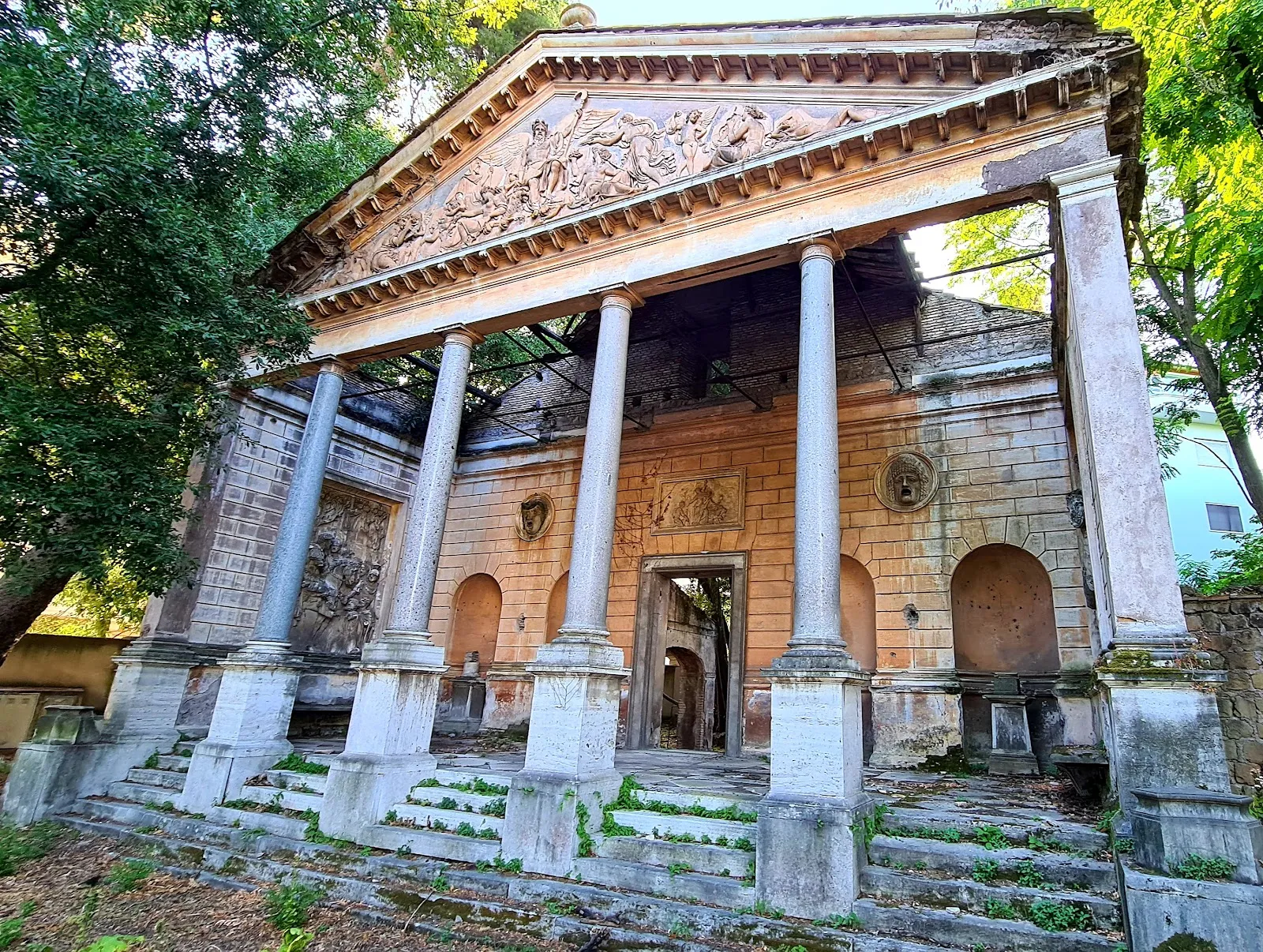
In Rome’s Villa Torlonia, the Temple of Saturn is a 19th-century imitation of an ancient temple, set along the path to the Casina delle Civette. Its unfinished porch has four grey granite columns with Doric capitals, and a terracotta relief of Saturn and the four seasons fills the triangular pediment. Inside, plaster casts reproduce two reliefs from the Arch of Marcus Aurelius. The structure is fenced off, so you can see it from outside as you explore the villa grounds.
An unfinished temple in Villa Torlonia
The Temple of Saturn stands in Villa Torlonia, along the path to the Casina delle Civette. It was built around 1838 by architect and painter Giovan Battista Carretti as an imitation of an ancient temple. The structure was never completed: it consists of a porch, with no rear section.
Four grey granite columns with Doric capitals divide the steps into five sections. The triangular pediment above them contains a terracotta high relief from the first half of the 19th century. Saturn appears at its centre, represented as an elderly, winged figure wearing a crown; allegorical figures and symbols of the four seasons flank him.
Reliefs inside the porch
Two large plaster reliefs inside the porch are casts of carvings in Rome’s Palazzo dei Conservatori on the Capitoline Hill. They reproduce two of the three reliefs associated with the Arch of Marcus Aurelius: the Triumph and the Clemency of the emperor. One depicts Marcus Aurelius in a toga on a chariot.
The temple is fenced off, so visitors view it from outside. Its position on the route to the Casina delle Civette makes it a brief stop while walking through Villa Torlonia.
Preguntas frecuentes
Where is the Temple of Saturn in Rome?
It is in Villa Torlonia, along the path leading to the Casina delle Civette.
Can you go inside the Temple of Saturn?
No. The structure is fenced off and can be viewed from outside.
What can you see on the temple?
The pediment has a terracotta relief of Saturn and the four seasons. Inside the porch are plaster casts of two reliefs associated with the Arch of Marcus Aurelius.


