
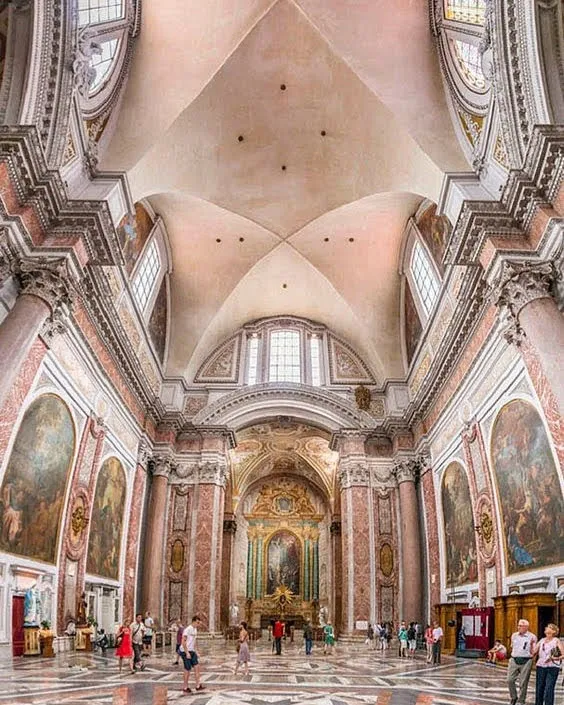
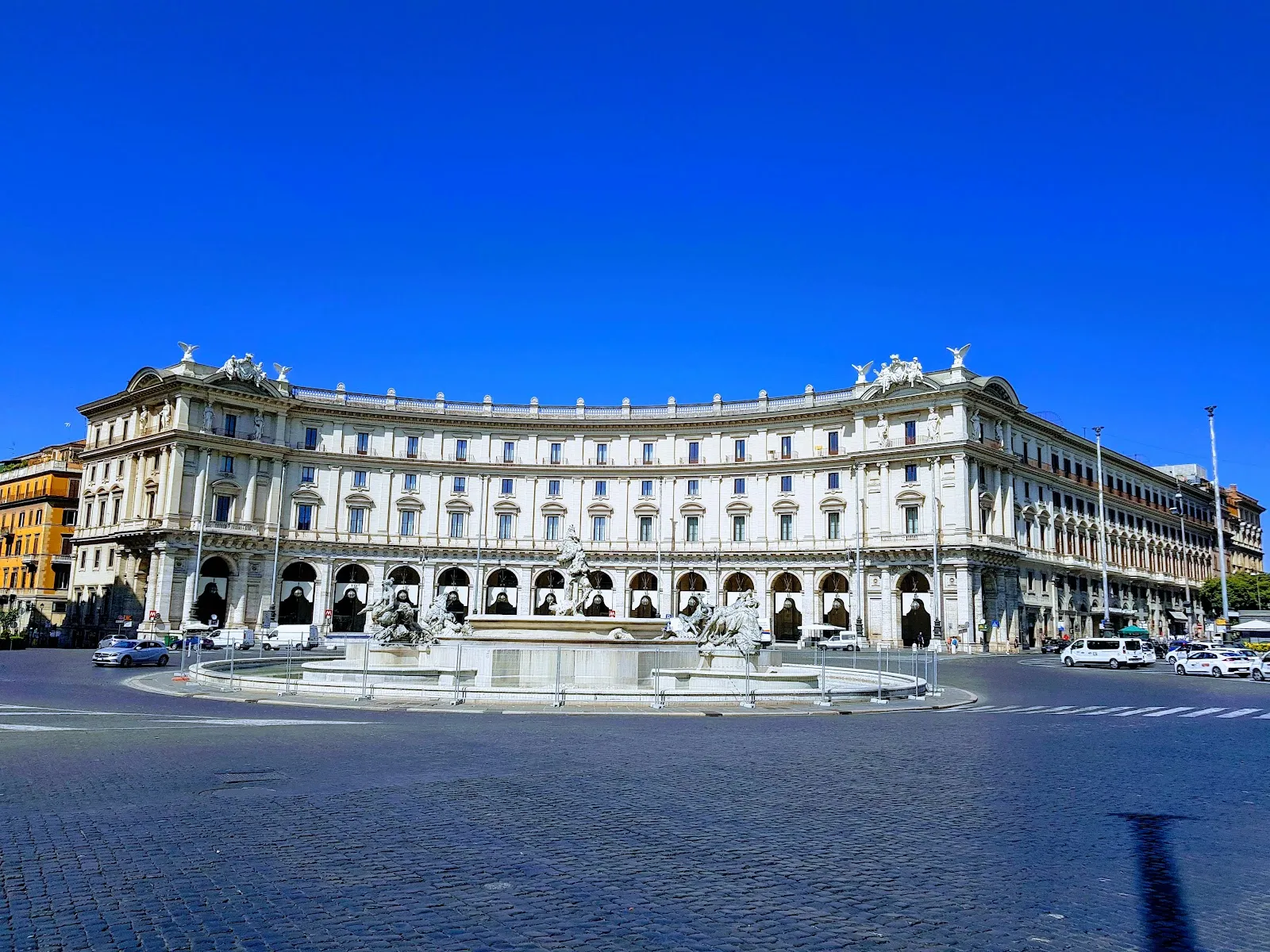
The Basilica of Saint Mary of the Angels and Martyrs stands on Piazza della Repubblica, close to Termini Station, inside the ruins of the Baths of Diocletian. Michelangelo designed the church in the sixteenth century and kept the Roman walls visible. You enter through an old bath apse, the former warm room forms the transept, and a meridian sundial marks the midday sun. Inside it is calm and full of art, and an organ is sometimes played. Entry is free.
From baths to basilica
The church sits inside the Baths of Diocletian, the large public bathing complex of ancient Rome. The site lay unused for centuries before it was reshaped.
In the mid-sixteenth century, a priest named Antonio Lo Duca had a vision that led him to dedicate the place to the seven Archangels. The Carthusian Order agreed to build a charterhouse on the spot, and the current basilica was the church of that monastery. In the sanctuary is the icon of Our Lady of the Angels that Lo Duca commissioned.
The dedication later widened to include the Christian martyrs of the age of Diocletian, the last great persecutor of Christians in Rome. Seven of these saints are remembered here. According to tradition, they worked on building the baths before they were martyred. The church holds tombs and relics of martyrs.
Michelangelo's design
The Pope entrusted Michelangelo with turning the bath site into a church. He accepted while still working on the Sistine Chapel. Michelangelo kept the ancient Roman structures visible instead of covering them.
Today you enter through one of the apses of the ancient caldarium, the hot room of the baths. The current transept occupies what was once the tepidarium, the warm room.
To raise the church to the height he wanted, Michelangelo lifted the floor by about two meters, so that he could use rose granite columns around 15 meters tall. The result is a large interior that shows how big the public baths were.
The cloister and the nearby museum
The former Charterhouse cloister is not reached from the church itself. To see it, go to the epigraphic section of the Museo Nazionale Romano Terme di Diocleziano, next to the basilica. The section gives access to the ancient cloister.
The Charterhouse was suppressed twice, first during the French occupation and then at the time of Italian Unification. Many churches in Rome went through a similar pair of closures.
The sundial and the meridian line
A meridian line crosses the church as part of a line that runs across Rome. Every day, between 11:54 and 12:14, sunlight passes through a small gap in the ceiling and falls on the line.
If you want to see the light on the line, plan your visit for that window. Outside those minutes, the line is simply part of the floor.
Preguntas frecuentes
Is there an entry fee?
Entry is free. The basilica is open to visitors without a ticket.
When can I see the sundial light?
Sunlight falls on the meridian line every day between 11:54 and 12:14. Plan to arrive a little before 11:54 so you have time to find the line.
Can I take photos inside?
Photography is allowed inside. Because it is a sacred space, keep the shots discreet and quiet.
How do I see the cloister?
Go to the epigraphic section of the nearby Museo Nazionale Romano Terme di Diocleziano, which gives access to the ancient cloister.
Is it close to Termini Station?
Yes, the basilica is on Piazza della Repubblica, close to Termini Station.


