Wat Suthat is a major royal Buddhist temple in Bangkok’s old city, beside the red Giant Swing. Construction began under King Rama I in 1807 and was completed during King Rama III’s reign. Inside the main assembly hall, Phra Si Sakyamuni, a large bronze Buddha from the Sukhothai period, sits beneath detailed murals depicting Buddhist stories and teachings. Take time to look around the spacious grounds and the smaller shrines, too. The temple is often a quieter stop than Bangkok’s best-known temple sites, with room to pause and explore.
A royal temple built over three reigns
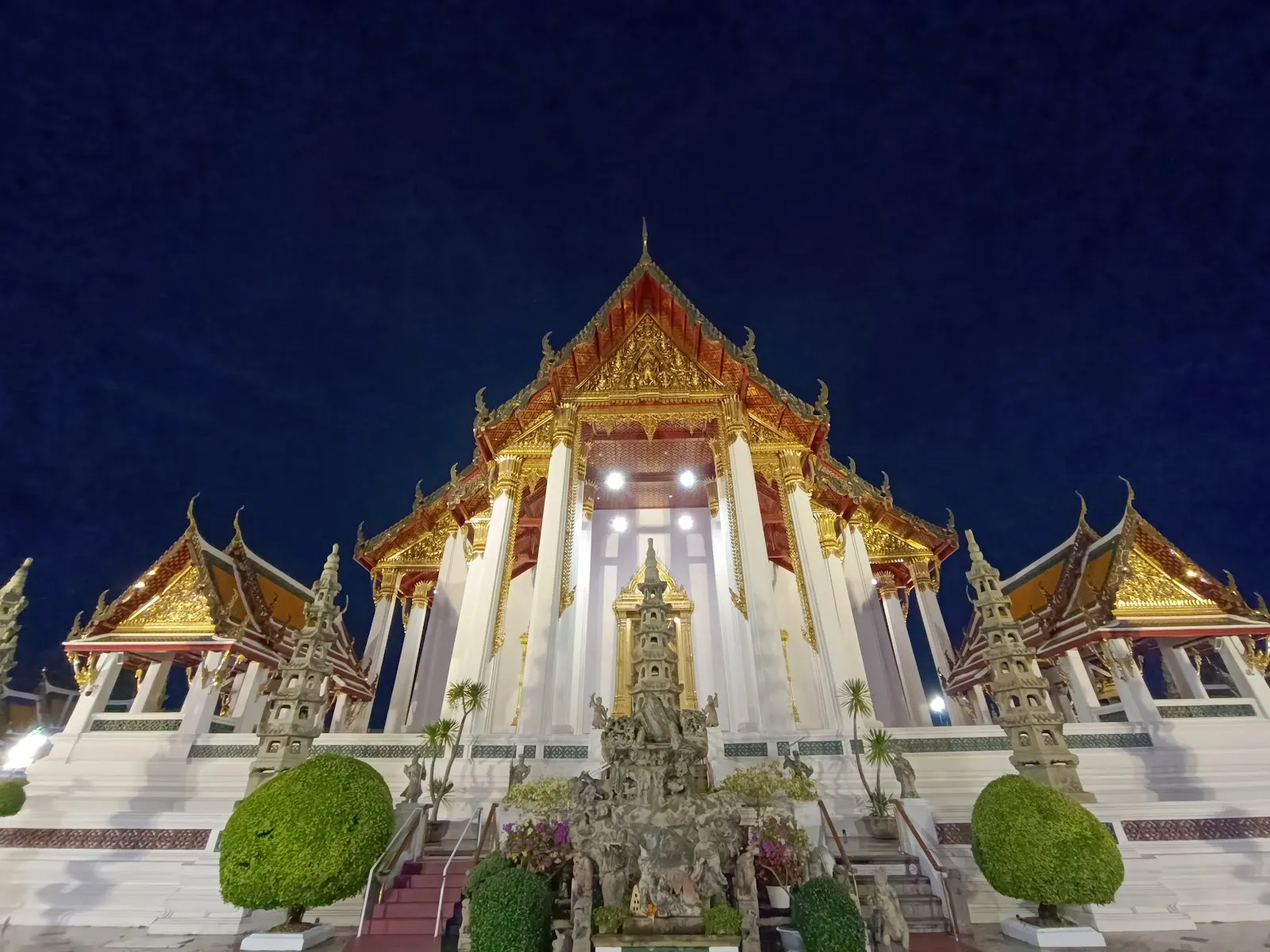
Construction of Wat Suthat began in 1807 under King Rama I. Work continued during the reign of King Rama II, who is said to have helped carve the wooden doors, and the complex was completed under King Rama III in 1847 or 1848. The temple is one of Bangkok’s first-class royal temples.
Its location beside the Giant Swing connects the temple grounds with an older ceremonial landscape. The swing dates to 1784 and was used in a Brahmin ceremony in which young men tried to reach a suspended bag of silver. After fatal accidents, the ceremony was discontinued in 1935. Today the red structure remains a prominent landmark outside the temple.
Phra Si Sakyamuni and the murals
The main assembly hall, or viharn, houses Phra Si Sakyamuni, a large bronze Buddha image from the Sukhothai period. It was brought to Bangkok from the former capital of Sukhothai. The Buddha sits in the earth-touching posture, and the base holds the ashes of King Ananda Mahidol, Rama VIII.
Murals inside the viharn depict Buddhist narratives, including the Three Worlds and the lineage of the 28 Buddhas. They date to the 1830s and 1840s. Look closely at the painted scenes as you move through the hall; their stories are part of the temple’s religious imagery, not simply decoration.
Details around the compound
The ubosot, or ordination hall, contains another Buddha image, Phra Buddha Trilokachet. Its murals show episodes from the Buddha’s life. The hall is regarded as the longest ordination hall in Thailand.
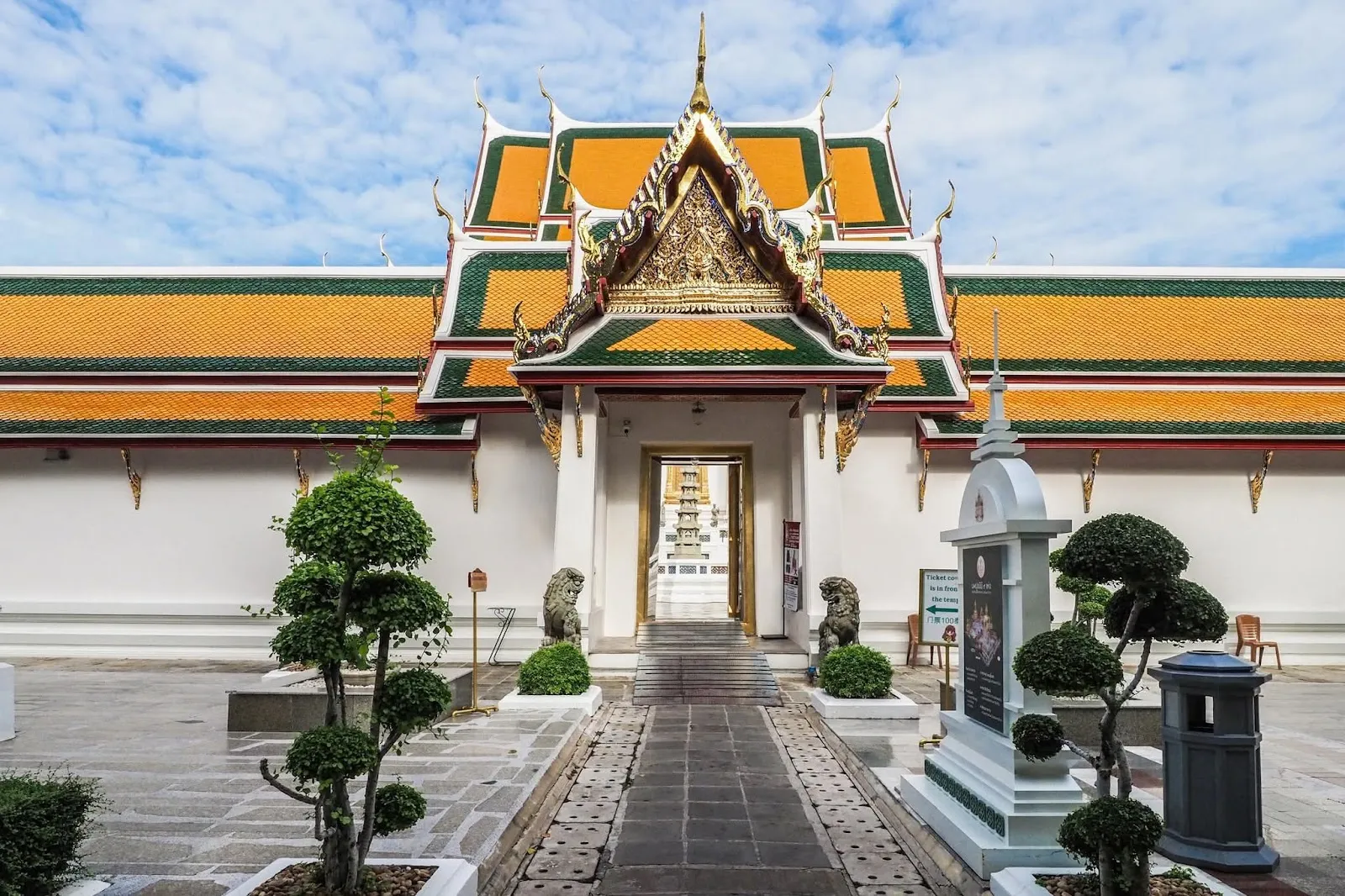
Around the main compound, 28 Chinese pagodas represent the 28 Buddhas in Theravada tradition. Chinese stone figures and numerous Buddha images add detail to the courtyards. Give yourself time to look beyond the main hall, while keeping the quiet, respectful atmosphere of an active place of worship in mind.
Getting there and visiting with care
Sam Yot is the nearest MRT station named in the available directions. From there, the walk to the temple is about 5 to 7 minutes. The temple is on Bamrung Mueang Road in Bangkok’s old city, with the Giant Swing outside its entrance.
Dress modestly for the temple. Shawls are available for visitors who need a covering before entering. Weekday afternoons are suggested for a calmer visit, and a local festival or ceremony can add a view of the temple in use. Check current ticket arrangements before setting out, as the available information gives conflicting details about admission.
Perguntas frequentes
Where is Wat Suthat in Bangkok?
It is on Bamrung Mueang Road in Bangkok’s old city, beside the Giant Swing.
How do you get to Wat Suthat by MRT?
Take the Blue Line to Sam Yot station. The walk from the station is about 5 to 7 minutes.
What is there to see inside Wat Suthat?
The main assembly hall contains the bronze Buddha Phra Si Sakyamuni and murals depicting Buddhist stories. The ordination hall has another Buddha image and murals about the Buddha’s life.
What should you wear to Wat Suthat?
Dress modestly. Shawls are provided for visitors who need a covering before entering.