The Palacio de Bellas Artes is on Avenida Juárez at the edge of Mexico City's Centro Histórico, next to Alameda Central. The exterior is Art Nouveau, with white Carrara marble and a dome of orange and yellow tiles. The interior is Art Deco. Inside are the National Museum of Architecture, galleries with temporary exhibitions, 17 murals by Diego Rivera, José Clemente Orozco, David Alfaro Siqueiros and others, and a theater with a glass curtain made by Tiffany. It is also a working concert hall, used by the National Symphony Orchestra, the opera company and the Ballet Folklórico de México.
From 1904 to 1934
Construction began in 1904 under the government of Porfirio Díaz. The Italian architect Adamo Boari directed the work, on the site where the National Theater had stood until 1901. The building was meant to replace that theater and to be ready for the 1910 centenary of Mexican independence.
It was not ready. The soft ground under the building caused problems, and the Mexican Revolution interrupted the project, which was halted in 1913. The Mexican architect Federico Mariscal took over later and finished the palace in 1934.
The long gap explains the building's two faces. The exterior belongs to the early 20th century and its Art Nouveau style, while the interior was completed in the Art Deco style of the 1930s. Mexicans often call the palace the cathedral of art.
The exterior and the plaza
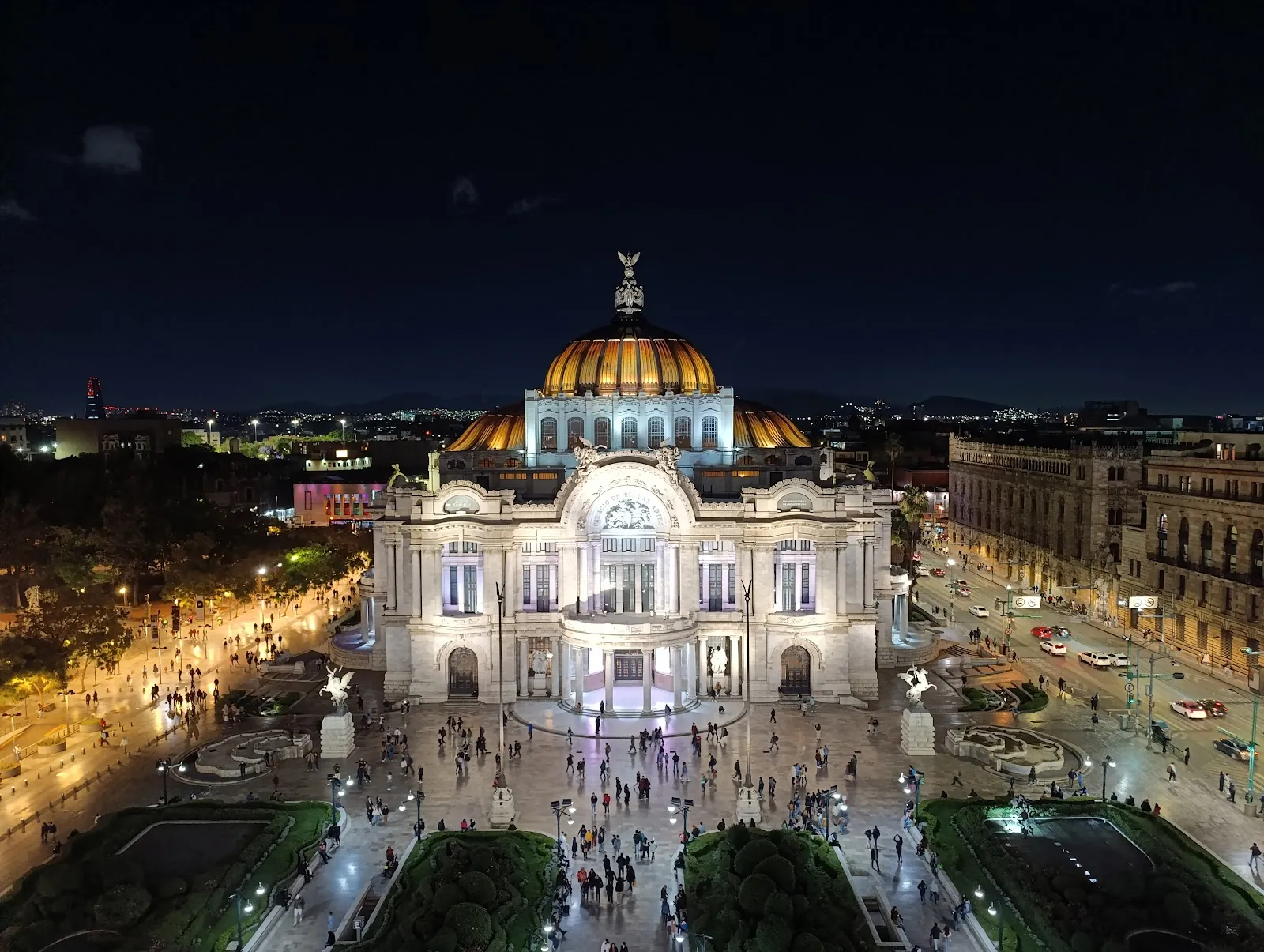
The facade is white Carrara marble combined with ironwork, with sculptures at the entrance and across the plaza. Three rotundas are covered in yellow and orange tiles, and the dome is visible from several blocks away. It catches the light at sunset.
Look closely at the Art Deco details, including the stylised masks of Tláloc, the rain god. Walking the full perimeter of the building shows decorative work that photographs from the front miss.
The plaza changes in the evening, when the building is lit in color and the square fills with people. Daytime and night give quite different impressions of the same place.
Murals and galleries
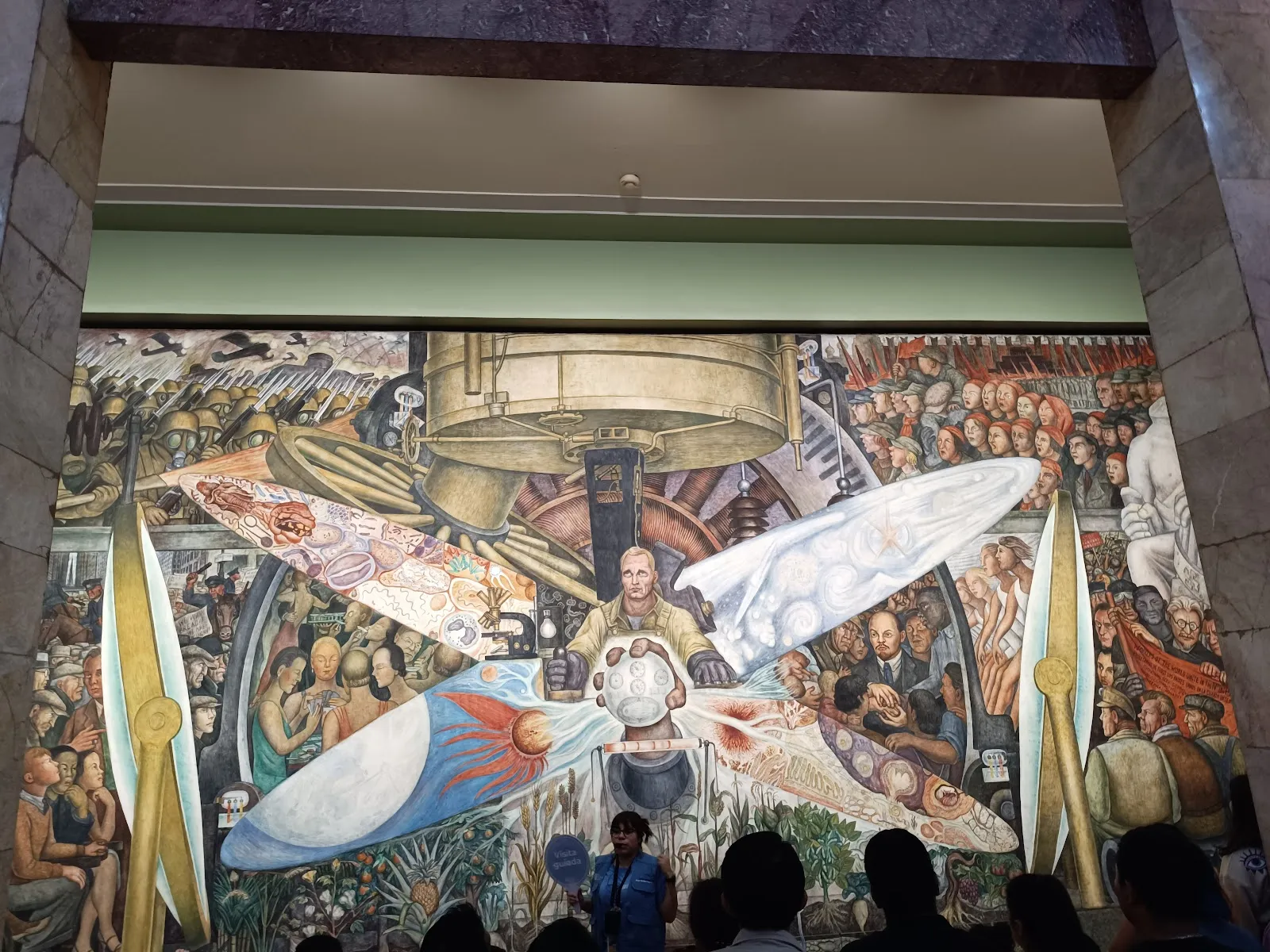
The third floor holds 17 murals by seven Mexican artists, painted between 1928 and 1963. Diego Rivera's Man at the Crossroads, from 1934, is a recreation of the mural he painted for Rockefeller Center in New York. The New York version was destroyed after it was judged too controversial. José Clemente Orozco's La Katharsis dates from the same year, and David Alfaro Siqueiros's Tormento de Cuauhtémoc from 1951.
Other artists represented include Rufino Tamayo, Roberto Montenegro, Jorge González Camarena and Manuel Rodríguez Lozano.
The palace also has four galleries with temporary exhibitions of painting, photography and sculpture, and a collection of 19th and 20th century Mexican art. The National Museum of Architecture is on the top floor. Its subject is the importance of preserving the country's architectural heritage.
The interior has marble floors, grand staircases and tall glass windows, so the walk between rooms is part of the visit.
The theater and its performances
The theater's stage curtain is made of glass, not fabric. Tiffany's workshop in New York built it from nearly a million pieces of iridescent colored glass. The design, by Gerardo Murillo, known as Dr. Atl, shows the volcanoes Popocatépetl and Iztaccíhuatl.
The hall is the home of the National Symphony Orchestra, the Chamber Orchestra of Bellas Artes and the National Opera Company. The Ballet Folklórico de México performs here twice a week. The company was founded in 1952 by the dancer and choreographer Amalia Hernández with eight members. Evening programs also include plays and galas.
Seeing the curtain generally means attending a performance. If a show is on your list, book ahead, as advance tickets are recommended.
Planning around the palace
The entrance and the restrooms have wheelchair access, and there is a wheelchair accessible parking lot. A free guided tour in Spanish has been run on Tuesday to Friday at 1 pm and 1:30 pm. Confirm the current schedule on the official site before you plan around it.
Alameda Central, one of the oldest public parks in the Americas, is next door and makes an easy walk before or after the visit. The Museo Nacional de Arte (MUNAL) is also close by.
Perguntas frequentes
Is there an entry fee at the Palacio de Bellas Artes?
Yes, the museum charges for entry. One guide lists free entry on Sundays and for students, teachers, seniors and children under 13. Prices and rules change, so check the official site at palacio.inba.gob.mx.
How long do you need at the Palacio de Bellas Artes?
Allow 2 to 3 hours to see the murals, the galleries and the building itself. A performance takes extra time.
Can you take food, drinks or bags inside?
No food or drinks are allowed. The bag check takes only backpacks and suitcases, so other types of bag need to stay elsewhere.
What is the best view of the Palacio de Bellas Artes?
The café on the 8th floor of the Sears store across the street looks straight onto the palace and its dome. Buy a drink and take a seat by the edge, ideally near sunset.
Can you see a show at the Palacio de Bellas Artes?
Yes. The building hosts concerts, opera, dance and theater, and the Ballet Folklórico de México performs twice a week. Tickets are best bought in advance.