At the tip of Venice’s Dorsoduro district, Santa Maria della Salute marks the entrance to the Grand Canal. Venetians know it simply as the Salute. Built in the 17th century after the plague, the basilica is a landmark of Venetian Baroque architecture, with a broad white dome and a richly sculpted facade. Step inside to see works by Titian and other Venetian artists, or take in the church from the water as a vaporetto approaches from Accademia. The basilica is also a quiet place to pause amid a day in Venice.
A church pledged during the plague
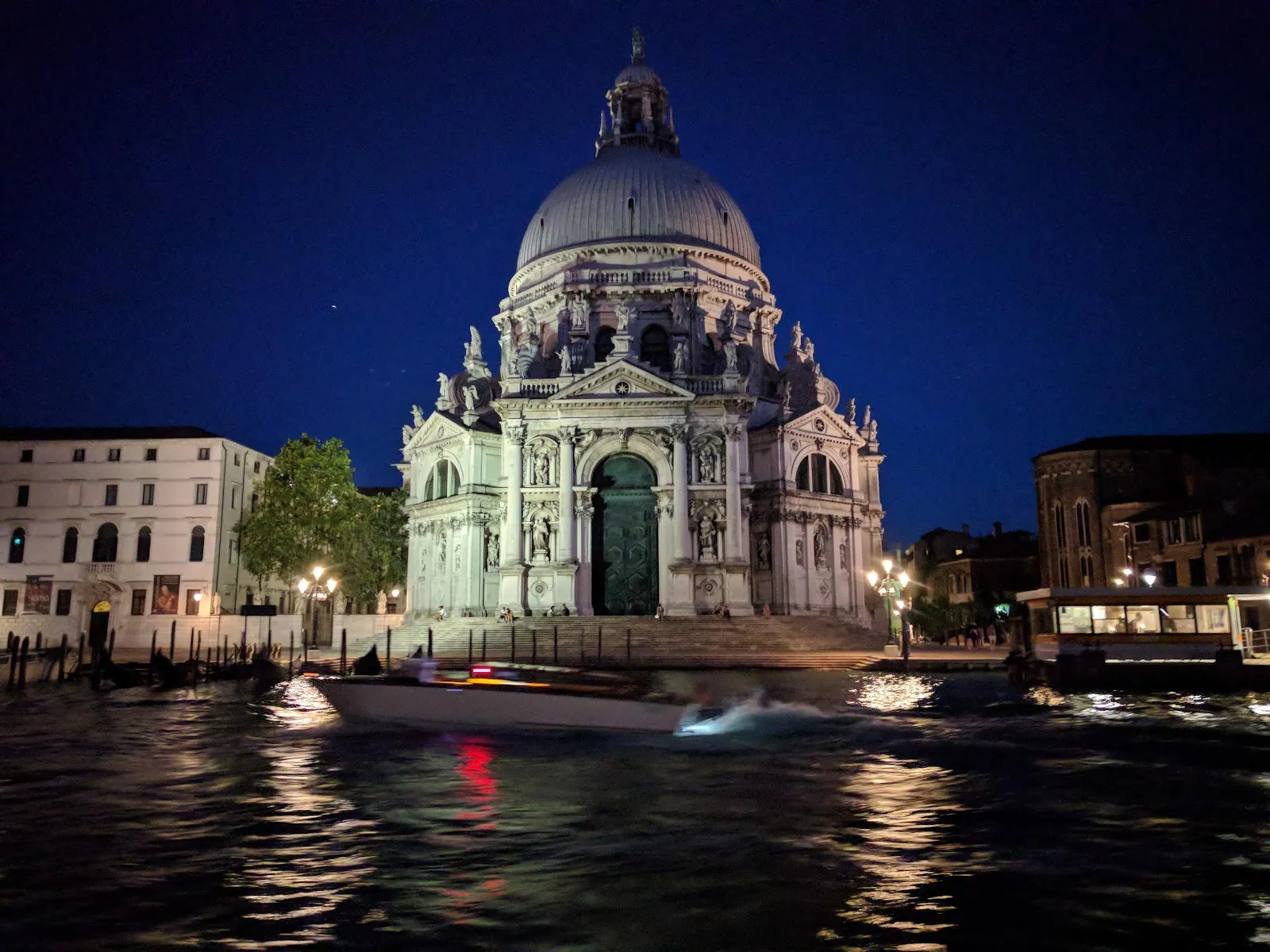
Santa Maria della Salute was built in response to the plague that struck Venice in 1630 and 1631. The epidemic killed tens of thousands of people, including about a third of the city’s population. The Venetian Senate vowed to build a church dedicated to the Virgin Mary if the city survived. The basilica’s name, often shortened to the Salute, refers to health.
Architect Baldassare Longhena won a competition to design the church in 1631. Construction took decades, and the basilica was completed in 1687, five years after Longhena’s death. Its position at Punta della Dogana places it between the Grand Canal and the Giudecca Canal, where the large dome has become a familiar feature of the city’s skyline.
The Baroque exterior
The basilica’s broad white dome and elaborate facade make it easy to recognize from across the water. Its octagonal plan and sculptural decoration are characteristic of Venetian Baroque design. A broad flight of steps leads to the entrance; the facade is adorned with figures, while statues also stand on the building’s exterior supports.
The setting changes with your viewpoint. From the Accademia Bridge, the church forms a landmark at the far end of the Grand Canal. From the water, its domes and pale stone rise above the narrow point of land. The waterfront around San Marco also gives views across the basin toward the basilica.
Art and the Festa della Salute
Inside, the church preserves works by Venetian painters, including Titian and Tintoretto. Titian’s paintings include a ceiling work depicting David and Goliath. In the sacristy, paintings connect the church’s art to the plague and the city’s survival. The interior offers a different experience from the monumental facade, with a quieter atmosphere for looking at the artworks.
The basilica remains the focus of the Festa della Salute, held on November 21. A temporary pontoon bridge is laid across the Grand Canal between the Salute and Santa Maria del Giglio, allowing people to cross to the church for the annual observance. The event commemorates Venice’s deliverance from the plague. It is a particular day to see the church as a place of worship as well as a landmark.
Perguntas frequentes
Is Santa Maria della Salute free to enter?
Entry to the basilica is free.
What artworks can you see inside Santa Maria della Salute?
The basilica preserves paintings by Titian and Tintoretto. Titian’s works include a ceiling painting of David and Goliath.
When is the Festa della Salute?
The annual observance takes place on November 21. A pontoon bridge is set up across the Grand Canal to the basilica.
Where is Santa Maria della Salute in Venice?
It stands at Punta della Dogana in Dorsoduro, at the entrance to the Grand Canal.