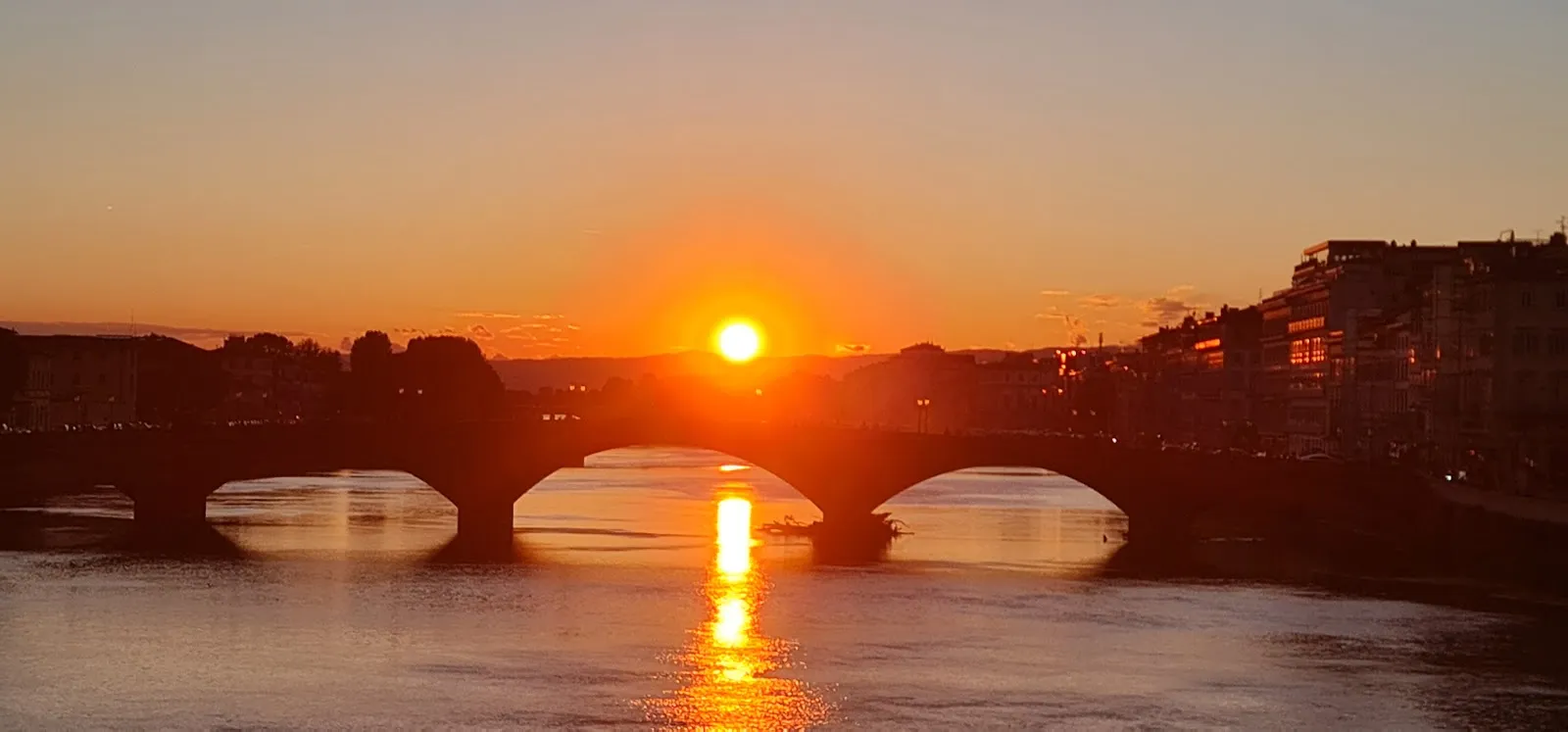
Ponte Santa Trinita crosses the Arno in central Florence, between Ponte Vecchio and Ponte alla Carraia. Its three flattened elliptical arches give the Renaissance stone bridge a distinctive, graceful profile, while statues representing the four seasons mark its ends. Pause mid-span for a clear view of Ponte Vecchio, the river and the buildings along its banks. Early morning brings softer light and fewer people; at dusk, river reflections and the illuminated city change the scene. It is an easy stop on a walk between Florence’s historic centre and Oltrarno.
A bridge shaped by the Arno
A bridge has crossed the Arno at this spot since 1252. The first was built of wood with funding from the Frescobaldi family, but it collapsed in 1259. A stone replacement followed and was swept away in the flood of 1333. The river damaged or destroyed bridges here more than once, and another flood led to the rebuilding of Ponte Santa Trinita in the 16th century.
Cosimo I de’ Medici commissioned the Renaissance bridge, designed by Bartolomeo Ammannati. Construction took place between 1567 and 1571. The design may have been influenced by Michelangelo, though accounts differ on his role. The nearby church of Santa Trinita gave the bridge its name.
Three elliptical arches and four statues
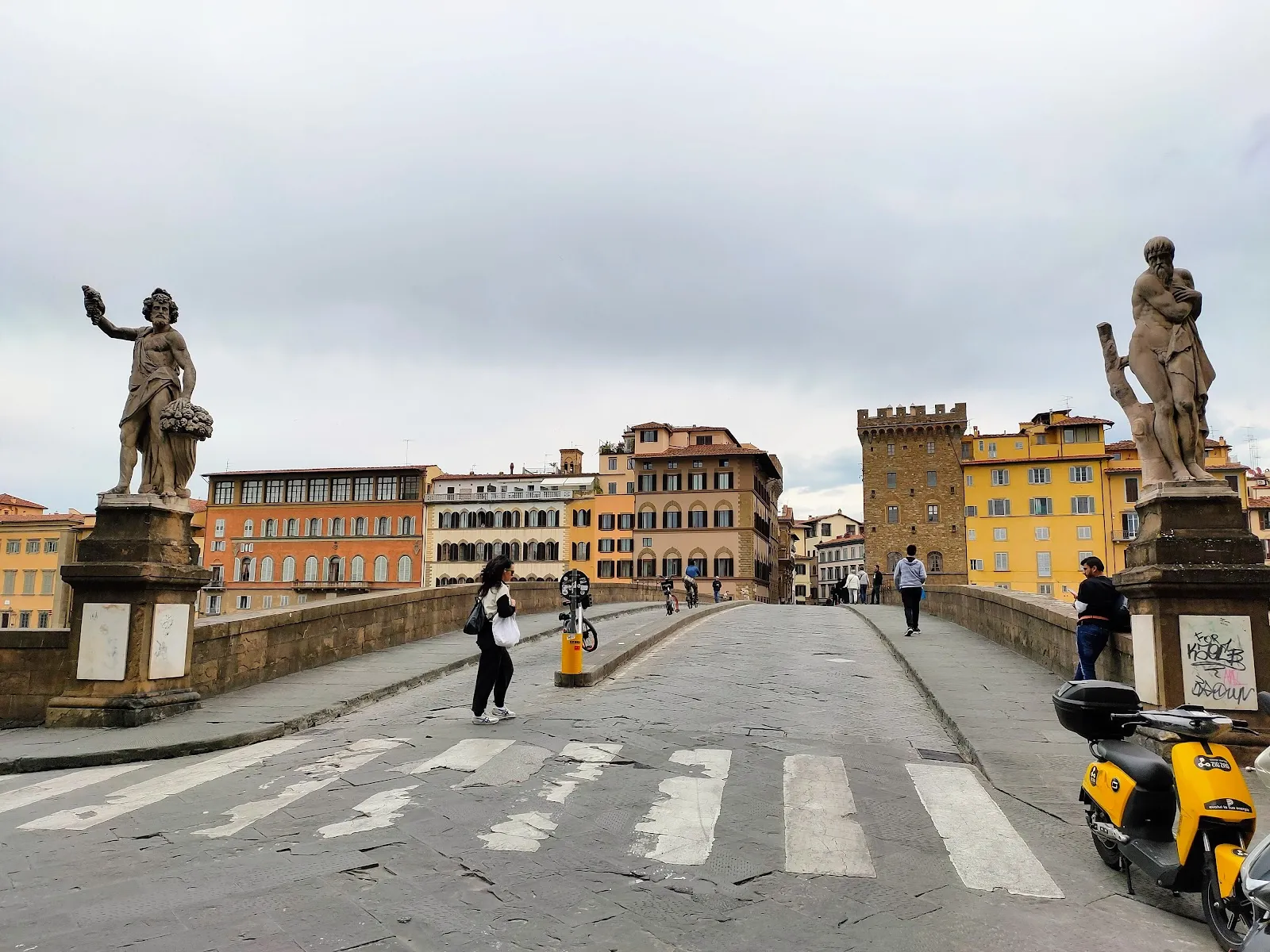
The bridge’s defining feature is its trio of low, elliptical arches. Their flattened curves distinguish it from the rounded arches found on many older bridges. Built of pietra forte, the structure was regarded as an elegant work of Renaissance engineering.
Four allegorical statues representing the seasons stand at the bridge’s ends. The stonework and statues are worth a closer look as you cross. From the span, the Arno opens in both directions, with Ponte Vecchio to the east and Ponte alla Carraia to the west.
Destruction and reconstruction
During the German retreat from Florence in August 1944, Ponte Santa Trinita was destroyed along with most of the city’s bridges over the Arno. After the war, it was reconstructed using many of its original stones, recovered from the river. The bridge you cross today follows Ammannati’s Renaissance design.
Its position makes it a useful place to look back at Ponte Vecchio, whose medieval outline stands out against the riverfront buildings. The view is especially sought after around sunset, when the light changes over the water. In the morning, the bridge is often quieter and the soft light suits photographs. A walk across also gives you a simple route between the historic centre and Oltrarno.
Perguntas frequentes
What can you see from Ponte Santa Trinita?
The bridge looks along the Arno and towards Ponte Vecchio, with Florence’s riverfront buildings on both banks. Its own arches and the statues representing the seasons are also worth a look.
When is the best time to visit Ponte Santa Trinita?
Go early in the morning for softer light and fewer people, or shortly before dusk for sunset views and reflections on the river.
How old is Ponte Santa Trinita?
A bridge was first built at this spot in 1252. The present design dates to the 16th century and was reconstructed after the bridge was destroyed in 1944.
Does Ponte Santa Trinita connect Florence’s historic centre with Oltrarno?
Yes. The bridge crosses the Arno between the historic centre and Oltrarno, close to Ponte Vecchio and Ponte alla Carraia.