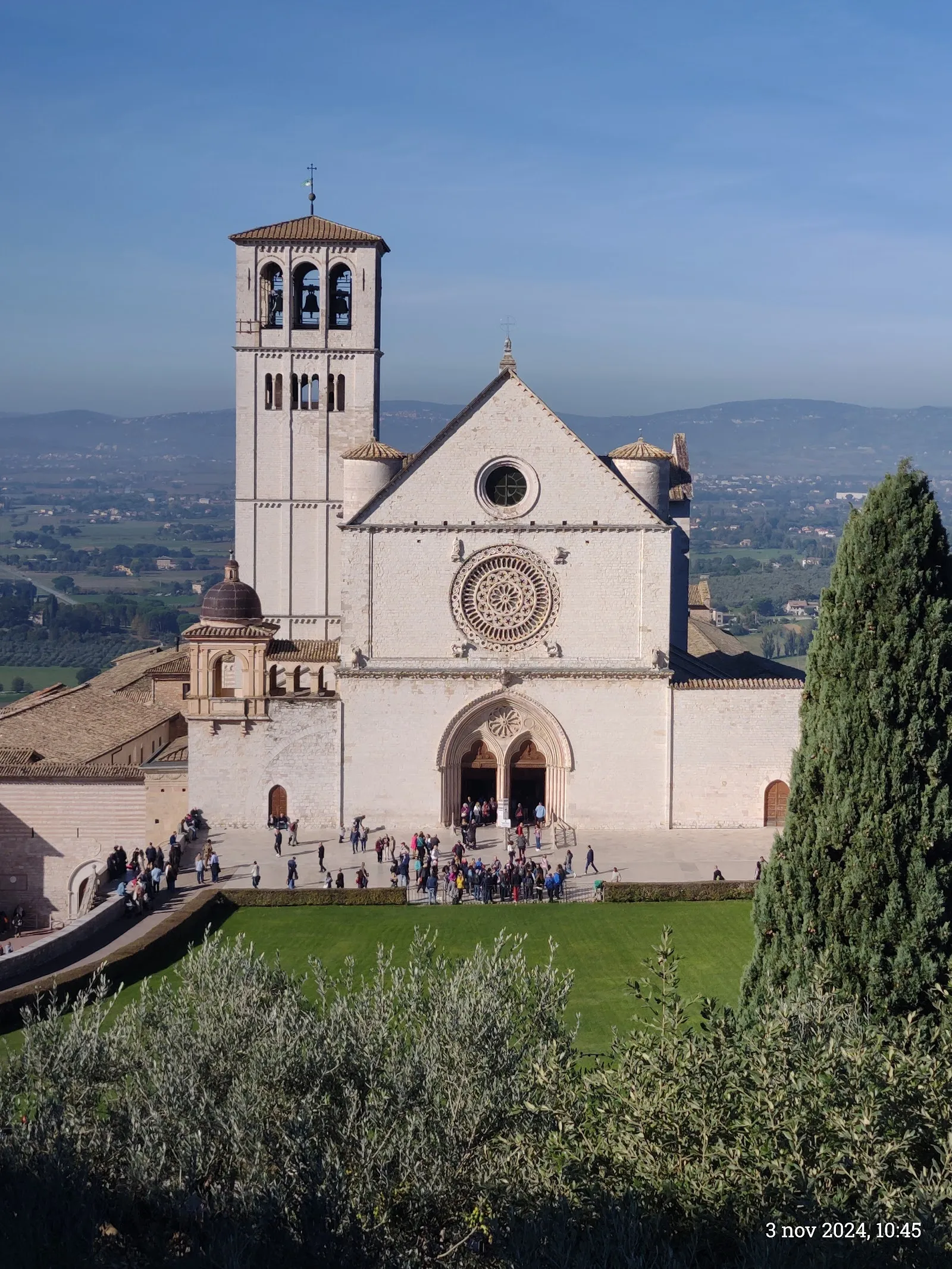
The Papal Basilica of Saint Francis sits on a hill above Assisi in Umbria, Italy. It is two churches stacked one above the other, the Lower and Upper Basilica, with a crypt below that holds the tomb of St Francis. The Upper Basilica is known for a cycle of 28 scenes from the saint's life, traditionally attributed to Giotto, and the Lower Basilica has frescoes by Cimabue and other painters. The complex is a UNESCO World Heritage site and one of Italy's main pilgrimage destinations. Entry to the basilica is free, and the calm inside makes it a good place to slow down.
Two churches on one hill
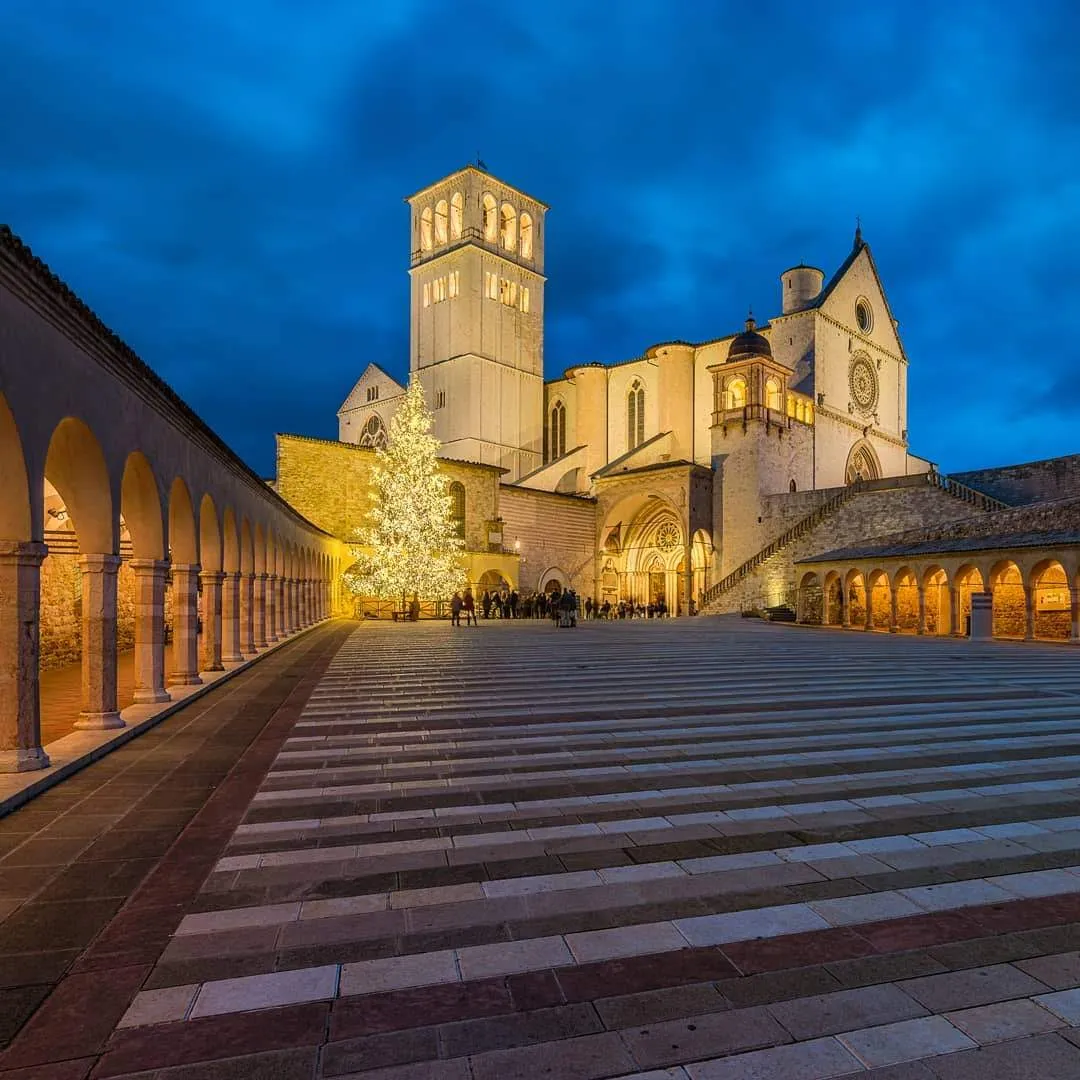
The Papal Basilica of Saint Francis was begun in 1228, soon after the saint was canonized. Pope Gregory IX commissioned it to hold the saint's remains and to present the teachings of the Franciscan Order through architecture and painting.
The complex is built into the side of a hill. The hill was once called Hell Hill, because executions took place there, and it later came to be known as Paradise Hill. Two churches stand one above the other: the Upper Basilica, in Italian Gothic style with tall, light-filled spaces, and the Lower Basilica, a darker Romanesque church. A crypt lies beneath the Lower Basilica.
The basilica is a UNESCO World Heritage site. It is also a pontifical basilica with extraterritorial status, and it is one of the most important pilgrimage sites in Italy.
The frescoes in the Upper and Lower Basilicas
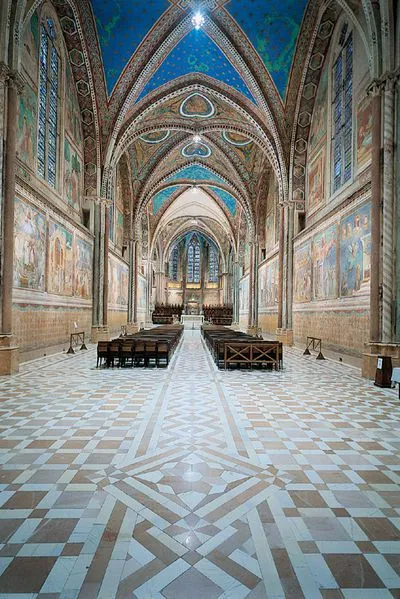
The Upper Basilica holds the cycle of 28 scenes known as the Legend of St Francis. The cycle is traditionally attributed to Giotto. Its painting is often credited with changing how artists handled space and perspective, moving away from rigid Byzantine forms toward a more human and natural style. In the transept of the Upper Basilica hangs Cimabue's Crucifixion, which shows the strong emotion typical of painting from the late 13th century.
The Lower Basilica has frescoes by Cimabue, who worked there between 1288 and 1292. In the apse are scenes of Mary. The left transept has scenes of the Apocalypse and one of two Crucifixions, and the right transept has scenes of Saints Peter and Paul and the second Crucifixion. In the 14th century, Simone Martini and Pietro Lorenzetti also worked in the Lower Basilica.
Photography is not allowed inside, so the frescoes are best seen slowly and in person. An audio guide is strongly recommended, since it points out the smaller chapels, including those of St Mary Magdalene and St Louis of Toulouse, that are easy to miss.
The crypt and the tomb of St Francis
The crypt lies below the Lower Basilica and holds the tomb of St Francis. The tomb is a stone sarcophagus, and four of the saint's early companions rest there with him. The tomb was hidden for centuries and was rediscovered in 1818.
The mood in the crypt is quiet and serious. The stone is plain, and many visitors find this the most moving part of the visit. Starting in the crypt is one way to follow the building's order, going down first and then up through the Lower Basilica.
The friars enforce silence in the sacred spaces, so keep your voice low when you approach the tomb.
Planning the visit
Entry to the basilica is free. Access to the Treasury Museum, which holds relics of the saint, comes through a guided tour or the Pilgrim's Pass available at the Info Point. Advance tickets are recommended for the visit.
For dress, cover your shoulders and knees, as is customary in a church. Photography is not permitted inside.
The complex is accessible for visitors with reduced mobility. It has a wheelchair accessible entrance, a wheelchair accessible restroom, and a wheelchair accessible car park.
Each year on 4 October, the Feast of St Francis draws visitors from across Italy. A different Italian region brings the oil that keeps the lamp burning at the saint's tomb. Later in the day there is music, dancing and food. With permission, choral groups may sing during Holy Mass.
Perguntas frequentes
Is there an entry fee?
Entry to the basilica is free. Access to the Treasury Museum comes through a guided tour or the Pilgrim's Pass available at the Info Point.
Can you take photos inside?
No. Photography is not permitted inside the basilica.
What should I wear?
Cover your shoulders and knees, as a mark of respect for the church.
Where should I park?
Park at Parcheggio Giovanni Paolo II or Parcheggio Porta San Giacomo. Both give access to lifts that go up to the basilica.
Do I need tickets in advance?
Getting tickets in advance is recommended.


