On Panepistimiou Street in central Athens, the Academy of Athens is a neoclassical landmark and Greece’s national academy. Its marble façade is framed by Ionic columns, with statues of Athena and Apollo above and sculptures of Socrates and Plato at the entrance. Look for the mythological scenes carved into the frieze over the portico. The building is one part of the Athenian Trilogy, alongside the National University and the old National Library. It is a rewarding stop for architecture and sculpture, even if you only admire it from outside.
A building completed before the Academy existed
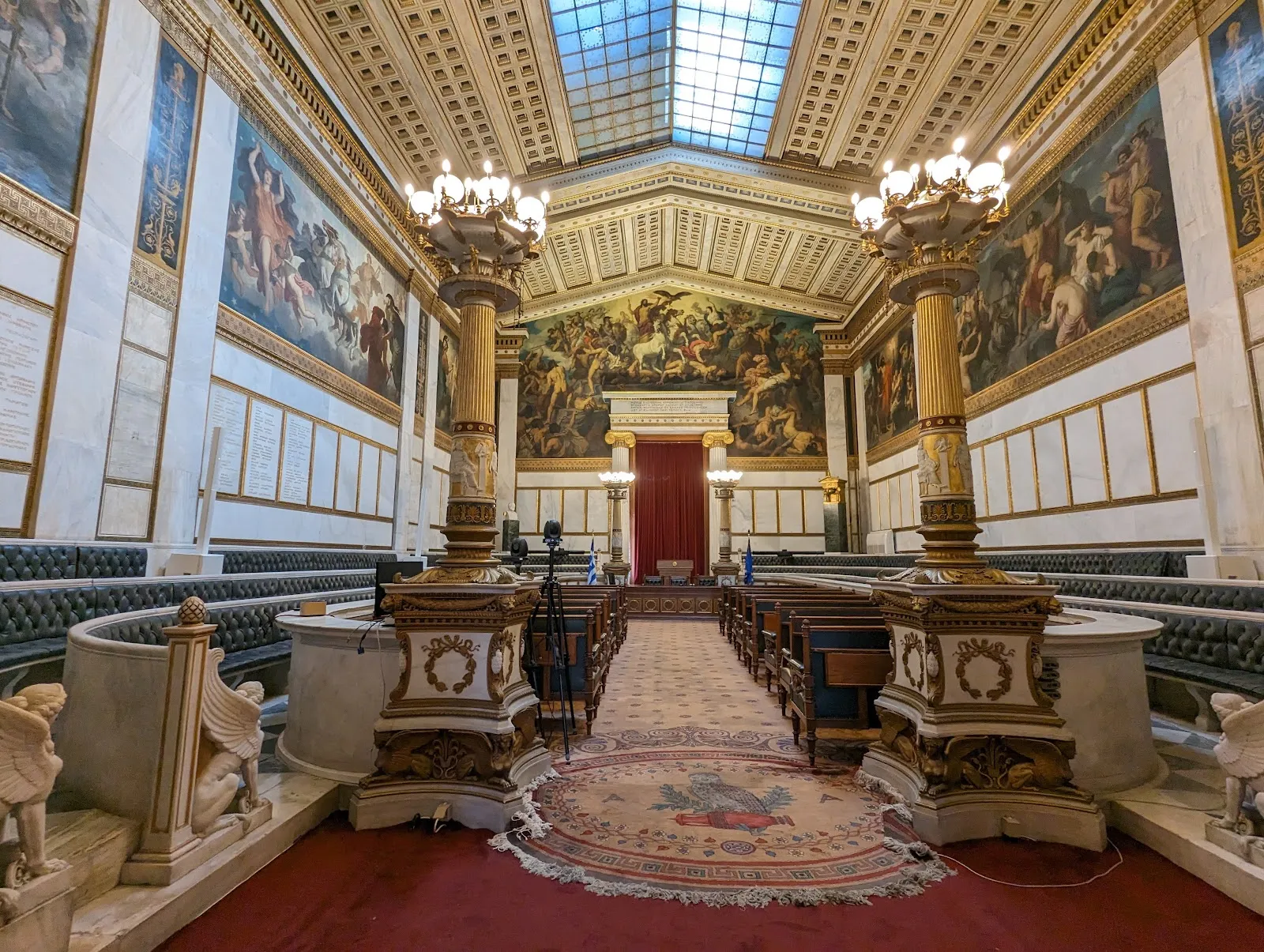
The Academy of Athens was built between 1859 and 1885, decades before the institution itself was established in 1926. The project began after Simon Sinas made a substantial donation to the Greek state. Danish architect Theophil Hansen designed the building, and construction began with a cornerstone ceremony attended by King Otto. After Sinas’s death, Ernst Ziller continued the work.
The building is one of three neoclassical landmarks known as the Athenian Trilogy. The other two are the National University of Athens and the old National Library. Together, they extend along Panepistimiou Street in central Athens. Their classical design belongs to the visual identity of the modern Greek state, founded after the Greek War of Independence of 1821.
Sculptures and details on the façade
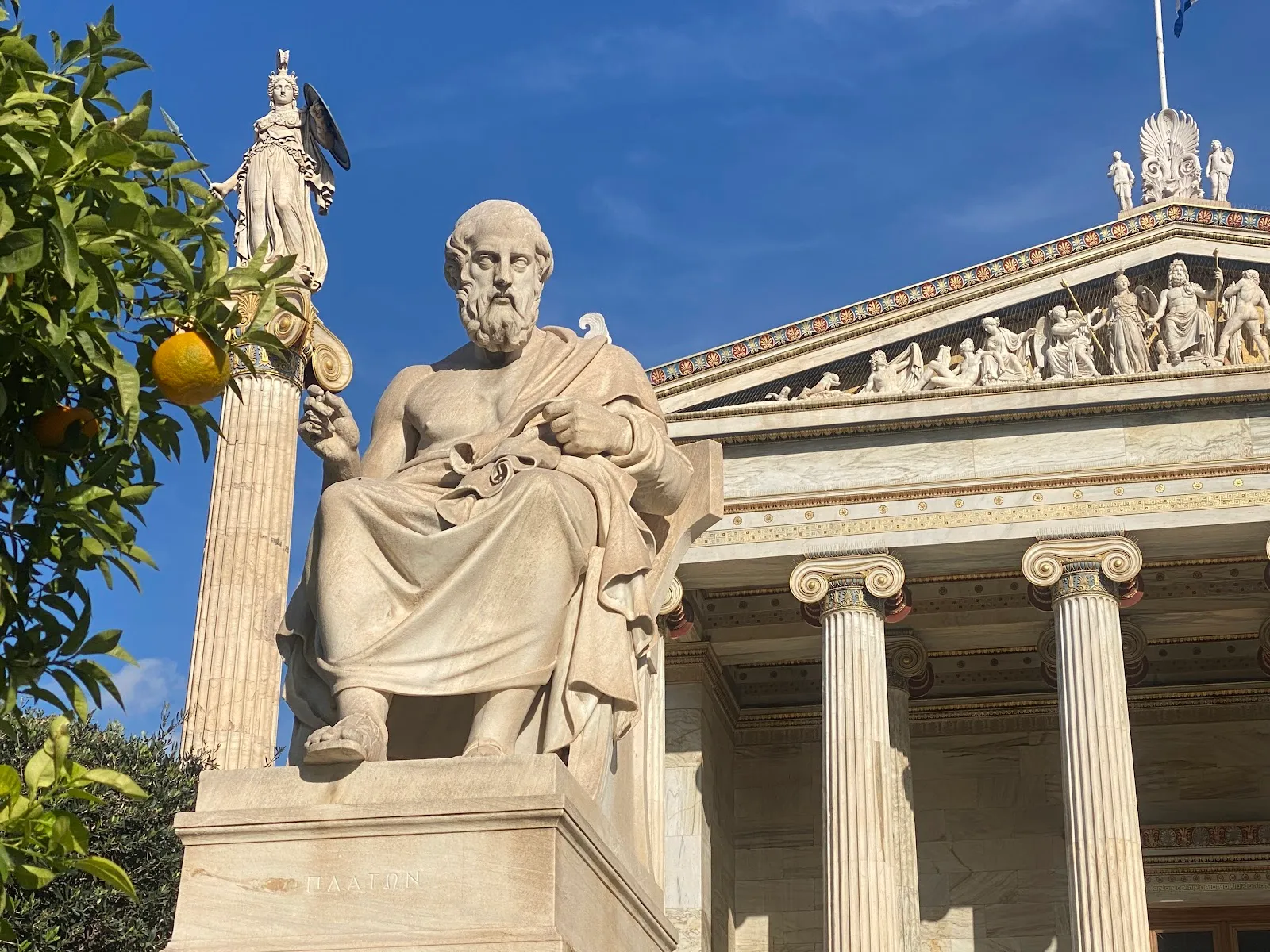
The Academy’s exterior brings architecture and sculpture together. Tall Ionic columns rise across the portico, while statues of Athena and Apollo crown the building. At the entrance, seated figures of the philosophers Socrates and Plato connect the institution with the tradition of ancient Greek thought. A sculpted frieze above the portico includes mythological scenes, among them the story of Prometheus.
The project involved several artists as well as architects. Sculptor Leonidas Drosis and painter Christian Griepenkerl contributed to its decoration. From the street, take time to look above the columns as well as at the figures around the entrance; the carved scenes and statues are key parts of the design.
The Academy’s role today
The institution is Greece’s national academy and a research establishment. It is regarded as an intellectual successor to Plato’s ancient Academy, continuing a tradition of scholarly and scientific inquiry in a modern setting. The building’s educational purpose gives context to its classical imagery: the philosophers at the entrance and mythological scenes on the façade point to the pursuit of knowledge and the arts.
The Academy is best approached as an architectural stop unless you have confirmed access to its interior or a public event. The building remains an active institution, and entry is not guaranteed. Its location makes it easy to include alongside the National University and the old National Library on a walk along Panepistimiou Street.
Perguntas frequentes
Where is the Academy of Athens?
It is at Panepistimiou 28 in central Athens, on the same street as the other buildings of the Athenian Trilogy.
When was the Academy of Athens building built?
Construction ran from 1859 to 1885. The Academy itself was established in 1926.
What should I look for on the façade?
Notice the Ionic columns, the statues of Athena and Apollo above, the seated figures of Socrates and Plato at the entrance, and the mythological frieze over the portico.
Can you go inside the Academy of Athens?
Interior access is not assured. Treat it as an exterior visit unless you have confirmed access to the building or a public event.