Dresden Zwinger is an early 18th-century Baroque palace complex on Sophienstraße in Dresden’s Old Town. Augustus the Strong commissioned it as a setting for court festivities; today, its galleries and pavilions enclose a broad courtyard with fountains. Walk through the grounds to see the Crown Gate, Wallpavillon and Nymphenbad, then climb to the upper terraces for views over the courtyard. Entry to the courtyard and terraces is free. The complex also houses the Old Masters Picture Gallery, Porcelain Collection and Mathematical-Physical Salon, each with its own collection to explore.
A court complex built for festivities
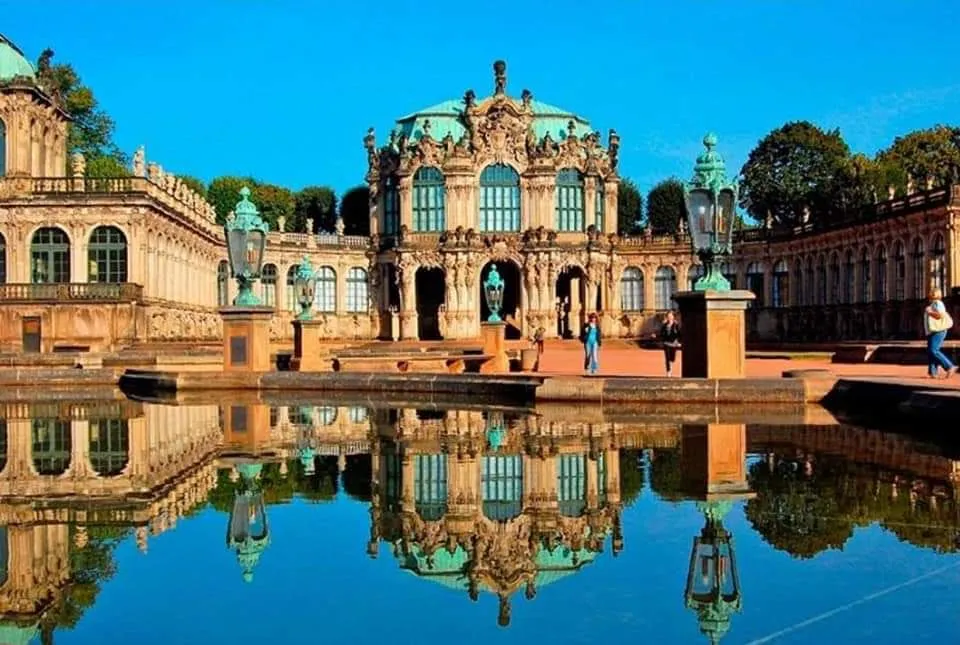
Augustus the Strong commissioned the Zwinger in the early 18th century, and construction took place between 1710 and 1728. Court architect Matthäus Daniel Pöppelmann and sculptor Balthasar Permoser shaped the complex. Its original uses included court celebrations, a festival arena and an orangery.
The Zwinger was planned as part of a larger palace scheme that was never completed. Its name comes from a medieval term for the area between defensive walls. The complex was badly damaged during the Second World War, then rebuilt after the war, with reconstruction bringing much of it back to its earlier appearance.
Courtyards, pavilions and fountains
The buildings frame a large central courtyard, where fountains, lawns and formal garden areas sit among Baroque sculptures. Look for the Crown Gate, the Wallpavillon and the Nymphenbad, a fountain area behind the French Pavilion. Galleries and pavilions around the courtyard include the Semper Gallery and the Long Gallery.
The upper terraces give a view down into the courtyard and across the surrounding area. The carillon in the Glockenspiel Pavilion plays classical melodies at intervals during the day, with some music linked to the season.
Three museum collections
The Zwinger houses three museums. The Old Masters Picture Gallery, in the Semper Gallery, displays paintings from the 15th to 18th centuries. Its collection includes Raphael’s Sistine Madonna, alongside works by other European artists.
The Porcelain Collection presents pieces collected by Augustus the Strong. The Mathematical-Physical Salon is devoted to scientific instruments, including clocks, globes and telescopes. If you want to see more than one collection, a combined ticket is available; check ticket details before your visit.
Planning a visit
You can enter the courtyard and go up to the terraces without buying a museum ticket. That makes a walk through the grounds an option even if you have limited time or are not planning to see the collections. For the museums, plan a longer visit: the galleries occupy several rooms and levels.
The Zwinger is in Dresden’s historic centre, close to the Semper Opera House and Dresden Castle. Give the grounds time for a slow circuit, and allow more time if you are visiting the galleries as well. The complex is wheelchair accessible at its entrance and restrooms.
Perguntas frequentes
Is Dresden Zwinger free to enter?
The courtyard and upper terraces are free to visit. Museum collections require a ticket.
How long should I spend at Dresden Zwinger?
Allow about 30 to 60 minutes for the grounds. Add more time if you plan to visit the museums.
Which museums are inside Dresden Zwinger?
The complex houses the Old Masters Picture Gallery, the Porcelain Collection and the Mathematical-Physical Salon.
Can I see the Sistine Madonna at Dresden Zwinger?
Yes. Raphael’s Sistine Madonna is in the Old Masters Picture Gallery.