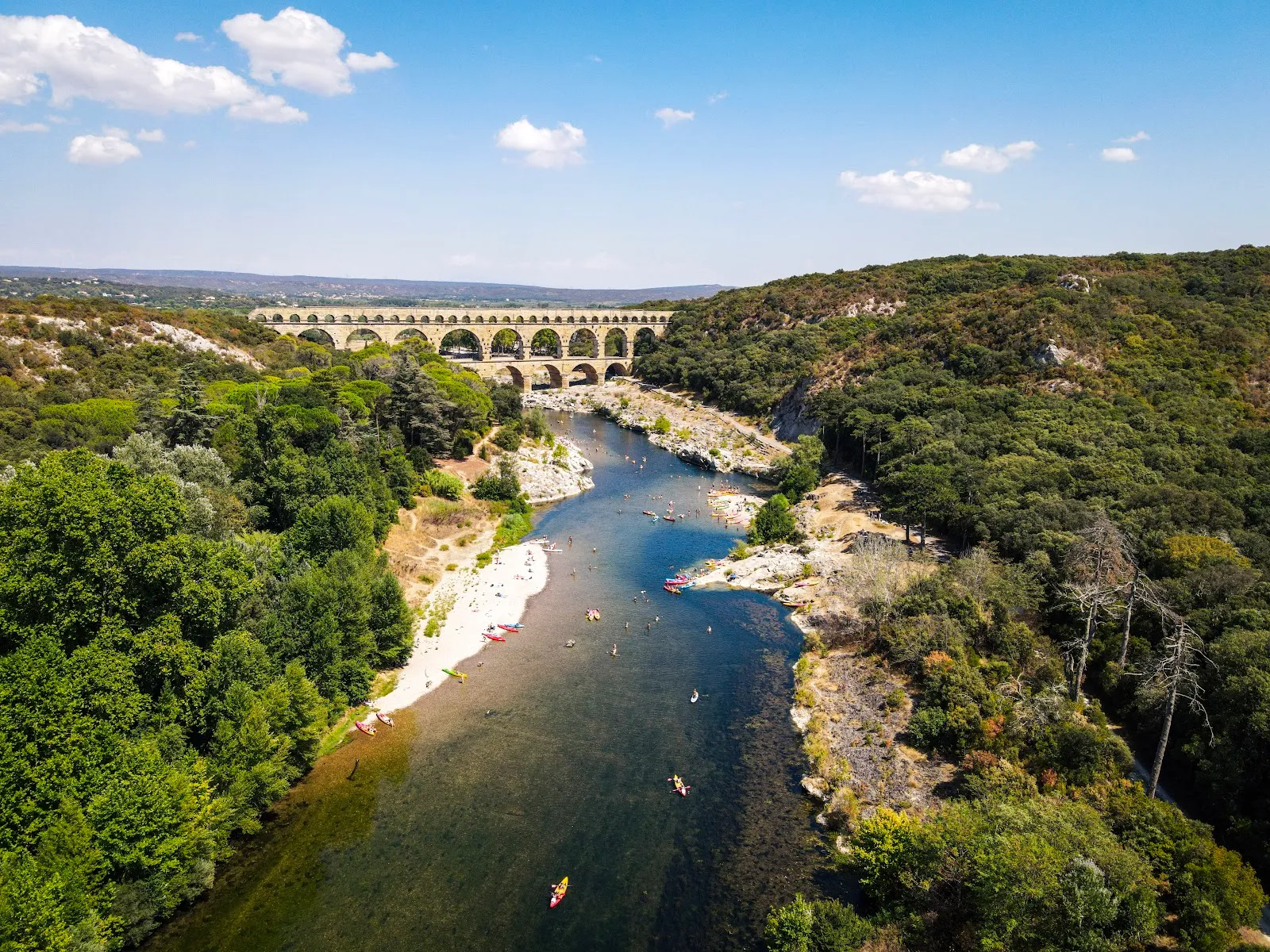
The Pont du Gard is a Roman aqueduct bridge over the Gardon River at Vers-Pont-du-Gard, in the Gard, southern France. Built in the first century AD to carry water to Nîmes, it has three tiers of golden limestone arches and is listed by UNESCO. The site is pedestrian only. A path leads from the museum, café and shop down to the bridge, and you can cross to the far bank and climb a trail to viewpoints. In summer, small beaches by the river let you swim with the aqueduct in view.
Why the Romans built it
Nîmes, then called Nemausus, was one of the most prosperous cities of Roman Gaul in the first century AD. Augustus had given it the status of a Roman colony, and the spring in the present-day Jardins de la Fontaine could no longer supply its growing population. The engineers went to the spring of the Eure, near Uzès, and built an aqueduct of about 50 km to bring water from there.
The route had to cross the deep gorge of the Gardon. The waterway falls only 17 m over its whole length, so the gradient was calculated closely, and the Pont du Gard is the structure that carried the channel over the river. Work is dated to around the middle of the first century, under the emperors Claudius and Nero.
For about five centuries the aqueduct delivered some 35,000 cubic metres of water a day. It supplied drinking water to the inhabitants, and also the baths, fountains and gardens of the city.
Three tiers of stone
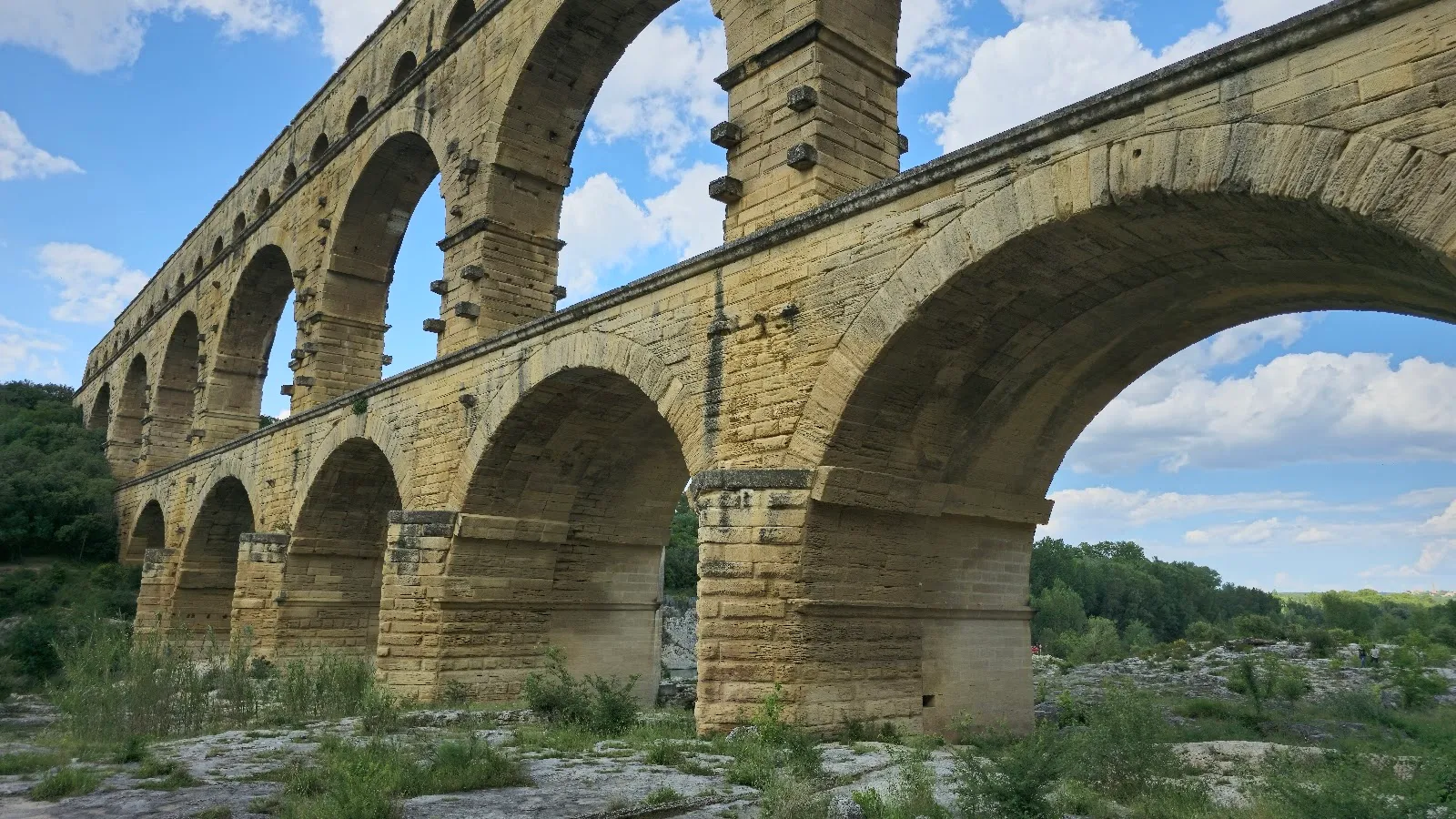
The bridge is three bridges stacked on top of each other to reach the height needed. The lower tier has six arches, the middle tier 11, and the top tier 36 smaller arches, with more of them originally. The bridge rises to roughly 49 m, and its longest tier measures 275 m.
The builders used large dressed limestone blocks, laid without mortar and held together with iron clamps. The stone has a golden colour. No cranes or excavators were used. The Pont du Gard is the tallest Roman aqueduct bridge and the only ancient three-level bridge that survives intact. UNESCO added it to the World Heritage list in 1985.
Walking the site
The whole site is closed to cars. From the parking side, a central row of buildings holds a museum, a café and a souvenir shop, and a path open to everyone leads from there down to the bridge. The museum is interactive and has temporary exhibitions. In summer there is also a sound and light show.
A pedestrian bridge runs alongside the aqueduct to the far bank. There is a restaurant, Les Terraces, on that side, and a trail climbs the hill to a point from which you can see the actual channel. Further along are viewpoints that take in the whole bridge. The trail is demanding, so allow for that if anyone in your group finds slopes difficult.
The top level can be walked only on a guided tour organised from the museum. Walkers on the elevated section see the stonework close up, including graffiti carved into it over the centuries. Several other marked walks cross the nature reserve around the bridge, past more remains of the aqueduct and old buildings. Strawberry trees grow along some of the paths.
The river and its banks
The Gardon is part of the visit in summer. Small beaches open on both sides of the bridge, and people paddle, swim and rent kayaks to float beneath the arches. The water is cold. The banks are shingle, so water shoes make getting in much easier.
The base of the valley is the main viewing area and gets very busy in summer. Arriving early gives you the bridge with fewer people around it.
Getting there and what costs money
The site is free to enter for anyone arriving on foot or by bike. Parking, the discovery spaces, guided tours and workshops are the paid parts. The car park charges €9 per vehicle per day.
Buses run from Nîmes and Avignon and stop on the highway, from where it is a 10-minute walk with pavements all the way and a little shade. By car, Avignon is about 30 minutes away. Uzès, the source of the aqueduct, is a 15-minute drive, which makes it an easy pairing for lunch.
Perguntas frequentes
Is there an entry fee for the Pont du Gard?
Walking or cycling onto the site is free. Parking costs €9 per vehicle per day, and the discovery spaces, guided tours and workshops are paid.
Can you walk on top of the Pont du Gard?
Only on a guided tour organised from the museum. It is worth arranging in advance.
Can you swim at the Pont du Gard?
Yes. In summer small beaches open on both sides of the bridge and you can swim in the Gardon. The water is cold and the banks are shingle, so bring water shoes.
How do you get to the Pont du Gard without a car?
Buses run from Nîmes and Avignon. They stop at the highway, and the walk to the site takes about 10 minutes on pavements.
Is the Pont du Gard accessible for wheelchair users?
The entrance, restrooms and parking lot are wheelchair accessible, and the main path to the bridge is open to everyone. The trail up the hill is steep and not suitable for visitors with mobility difficulties.
Who built the Pont du Gard and why?
The Romans built it around the middle of the first century AD. It carried the Nîmes aqueduct over the Gardon, bringing water from near Uzès to the city, about 50 km away.