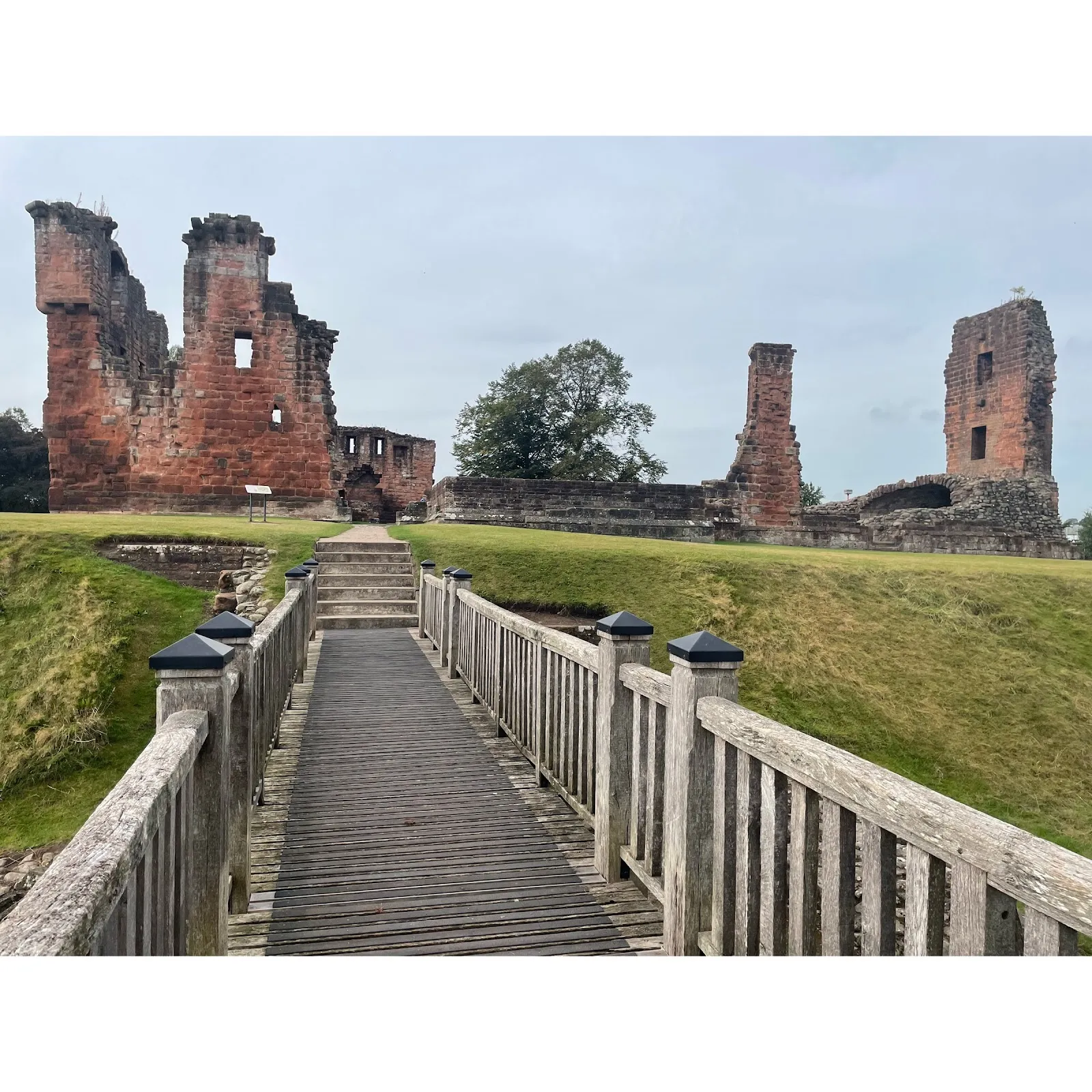
Penrith Castle is a medieval ruin on Ullswater Road, directly opposite Penrith railway station and beside Castle Park. Its red-brick walls and traces of the moat give you a close look at a fortress built to defend the border from Scottish raids. Richard, Duke of Gloucester, later Richard III, lived here after it was strengthened and turned into a residence. Entry is free, and information boards explain the site. Pair a walk around the ruins with time in the park, which has paths, a playground and picnic spots.
A border fortress and royal residence
Penrith Castle began as a defensive stronghold in the late 14th century, when the border faced raids from Scotland. Ralph Neville, Earl of Westmorland, was responsible for its early construction. The castle was later strengthened and enlarged, changing from a military building into a residence associated with Richard, Duke of Gloucester.
Richard lived here before he became King Richard III. The site links the town’s border history with the story of a future king, but the surviving remains are the focus of a visit today. By the 16th century the castle had fallen into disrepair; it later became a ruin. Some accounts also connect its decline with the upheaval of the English Civil War.
What remains at the site
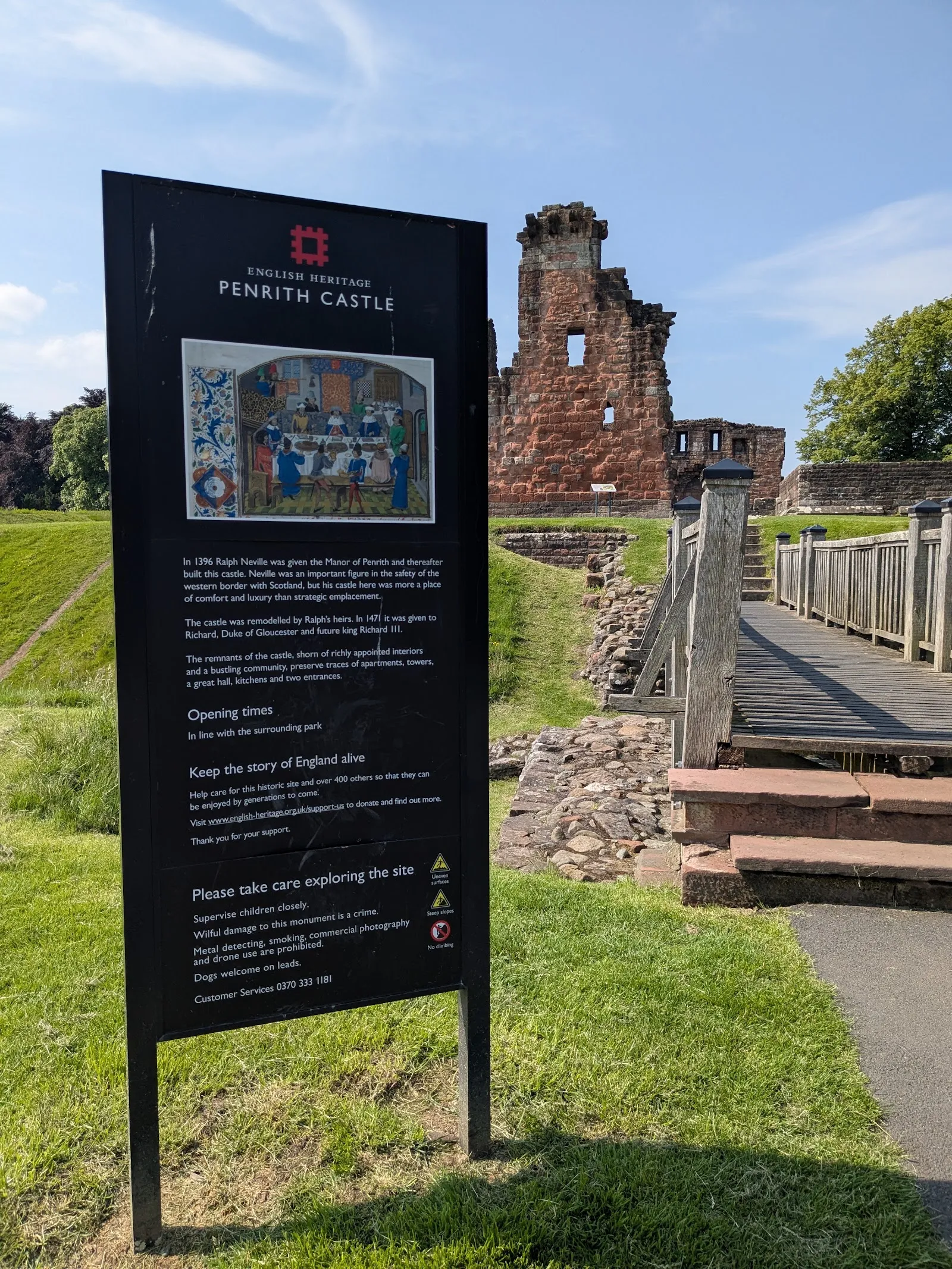
The castle stands within Castle Park, close to Penrith town centre. Its red-brick walls rise above the ground and give a sense of the building’s original scale. Look for the surviving wall lines and the remains of the moat, which help explain how the castle was arranged and defended. Information boards around the site provide context as you move through the ruins.
The castle was more than a defensive structure. Under Richard, Duke of Gloucester, it was adapted as a residence. That shift is part of what makes the site interesting: the remains belong to a building with both a border role and a domestic history. The present walls are only part of the original structure, but they still make the former footprint easier to imagine.
Making a visit
The railway station is directly across the road, so the castle is an easy stop if you are arriving by train or have time before a connection. Entry is free. The park provides space to continue your visit, with wheelchair-friendly paths, picnic spots and a children’s play area. The ruins themselves are not accessible to wheelchair users, so plan to enjoy the park paths if access to the castle is a concern.
You can keep the visit focused on the walls and information boards, or spend longer in the surrounding park. The site is close to town services, including places to eat and drink, and the railway station area. If you are driving, parking is available nearby, including paid options; check the parking arrangements before setting off.
Perguntas frequentes
Is Penrith Castle free to visit?
Yes. Entry to the castle is free.
How long should I allow for Penrith Castle?
Allow around 30 to 60 minutes for the ruins and a walk in Castle Park.
Is Penrith Castle wheelchair accessible?
The ruins themselves are not accessible to wheelchair users. Castle Park has wheelchair-friendly paths.
How do I get to Penrith Castle by train?
The castle is directly opposite Penrith railway station.