Wat Phra That Lampang Luang is a Lanna-style temple on a low hill outside Lampang city, in northern Thailand. Its golden chedi is said to hold a relic of the Buddha, and the grounds include one of the country's oldest standing wooden buildings. Visitors come for the open-sided wooden wihan with its teak pillars, the old murals, and an optical effect that projects the chedi upside down inside a small chapel. Walk around the stupa, look at the bullet marks on the iron fence, and allow time for the grounds.
Lanna history and the walled hilltop
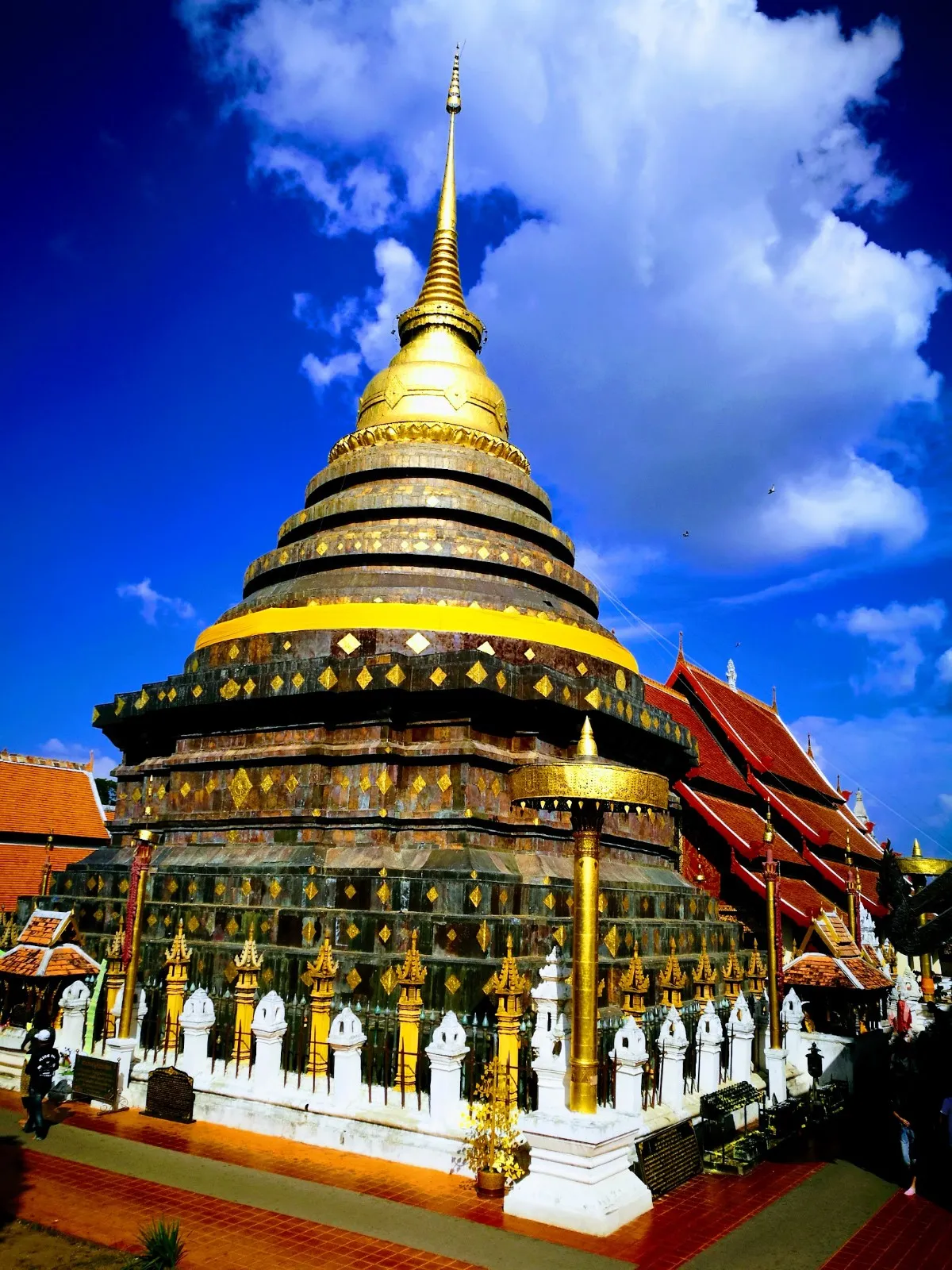
The temple stands on the site of the ancient Lampang City, and it is said to date back to the 13th century. It sits on a small hill and is enclosed by fortified walls, which give the complex an old walled-town feel.
The entrance arches, called Pratu Khong, are decorated with fine plaster designs. The climb up to the main entrance is by a naga stairway, whose design follows the arched gateway of Wat Lai Hin.
Lampang's provincial seal shows the temple. Its architecture, a square structure with arches and a pyramid roof, was used for the seal, which shows how central the temple is to the province.
The chedi and its legend
The chedi is the most notable feature of the temple. It is said to enshrine a relic of the Buddha, and one source dates its construction to 1413.
According to local legend, the Buddha passed through this land, tossed a bamboo cane to the north, and foretold that the land would be called Lampang. He also gave a tuft of his hair to a devotee, who placed it in a golden container and buried it in a tunnel. A stupa was then built over it.
In Lanna belief, people born in the year of the Ox come here as pilgrims, so the temple is an important place of worship as well as a historic site.
The wooden wihan and its murals
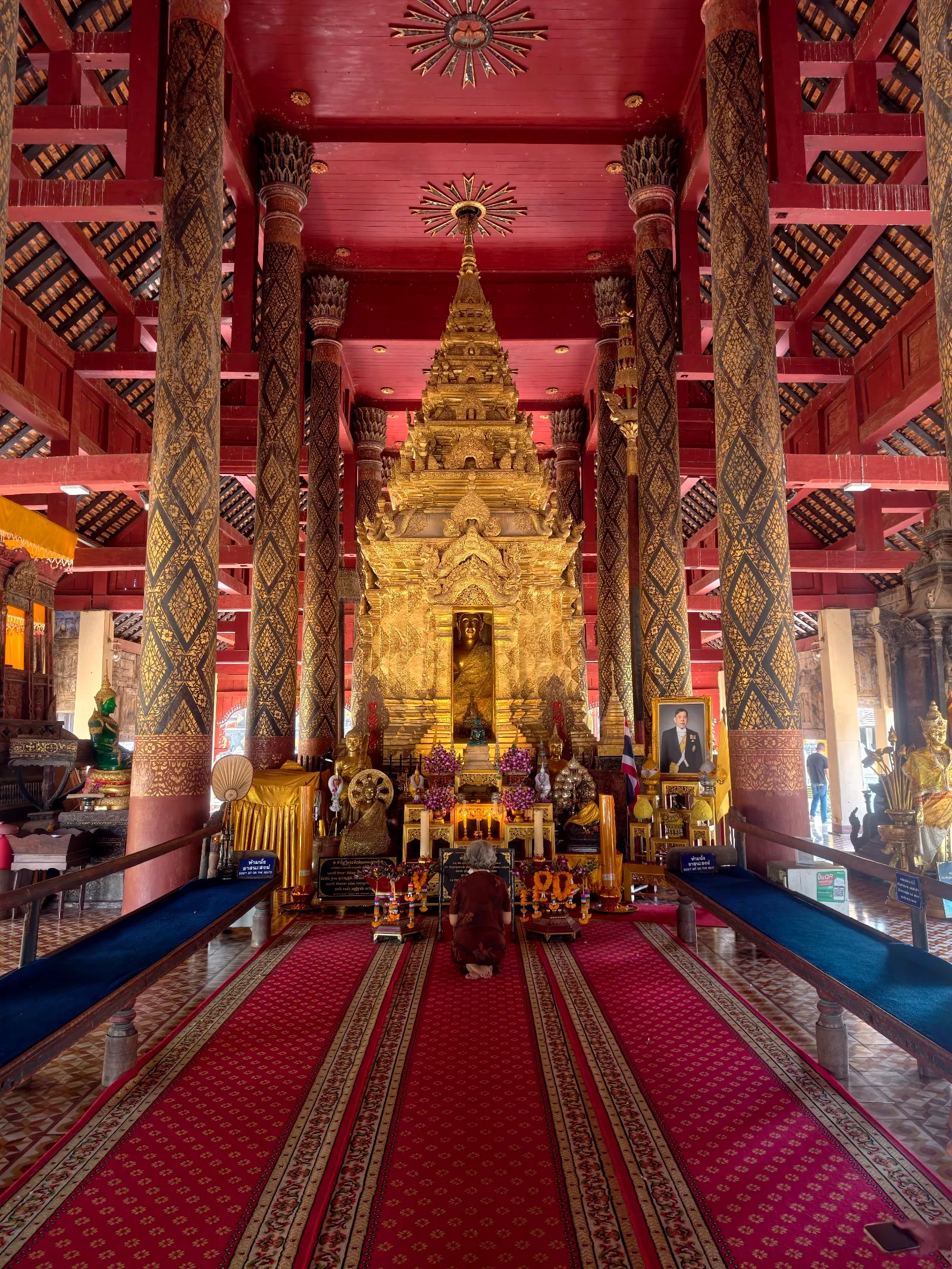
The wihan luang is open on its sides and has three tiers of wooden roof. Immense teak pillars support it, and many of the buildings on the grounds date from the 1400s. It is considered by many to be Thailand's oldest teak building.
Inside the upper perimeter, painted wooden panels show the Jataka, the stories of the Buddha's previous lives. Ancient Lanna murals also decorate the open viharn at the entrance.
The main viharn has elaborately carved wooden columns, and the old painted surfaces are a reason to slow down and look closely.
The inverted image
One of the temple's most distinctive features is an optical effect. When light passes through a small opening, it projects the image of the chedi upside down inside the building.
This is the camera obscura inside a small chapel, where the inverted image of the temple appears on the wall.
The effect is easiest to see in the chapel, so plan time for it along with the stupa and the wihan.
Visiting with respect
Many people come here to pray, so keep your voice low and stay quiet while others are in prayer. Wear clean clothes, as is customary at a working temple.
For the walking meditation around the stupa, offerings are provided. A small donation is a generous way to support the temple.
The entrance and restroom are wheelchair accessible, and the parking lots include accessible spaces.
Preguntas frecuentes
Is there an entry fee?
The input does not give an entry fee, so check on arrival. Getting tickets in advance is recommended.
Is it far from Lampang city centre?
The temple lies outside the city, to the southwest of the centre. Taking a Grab from the city centre is a convenient option if you travel independently.
Is there parking?
Yes. The site has a free parking lot and a paid parking lot, along with free and paid street parking nearby.
Is the temple wheelchair accessible?
Yes. The entrance, restroom and parking lot are listed as wheelchair accessible.