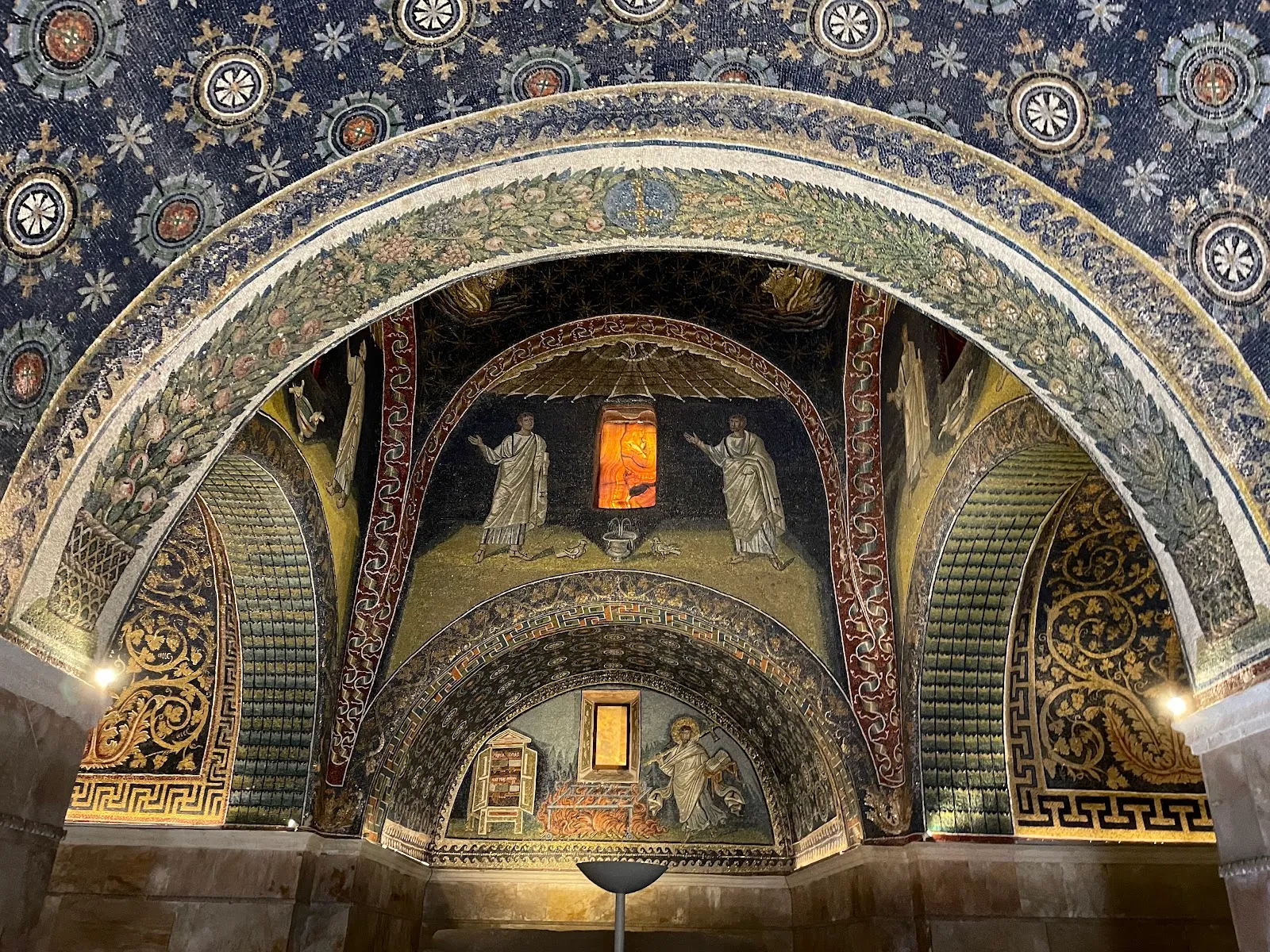
The Mausoleo di Galla Placidia is a small brick building on the grounds of the Basilica of San Vitale in Ravenna. Its plain exterior gives little hint of what lies inside. The interior is covered in some of the oldest and best-preserved mosaics in the city, dating from the 5th century. Look up at the vault, where a starry sky surrounds a cross in deep blue and gold glass, and look for the figure of the Good Shepherd and the scenes of apostles and symbolic animals. The building is one of Ravenna's UNESCO World Heritage monuments and is usually visited together with San Vitale.
Galla Placidia and the name of the building
The mausoleum takes its name from Galla Placidia, a woman of the imperial family who lived through a turbulent period of the late Roman Empire. She was the daughter of Emperor Theodosius I, sister of Emperor Honorius and mother of Emperor Valentinian III. When her son was still young, she held political power in his name and acted as his regent for 14 years. She died in Rome in 450.
Her link to the building is traditional rather than fully documented. Little is known for certain about who commissioned it or who was buried there. The building may have served as a chapel, possibly commissioned by her family, and it is not certain that it was ever her tomb.
A brick building from the Western capital
Ravenna was the seat of the imperial court in the 5th century, when Honorius moved the capital of the Western Roman Empire to the city in 402. The mausoleum dates from that period. Its outer walls are plain brick, and the building is cross-shaped, with a central dome and barrel-vaulted arms.
The construction method is western, but the cross plan has eastern precedents. The result is a compact building whose architecture is simple and whose decoration is concentrated on the inside.
What the mosaics show
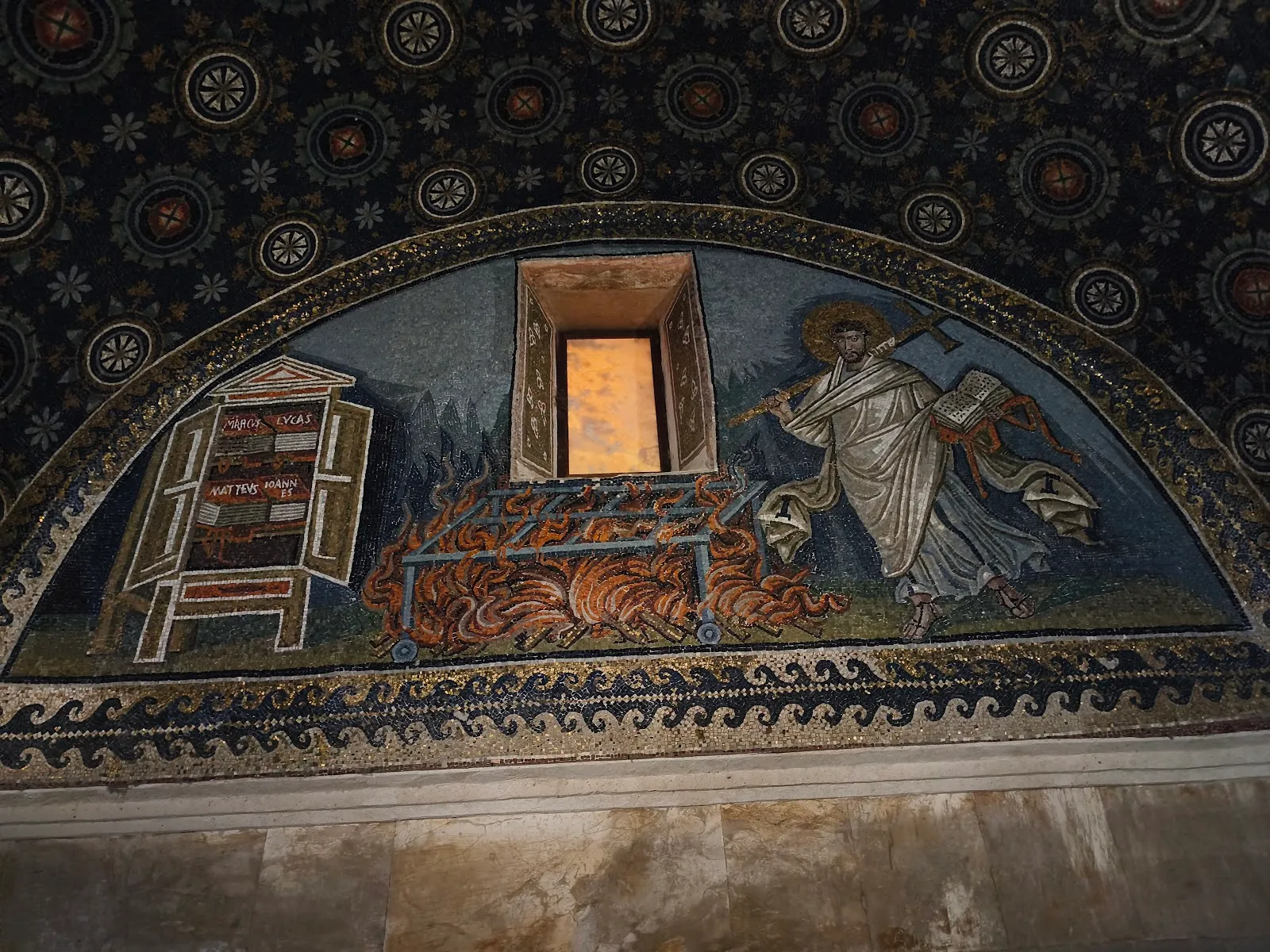
The mosaics cover almost every surface of the interior. The vault above the centre is decorated with a starry sky around a cross, set in deep blue and gold glass. On the walls, the scenes include apostles, martyrs and symbolic animals, along with the figure of the Good Shepherd. Their themes are eternal life and the victory of life over death.
The central part of the mausoleum holds three sarcophagi. They are traditionally linked to Constantius III, Galla Placidia's husband, and to her son or brother, but the identities are not settled.
Light and atmosphere inside
Light enters through alabaster windows, which filter it into a soft, even glow. The walls and vault seem to glow in this light, and the blue and gold of the tiles shifts as the light changes during the day. The interior is dim and quiet, so your eyes need a minute to adjust before you can see the details in the upper vault and walls.
Preguntas frecuentes
Is there an entry fee?
Yes, entry is by ticket. Tickets can be bought online or at the ticket offices near the churches, and a combination ticket covers several sites in Ravenna.
Do I need to book a time slot?
You may need to select a time slot for the Mausoleo di Galla Placidia and the Battistero Neoniano. In high season, entry is in timed slots of about five minutes per person.
Is the mausoleum wheelchair accessible?
The site lists a wheelchair accessible entrance. One visitor reported that the doorway seemed narrow for wheelchairs, so check with the ticket office before you plan your visit.
Is it suitable for children?
The site is listed as good for children. The interior is small and can get warm when it is crowded, so a short visit at busy times suits younger visitors best.