
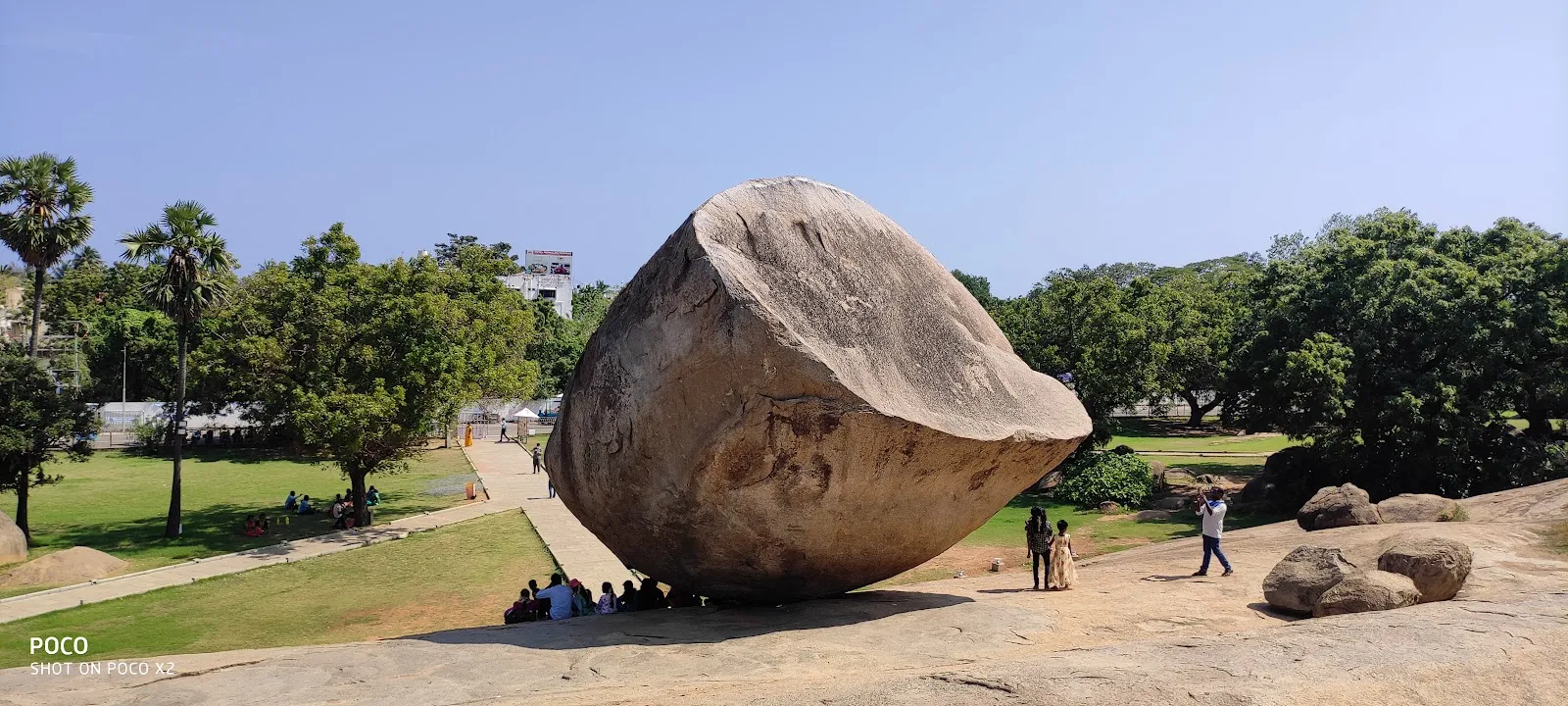
Krishna's Butter Ball is a granite boulder in Mahabalipuram, Tamil Nadu, resting on a sloping rock face a short walk from Arjuna's Penance. It is about 6 metres high and 5 metres wide and weighs an estimated 250 tons. It touches the rock on a narrow base, yet it has stayed in place for more than a thousand years. Its Tamil name, Vaan Irai Kal, means sky god's stone, and the English name comes from the story of Krishna and butter. The boulder belongs to the Group of Monuments at Mahabalipuram, a UNESCO World Heritage Site, and is a protected national monument.
The boulder and its balance
Krishna's Butter Ball is a single block of granite. It stands about 6 metres high and 5 metres wide, and its weight is estimated at 250 tons. It sits on a sloping rock surface and rests on a narrow base of roughly 1.2 metres. Seen from below, it looks ready to slide, and the slope beside it makes the angle easy to read.
The rock is thought to have stood in this position for around 1,200 years, and the Pallava king Narasimhavarman is said to have been amazed by it. Its exact origin is not settled. It has stayed in place through cyclones and earthquakes.
The boulder is part of the Group of Monuments at Mahabalipuram, a UNESCO World Heritage Site. The Archaeological Survey of India also lists it as a protected national monument. It differs from most of the other monuments in the group, which are carved temples and caves, because this one is a natural rock that was left as it was.
The name and the legend
In Tamil the boulder is called Vaan Irai Kal, which means the stone of the sky god. The English name comes from Hindu tradition. According to the stories of his childhood, Krishna loved butter and took it from the houses in his neighbourhood, and his mother kept it in a pot. Local belief sees the boulder as a huge lump of butter that fell from heaven, or as a reminder of his playfulness.
The legend adds a second story. It says that rulers tried to move the rock because of safety worries, using elephants, and that it did not shift. Accounts differ on who made the attempt and when, but they agree on seven elephants and on the result. Visitors today often take photos that play on the size of the rock, such as pretending to push it or hold it up.
What is around it
The boulder lies within a short walk of several other monuments. Arjuna's Penance is about 200 metres away, and the Ganesha Ratha and the Five Rathas are close. The Varaha Cave Temple is a few minutes on foot. A walking route runs past the Varaha cave and the Krishna Mandapa and ends at the boulder.
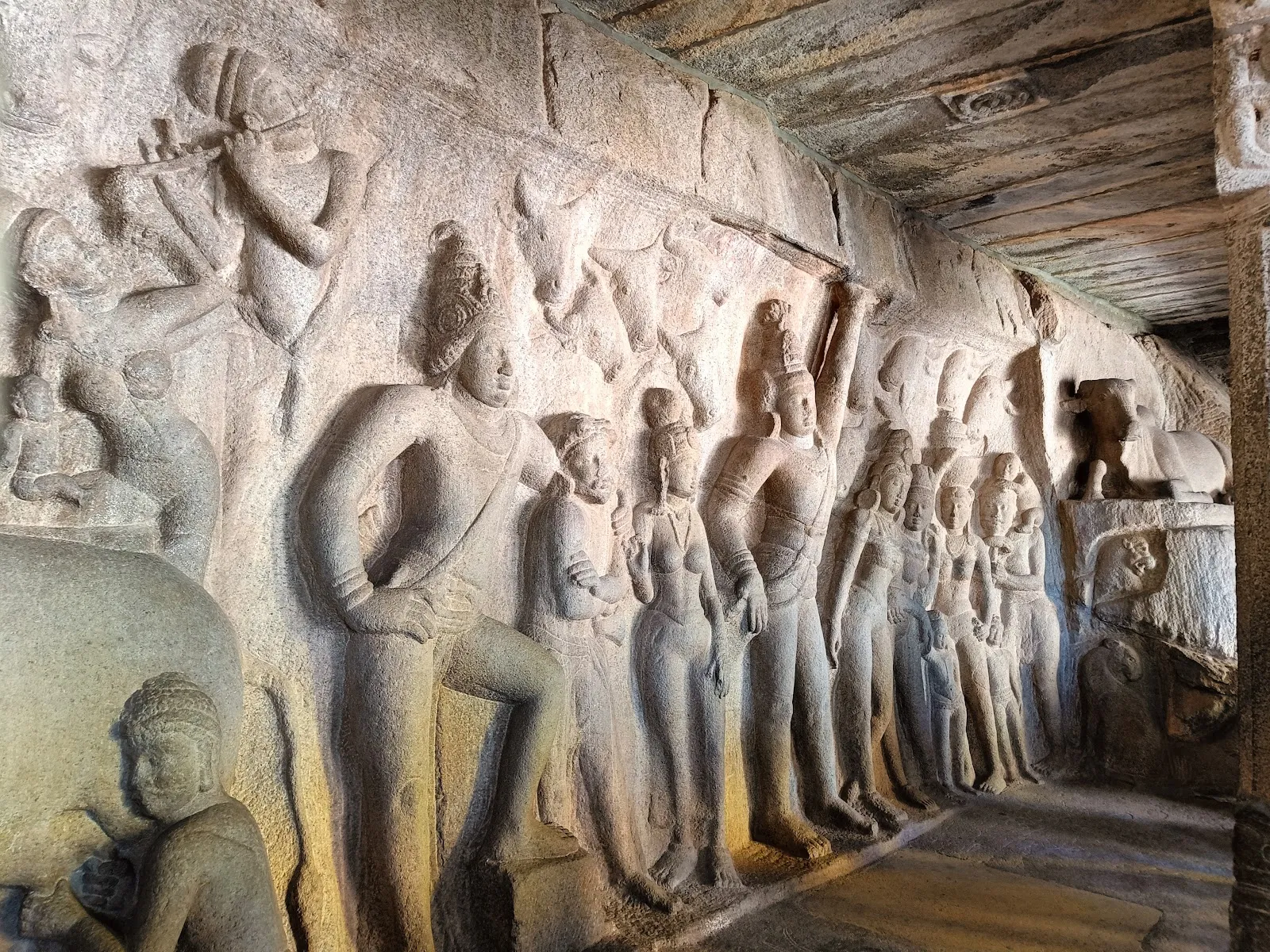
The Krishna Mandapa holds a bas-relief of Krishna as Govardhanadhari. In it Krishna lifts the Govardhana hill with his left arm to shelter the cowherds and their cattle from a storm. Other things nearby are the Trimurti cave temple, the Varaha Mandapa, an unfinished gopuram, the Mahabalipuram lighthouse, and the Draupadi's bath and Lion's Throne further up the hill.
The bus station in Mahabalipuram is about half a kilometre away. Small shops around the site sell souvenirs, clothes, accessories and local snacks.
Planning the walk
The ground around the boulder is rocky and open, with steps and slopes between the monuments. In summer and before the monsoon the sun is strong, and the heat is easier to manage early in the day. The site closes at 6 pm, and visitors are asked to leave by then.
Mahabalipuram suits a one-day trip with a family, and the boulder is one stop among many. It works well as a short pause between the cave temples and the rathas.
Preguntas frecuentes
What is Krishna's Butter Ball?
It is a natural granite boulder in Mahabalipuram, about 6 metres high and 5 metres wide, weighing an estimated 250 tons. It rests on a sloping rock on a narrow base and has stayed there for more than a thousand years.
Why is it called Krishna's Butter Ball?
Hindu tradition says Krishna loved butter and took it as a child. The boulder is seen as a lump of butter that fell from heaven. Its Tamil name, Vaan Irai Kal, means sky god's stone.
What can you see nearby?
Arjuna's Penance is about 200 metres away. The Ganesha Ratha, the Five Rathas, the Varaha Cave Temple, the Krishna Mandapa and the Trimurti cave temple are also close, and the Shore Temple is a short distance beyond.
When is the best time to visit?
Early morning or late afternoon, when it is cooler and quieter. The site closes at 6 pm, so leave time to walk through the nearby monuments.
How long does a visit take?
The boulder itself needs about 30 to 60 minutes for viewing and photos. Allow more if you also walk to the nearby caves and rathas.


