
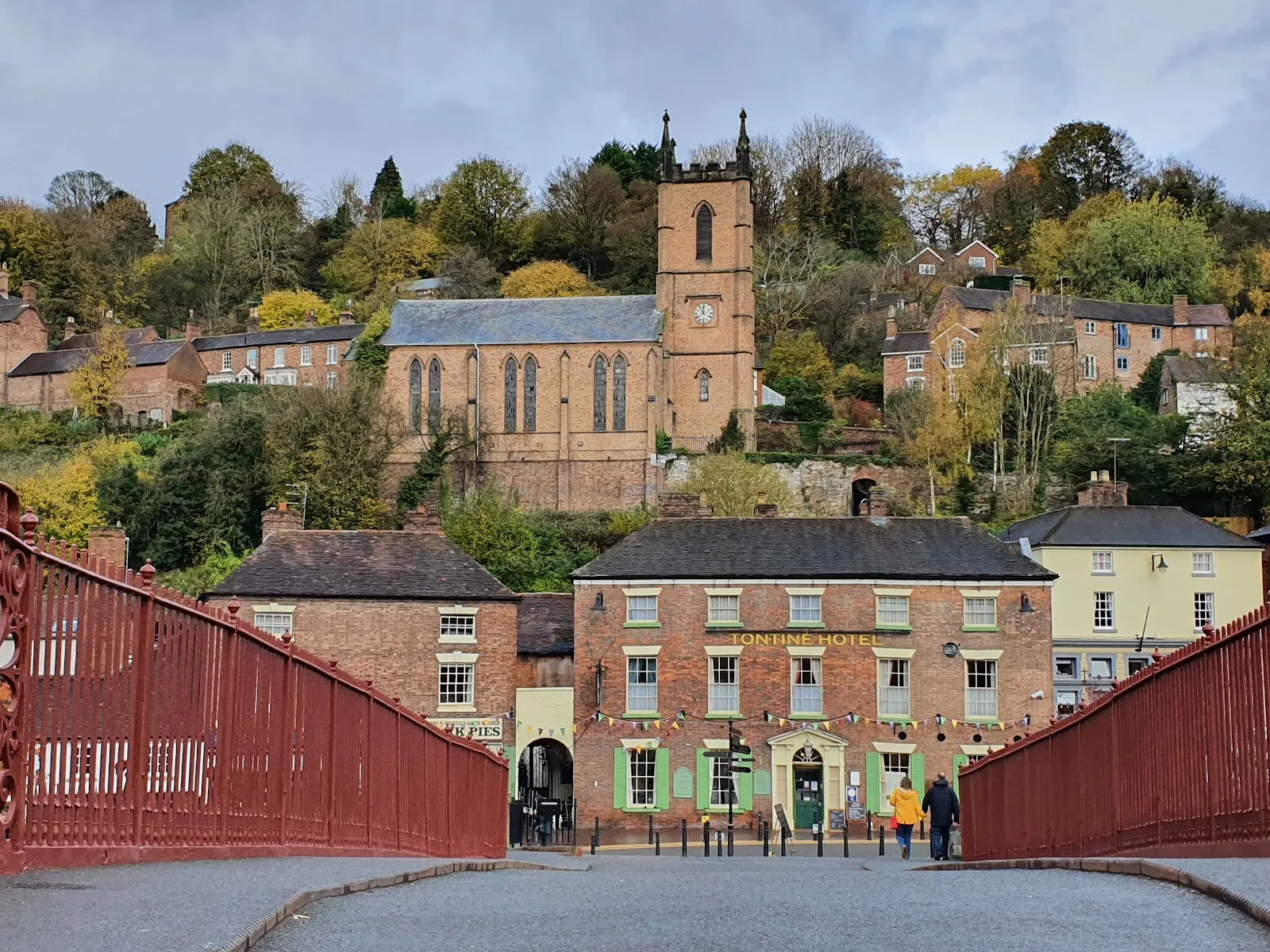
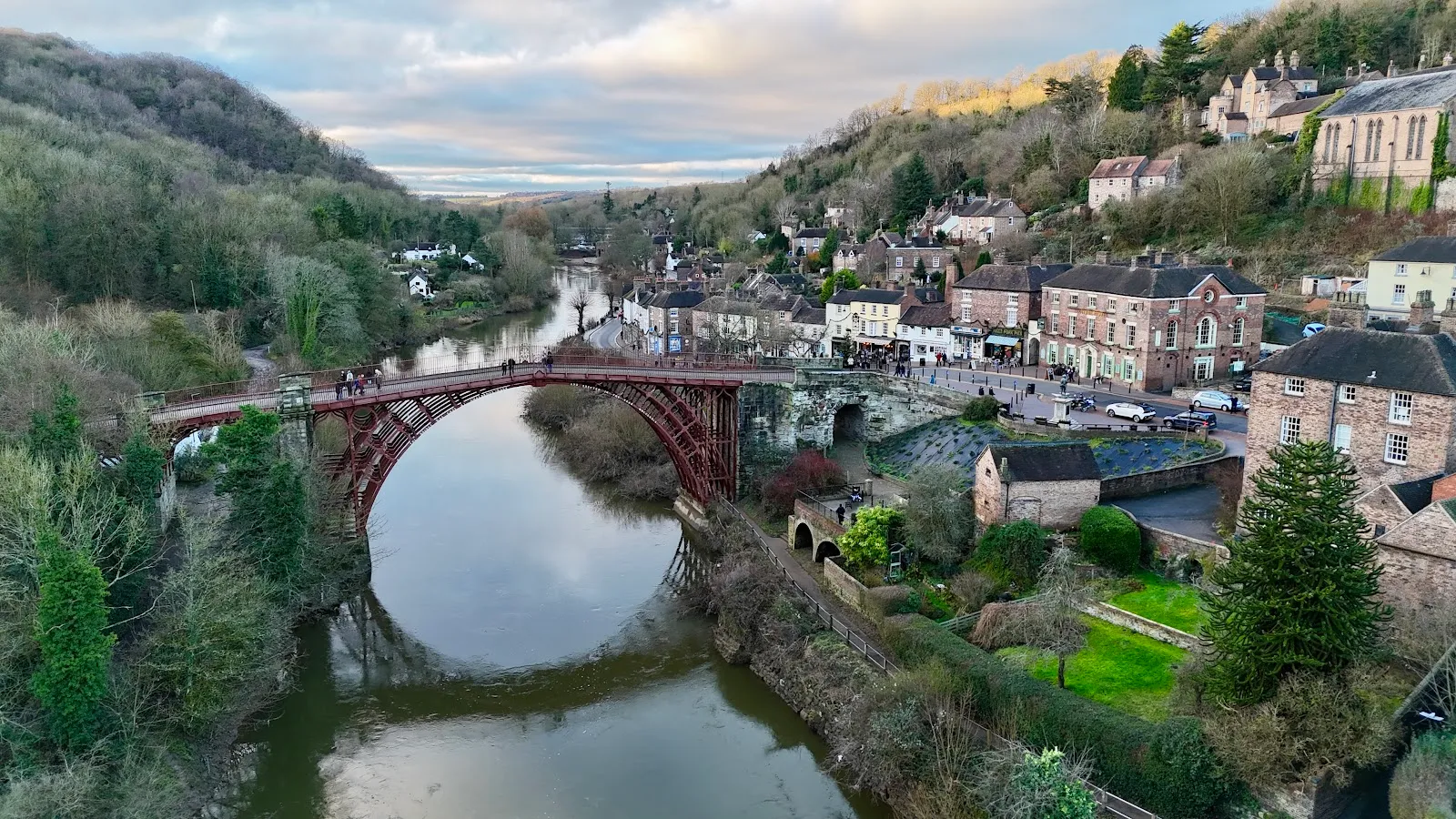
The Iron Bridge crosses the River Severn at Ironbridge in Shropshire, England. Completed in 1779, it was the first major bridge built from cast iron, and it gave the village its name. You can walk across it for free and look down the river and over the gorge. The Tollhouse beside it has a small exhibition on the bridge's history, and the Iron Trail begins here. The bridge is the focal point of the Ironbridge Gorge UNESCO World Heritage Site.
Why the bridge was built
Before the Darby family began smelting iron with coke in 1709, iron was costly and was used mainly for swords, knives and small goods. A new blast furnace nearby later brought the price of cast iron down, which made it practical for large structures.
The Severn had only a ferry service at this point, and the lack of a fixed crossing held back industry in the gorge. Plans were drawn up in 1775, and work began two years later.
The gorge had most of what ironmaking needed close at hand: coal, iron ore, water for power and transport, sand for moulding, limestone to flux the slag in the blast furnaces, and clay for tiles and bricks. The area was later named a UNESCO World Heritage Site in 1986, and the bridge is its focal point.
Who designed and built it
Thomas Farnolls Pritchard, a local joiner who became an architect, designed the bridge. Abraham Darby III, grandson of the man who first smelted iron with coke, built it. The castings were made at the family foundry at Coalbrookdale.
The bridge is about 100 feet long and is made from a single cast iron arch. At the time, many people doubted that a structure so large could be built from cast iron without collapsing under its own weight. It showed what the material could carry.
Walking across and around it
The crossing is free, and the views along the river and into the gorge are the main reason to linger. Drifting along the river by boat is another way to see the bridge from the water.
The Iron Trail is a circular walk of about 3.5 miles. It starts at the bridge and follows the Wharfage along the River Severn, then climbs to Coalbrookdale, Dale Coppice and Lincoln Hill. In the 18th century, these woods were laid out with walks for workers and their families, and with ornamental follies for the views. The view from where the Rotunda stood is a strong finish to the route.
The Tollhouse and nearby museums
The Tollhouse next to the bridge has a small exhibition on its history. Admission to the Tollhouse museum carries an additional charge.
The Museum of the Gorge, once the Severn Warehouse, is a short walk away. Its film explains the port-like area built around the Coalbrookdale Company. Visiting it before the bridge gives useful context for what you see on the crossing.
Blists Hill Victorian Town covers a 50-acre woodland site. Demonstrations there show the work and daily lives of the people of the Industrial Revolution.
The restoration
Over the years the bridge has faced stress in its ironwork from the original construction, ground movement in the gorge, and a 19th-century earthquake. English Heritage carried out work to preserve as much of the original fabric as possible.
A renovation costing about £1 million restored the bridge to its former strength and appearance, with its red exterior. Since restoration work was completed in 2018, the bridge has been illuminated at night.
Preguntas frecuentes
Is there an entry fee to see the Iron Bridge?
Crossing the Iron Bridge is free. The Tollhouse museum has additional charges.
Is the Iron Bridge wheelchair accessible?
Yes. The site lists a wheelchair accessible entrance, restroom, parking and seating.
Where can I park for the Iron Bridge?
Options include free and paid car parks, free and paid street parking, and park-and-ride facilities. You can also park alongside the river.
Is the Iron Bridge lit at night?
Yes. It has been illuminated at night since restoration work was completed in 2018.


