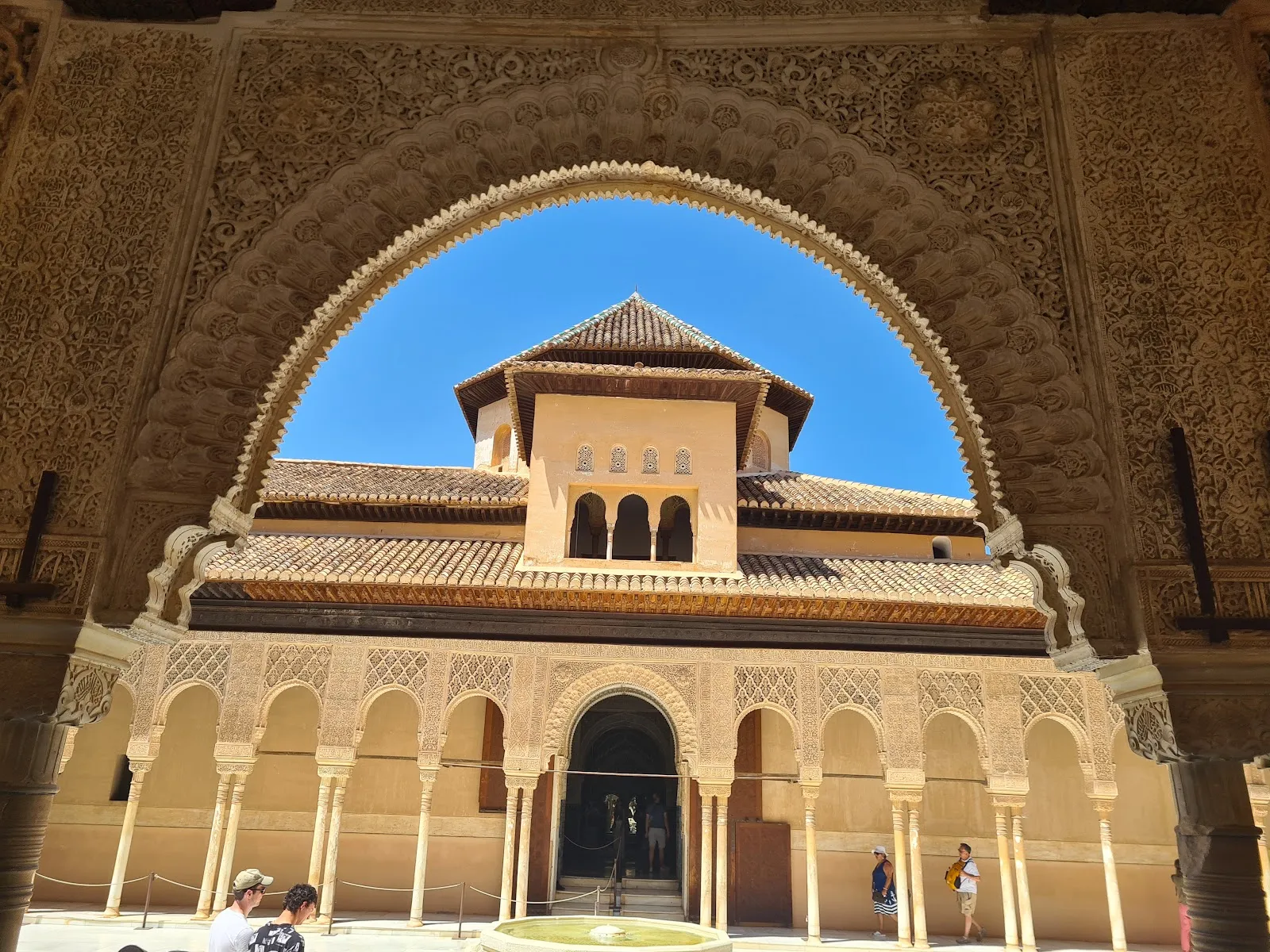
Inside Granada’s Alhambra, the Nasrid Palaces bring together royal residences built under the Nasrid dynasty, the last Islamic rulers of Granada. Their rooms and courtyards are known for finely worked stucco, geometric tile patterns, Arabic inscriptions and wooden ceilings. Look closely at the Court of the Lions, where a fountain rests on twelve marble lions among slender columns. Water, carefully shaped light and inward-facing courtyards give the interiors a quieter feel than the fortress walls outside. Book ahead and plan your visit around the timed palace entry on your ticket.
Three palaces, different roles
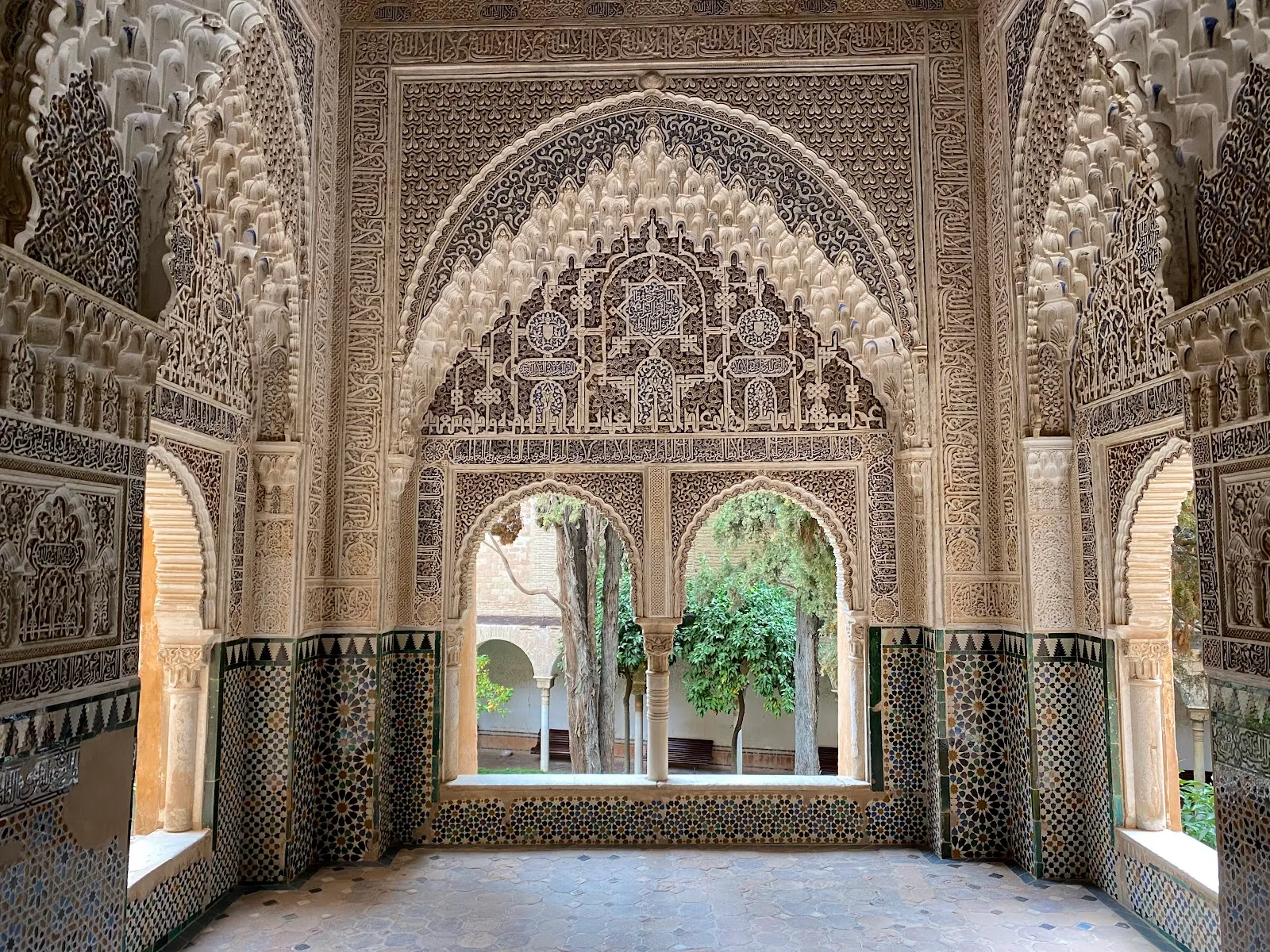
The Nasrid Palaces are a group of royal buildings within the Alhambra in Granada. Built mainly in the 13th and 14th centuries, they served as residences for the Nasrid rulers and as a centre for the work of their court. The last Nasrid rule in Granada ended in 1492.
The complex includes the Mexuar, the Palace of Comares and the Palace of the Lions. The Mexuar was associated with governance and judicial affairs. Comares was used for official audiences and ceremonial functions, while the Palace of the Lions served as a private royal residence. These different purposes help explain why the palaces are arranged as a series of connected spaces rather than a single grand hall.
Look closely at the decoration
The decoration rewards a slow visit. Finely carved stucco, geometric tilework, Arabic calligraphy and painted details cover walls and other surfaces. Wooden ceilings add another layer of craftsmanship overhead. Inscriptions include poetry and Qur’anic verses, so the writing is part of the architecture as well as an element to notice as you move through the rooms.
Give yourself time to look at the details from nearby instead of relying only on photographs. Courtyards and halls bring different patterns, materials and light into view. The intricate surfaces are among the clearest ways to appreciate the skill behind the palaces.
Courtyards, water and the Court of the Lions
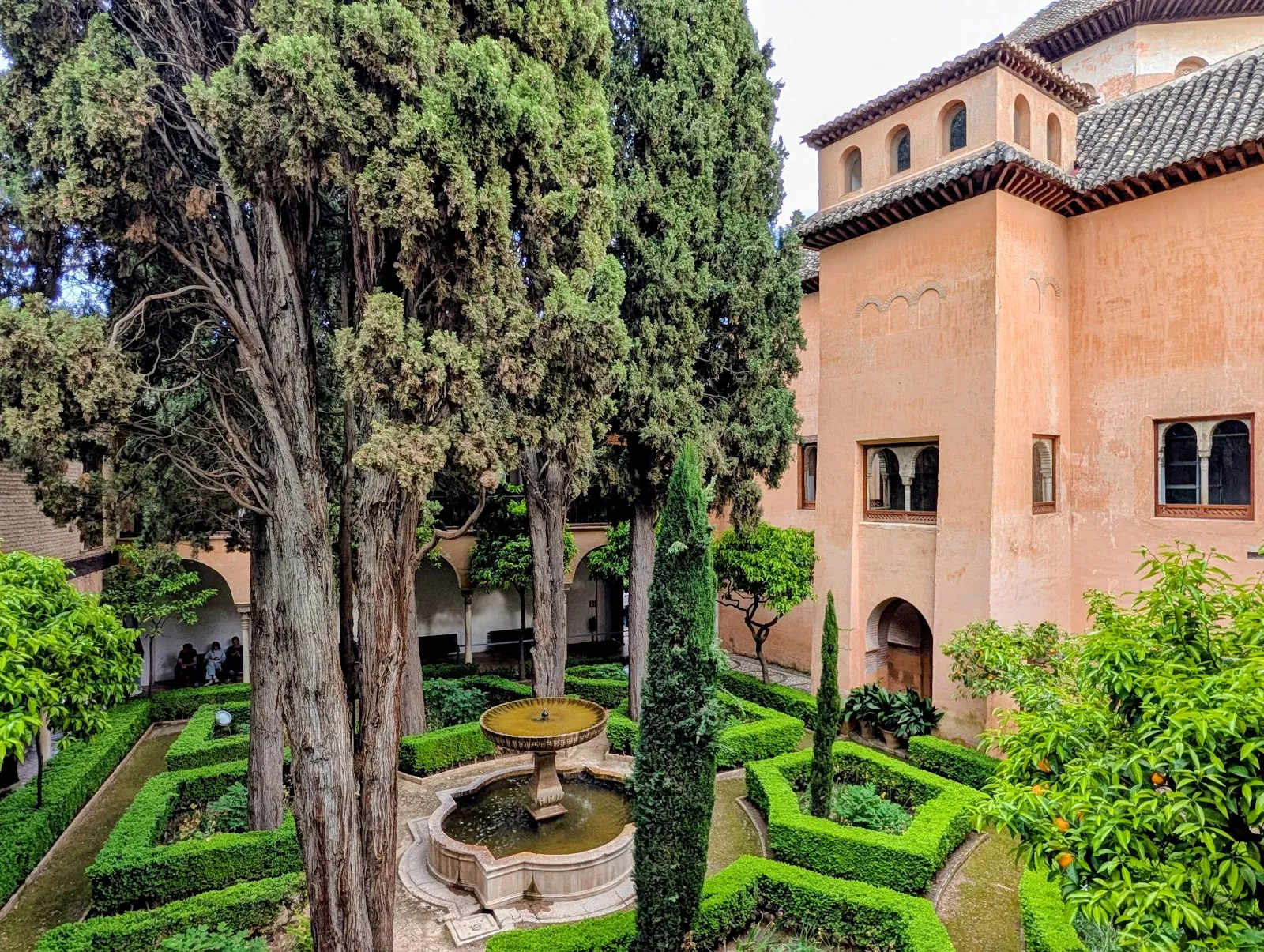
Many of the rooms open onto inward-facing courtyards. Their proportions, fountains and controlled light create a sense of privacy and calm within the palace complex. Water appears throughout the design as both a practical feature and a visual one, linking the built spaces with the courtyards.
The Court of the Lions is one of the most recognisable spaces. A central fountain rests on twelve marble lions, with slender columns surrounding the courtyard. Pause here to take in how the fountain, columns and surrounding decoration work together. The space is a useful place to notice the recurring relationship between water, geometry and ornament across the palaces.
Plan around your timed entry
Your Nasrid Palaces entry time is set on your ticket, so make it the anchor for your Alhambra visit. The rest of the complex can be visited outside that slot, but you cannot enter the palaces after your assigned time has passed. Check your ticket and find the entrance route before setting off; arriving in good time gives you room to reach the entry point.
Allow time to explore at a measured pace, and wear comfortable shoes for the stairs. The palaces are only one part of the Alhambra: the complex also includes the Alcazaba and the Generalife gardens. If you are visiting those areas too, plan your route around the palace slot. Summer visits can be hot, so bring water and a hat for shade.
Perguntas frequentes
Do I need to book Nasrid Palaces tickets in advance?
Yes. Tickets are in high demand, so book well ahead and check availability online.
Is entry to the Nasrid Palaces timed?
Yes. Your ticket has a specific entry time. If you miss that slot, you cannot enter the palaces.
How long should I allow for the Alhambra?
Allow at least 3 to 4 hours for the Alhambra, and longer if you want to explore at a relaxed pace.
What should I wear for a visit?
Wear comfortable shoes for the stairs. In summer, take water and a hat for shade.


