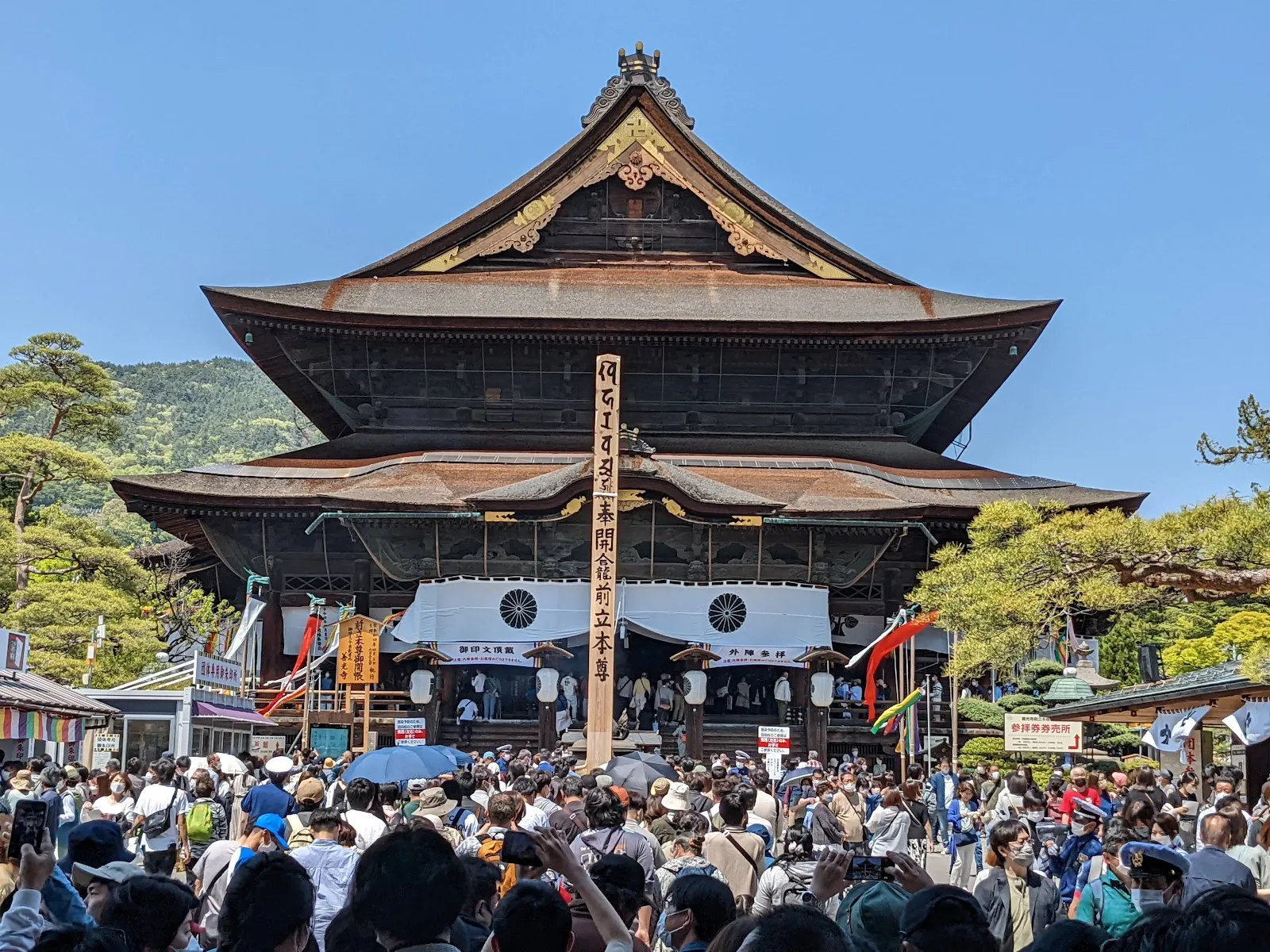
Zenkōji is a Buddhist temple on a hill in Nagano, about 2 km north of Nagano Station. It was founded in 642, and its main hall, a National Treasure, is the largest wooden structure in eastern Japan. You reach it along a cobblestone approach, through the Niomon Gate and the shop-lined Nakamise Dori. The temple has long welcomed pilgrims of any gender, creed or belief. Beyond the main hall you can walk a pitch-dark underground passage, listen to chanting, or stay overnight in one of the sub-temples.
A temple that built a city
Zenkōji was founded in 642 and is about 1,400 years old. It is counted among the most important Buddhist complexes in Japan. Nagano grew as a monzen-machi, a town that developed around a major temple, and it has drawn pilgrims for more than a thousand years. In the Edo period (1603 to 1867), people from all over Japan travelled here, and a saying arose that you should visit Zenkōji at least once in your life. The temple is said to receive as many as 6 million visitors a year.
Part of the temple's appeal is its open door. It has a long record of welcoming pilgrims regardless of gender, creed or religious belief.
The principal image, Ikkō-Sanzon, is said to be the first Buddhist image brought to Japan. It is kept hidden from public view. A copy is shown to the public only at the Gokaichō Matsuri, which comes round once every several years.
The approach and the main hall
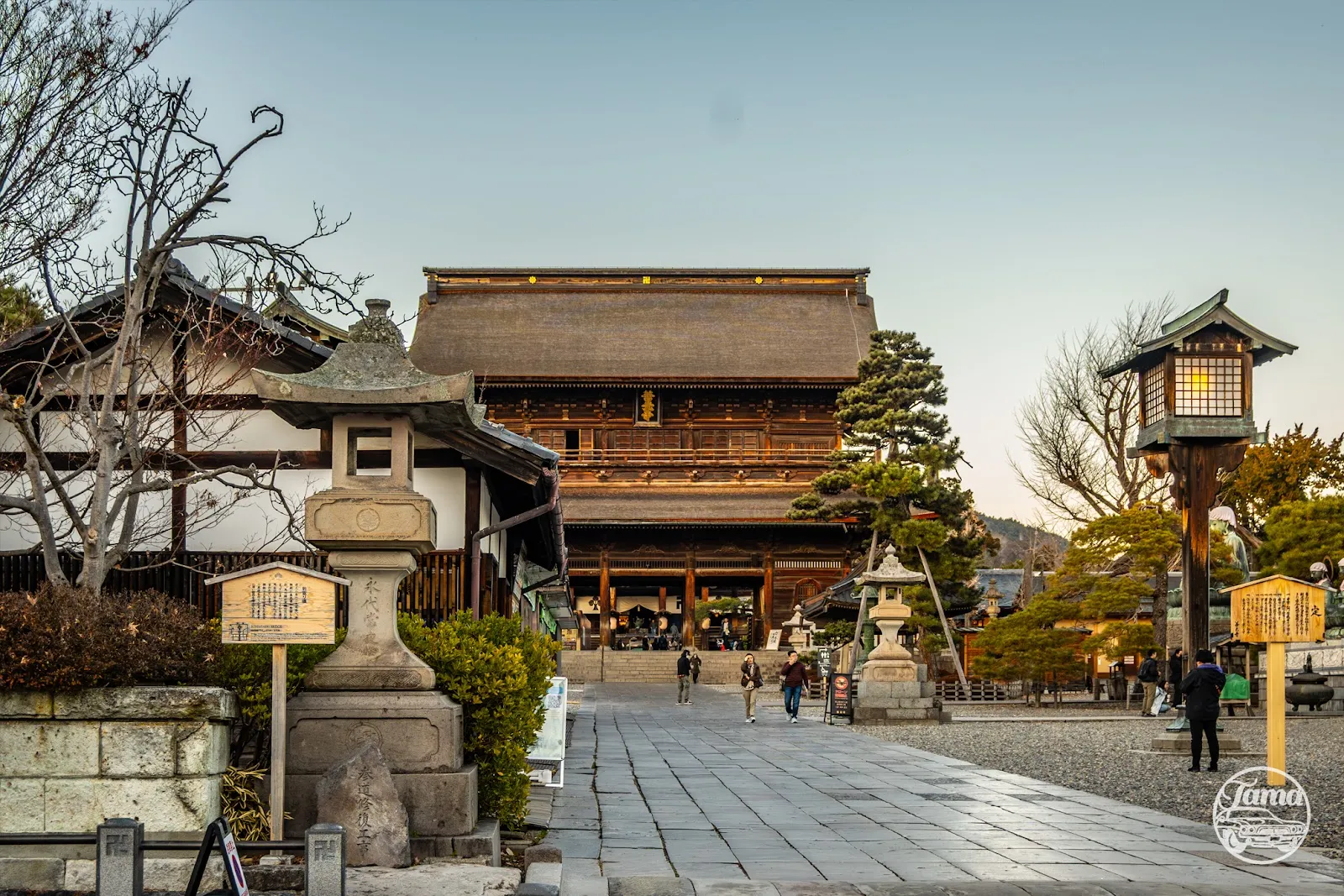
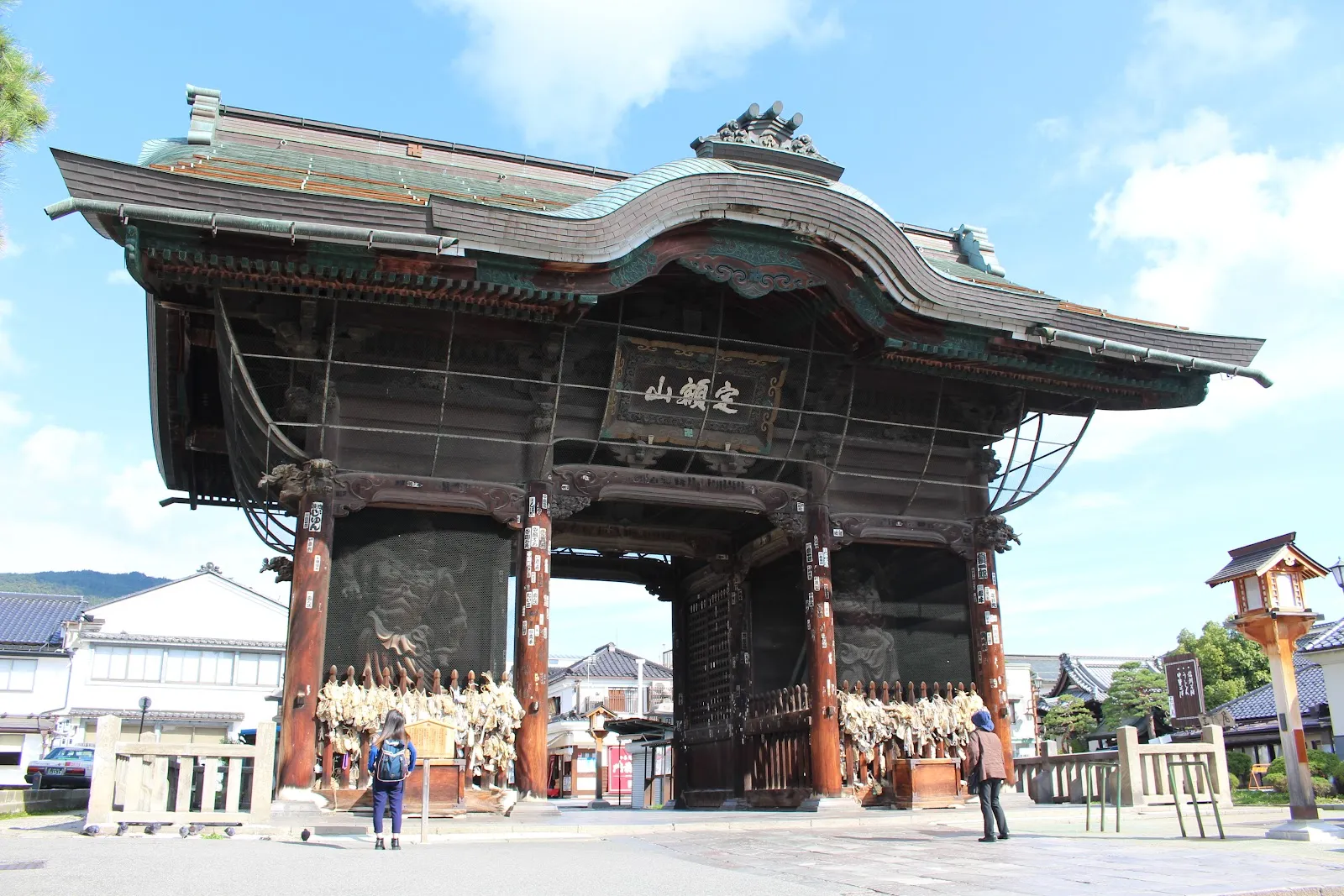
The walk up is part of the visit. The path to the main hall is paved with cobblestones. The first stop is the Niomon Gate, where two guardian statues stand on either side. The one on the left has its mouth open (A-form) and the one on the right has it closed (Un-form).
Past the gate, Nakamise Dori is lined with shops. This is where you can try Shinshu foods such as soba noodles and oyaki, the local filled dumplings. The temple sits on a hill above the town, set apart from the streets by lodgings, smaller temples and heavy wooden gates.
The present main hall was built about 300 years ago in the Shumoku style. It is a National Treasure and the largest wooden structure in eastern Japan. Take time for the grounds around it as well, with their small shrines, gateways, lanterns and gardens.
Ceremony, blessing and the dark passage
Inside the main hall, prayer ceremonies combine the sound of a conch shell, drums, the chanting of more than ten monks and the deep note of the temple bell. At the end, the chief priest may touch each visitor's head with Buddhist prayer beads in a blessing known as Ojuzu Chodai. An early morning visit can also include a blessing from the head priest before breakfast.
Zenkōji is unusual in Japan because two Buddhist traditions look after it together: Daikanjin of the Tendai school and Daihongan of the Jodo school.
The optional underground passage is entered with a ticket for the main hall and museum. It is completely black. You walk with your hand along the wall as your only guide. Visitors of all beliefs describe it as a quiet, inward experience.
Seasons, festivals and staying overnight
Cherry blossom in spring fills the grounds with pink and white. In November the Japanese maples turn red, and crowds are thinner than in spring. At the end of February, a festival has drawn thousands of people to the area at night. The temple is lit up, lanterns line the streets and shops stay open late. During illumination events, Zenkōji is lit in the five Olympic colours, with lanterns along the street from the station to the temple. Music and sake tasting are sometimes part of it.
There are 39 sub-temples on the grounds, called shukubo, and they accept overnight guests who want to experience a temple stay.
Getting there and what is nearby
From Tokyo Station, the shinkansen reaches Nagano Station in about 1.5 hours. The temple is roughly 2 km north of the station. Chuo-dori connects the two, and walking up gives you the chance to see shops and boutiques on the way. Buses also run to the temple. A paid parking lot is available, and the entrance and parking have wheelchair access.
The Nagano Prefectural Art Museum is a short walk away and shows rotating exhibitions, many by artists from Nagano Prefecture. Next to the temple, Joyama Park holds the Nagano City Youth Science Museum and Joyama Zoo, a useful stop if you are travelling with children.
Perguntas frequentes
How long do you need at Zenkōji temple?
Allow about two hours to walk the approach, see the main hall and explore the grounds. Add time if you want to walk the underground passage or attend a ceremony.
Can you see the main Buddha statue at Zenkōji?
No. The principal image is kept hidden from public view. A copy is displayed only at the Gokaichō Matsuri, which is held once every several years.
Is the underground passage really dark?
Yes, it is completely black. You walk with one hand on the wall as your guide. It is entered with the main hall and museum ticket.
Can you stay overnight at Zenkōji?
Yes. There are 39 sub-temples on the grounds, called shukubo, that accept guests for a temple stay.
How do you get to Zenkōji from Nagano Station?
The temple is about 2 km north of the station, on a hill. You can walk up Chuo-dori, which links the two, or take a bus.
When is Zenkōji least crowded?
Early in the morning and on weekdays. Weekends and holidays bring long lines, and popular sights in Nagano tend to fill up from about 10 a.m. November is quieter than the cherry blossom season.