St Euphemia's Church sits on the hilltop at the heart of Rovinj's old town, on the Istrian coast of Croatia. Built in the 18th century, it is Istria's largest Baroque church, and its bell tower, modelled on the one in Venice, is the first thing most people see of the town. Inside, marble columns, statues and paintings fill the side altars. The main draw is the climb to the top of the tower, where the view reaches over the Adriatic, the old town and the islets.
From earlier churches to the Baroque building
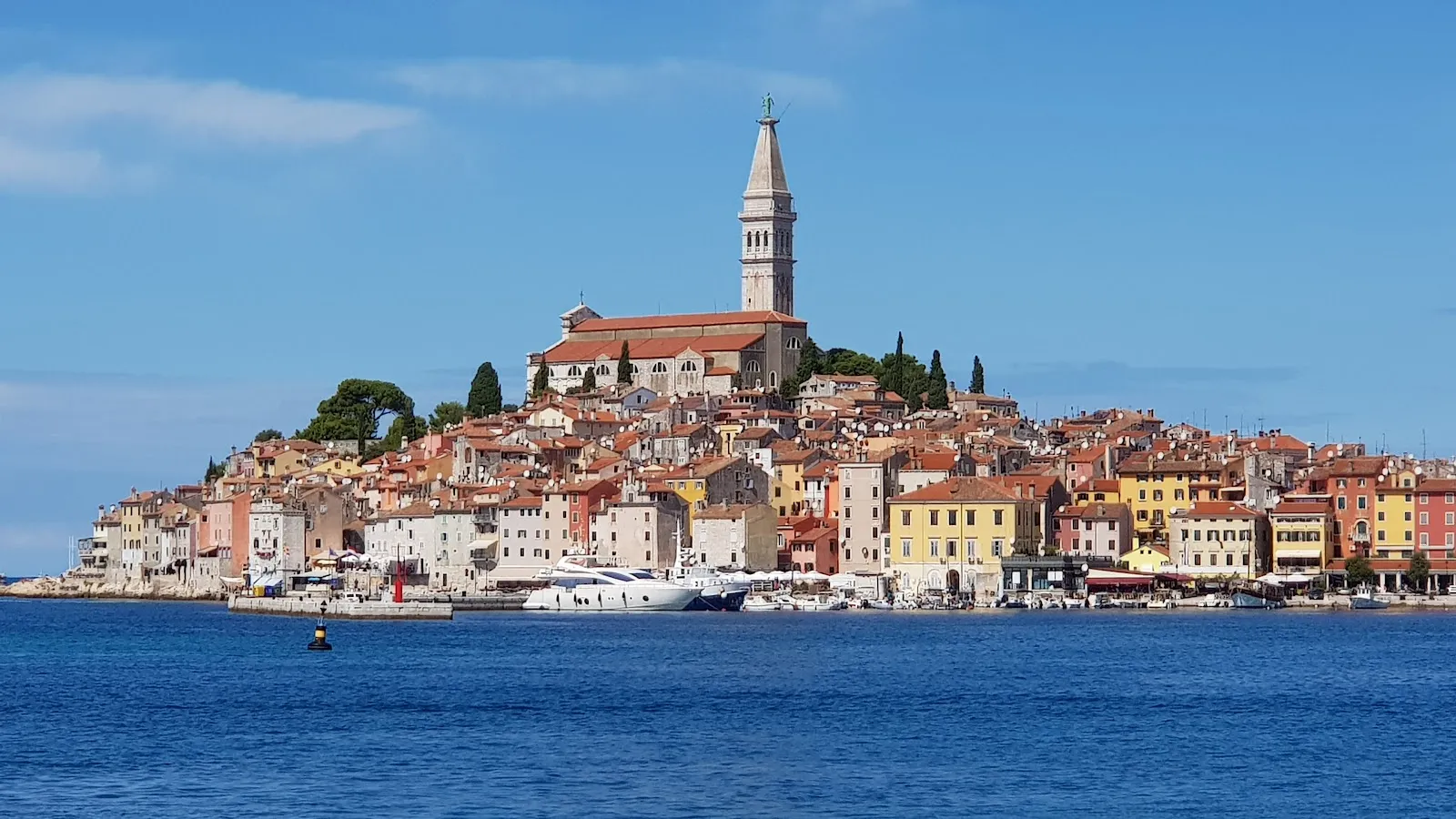
A church has stood on this hilltop for centuries. The first one here was dedicated to St George. The site grew busier once pilgrims began to come to the tomb of Saint Euphemia, and a larger church was built to receive them.
The present building was put up in the Baroque style between 1725 and 1736, when Venetians controlled Rovinj and brought their architects with them. The church is often called Istria's largest Baroque church. Its main front was rebuilt later. An inscription on the lintel above the main doors records the work, carried out from 1861 to 1865 to a design by Rovinj architect Giacomo Depozza.
The bell tower and the copper statue
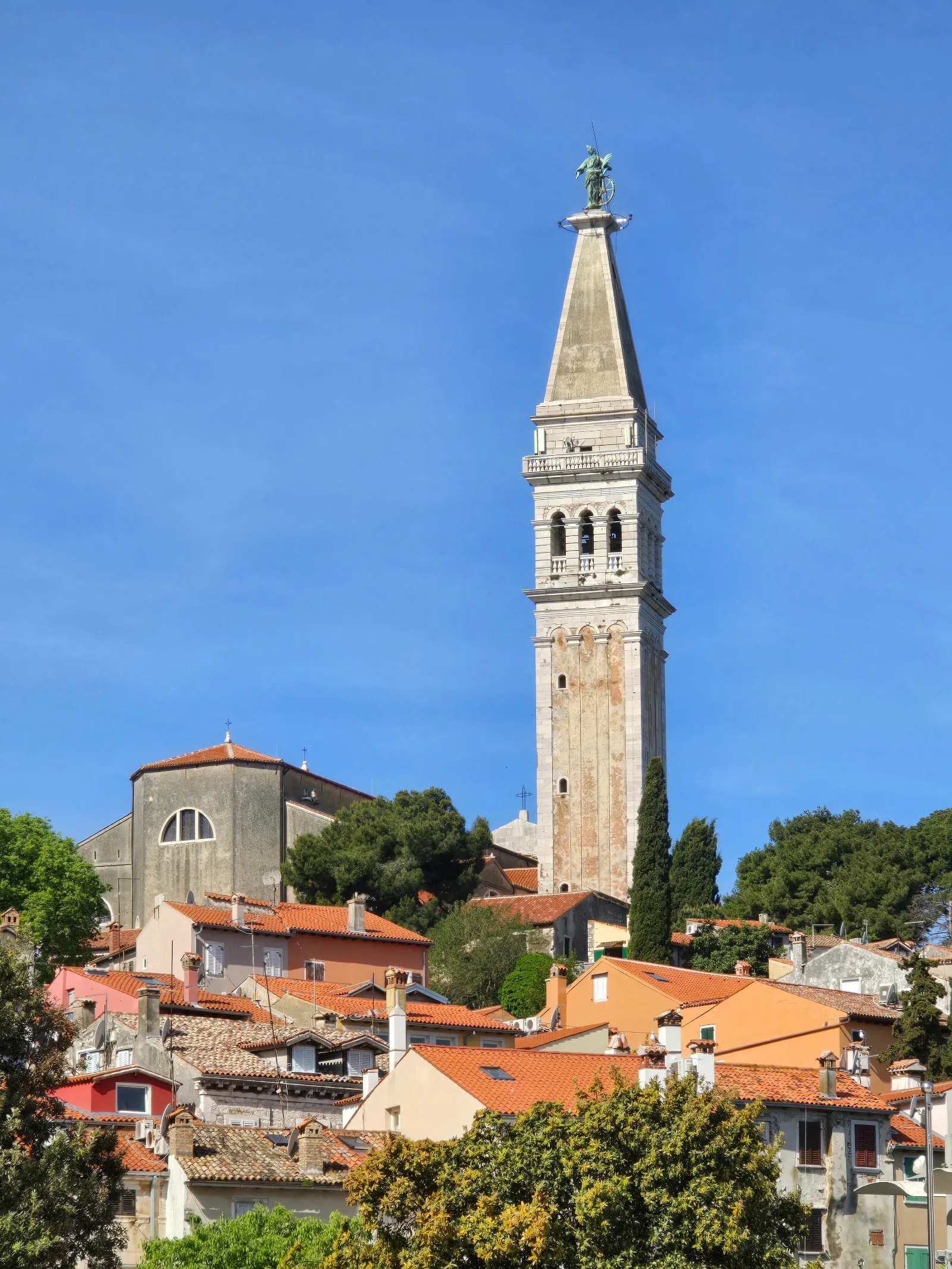
The bell tower rises about 60 metres above the town. Its design follows the campanile of St Mark's in Venice. Work on the tower began in 1654, before the present church, and took 26 years to finish.
On top stands a copper statue of St Euphemia, about 4 metres tall, mounted on a spindle so it turns with the wind. Local lore holds that the way she faces tells fishermen what to expect. Turned toward the sea, she signals clear skies. Turned inland, a storm is coming.
Inside the church
The Baroque design shows in the marble columns and the side altars, which hold marble statues and paintings. The decorated columns are among the details that stand out first.
Beside the front door is a copy of a Gothic bas-relief showing St Euphemia holding a model of the town. The original is kept on a wall of the presbytery. The interior feels calm and well kept. The church is used for weddings and for choral singing. In summer it can get very warm, so an early visit is more comfortable. Staff and volunteers are glad to answer questions about the church's history.
Climbing the bell tower
The climb has 192 steps. They are narrow and steep, and some are worn smooth. Gaps between the steps let you see straight down through the tower, and there are no safety nets, so take the climb slowly.
At the top, the view covers the red roofs of the old town, the port, the islets and the open sea. The walled grounds in front of the church also give wide views, and the western side is a popular spot for watching the sun go down over the water.
The legend of Saint Euphemia
Euphemia was a young Christian woman from a wealthy family. She refused to give up her faith, and legend says she was thrown to lions under Emperor Diocletian. According to the story, the animals would not harm her.
After a storm, her body is said to have floated into the port at Rovinj in a marble sarcophagus. Her relics are kept inside the church, in a sarcophagus said to be from the 6th century. She is the patron saint of the town, and the church bears her name.
Around the church
The church stands at the top of the old town, and the streets below lead up to it. Grisia, the artists' street, runs toward the church. Its galleries and small shops sell paintings, jewellery and sculpture. Every August the street holds a day-long arts festival, when studios open their doors.
Balbi's Arch, one of the old town's seven gates, is a short walk away. The Museum of the City of Rovinj is housed in the Baroque Califfi palace. The Batana Museum tells the story of the flat-bottomed wooden boat that gives it its name and the fishing tradition behind it.
Perguntas frequentes
Can you climb the bell tower?
Yes. The tower has 192 steps that are narrow and steep, and the climb costs money. It is not suitable for anyone who is afraid of heights or has limited mobility.
Is the church warm in summer?
It can get very warm in summer, so an early visit is more comfortable.
Where is St Euphemia's Church?
It stands on the square at the top of Rovinj's old town, at Trg Sv. Eufemije. The walk up the old town's streets leads to it.
Who was St Euphemia?
She was a Christian martyr and is the patron saint of Rovinj. Legend says she was thrown to lions under Emperor Diocletian and that her sarcophagus later washed ashore at Rovinj.