Sensō-ji is a Buddhist temple in Asakusa, Tokyo, dedicated to Kannon, the bodhisattva of compassion. Enter beneath Kaminarimon Gate and follow Nakamise Street past stalls selling traditional snacks and souvenirs to the temple grounds. Look for the main hall, the five-story pagoda and the incense burner, where people pause to pray or reflect. The grounds can be busy, especially as the day goes on; early morning and evening bring a quieter feel, and the buildings are illuminated after dark.
Why the buildings are newer than the temple
By tradition, Sensō-ji dates to 628, when two fishermen pulled a small statue of Kannon out of the Sumida River. Their village headman turned his house into a shrine for it, and the temple grew from there. The statue has never been put on public view. What people pray to in the main hall is a closed altar.
Air raids in March 1945 burned the main hall, the pagoda and most of the complex, and the temple spent the next three decades putting it back. The main hall was completed in 1958, Hōzōmon followed in the 1960s and the five-story pagoda in the 1970s, all in concrete under traditional roofs. Kaminarimon had burned in the 1860s and went up again only in 1960. Asakusa Shrine next door, built in the 17th century, is one of the few structures that came through the war.
Most visitors arrive at midday from Asakusa Station and walk straight up the middle. Before 8am or after dark the complex has fewer tour groups, softer light and room to stand under the lantern.
Kaminarimon and the dragon under the lantern
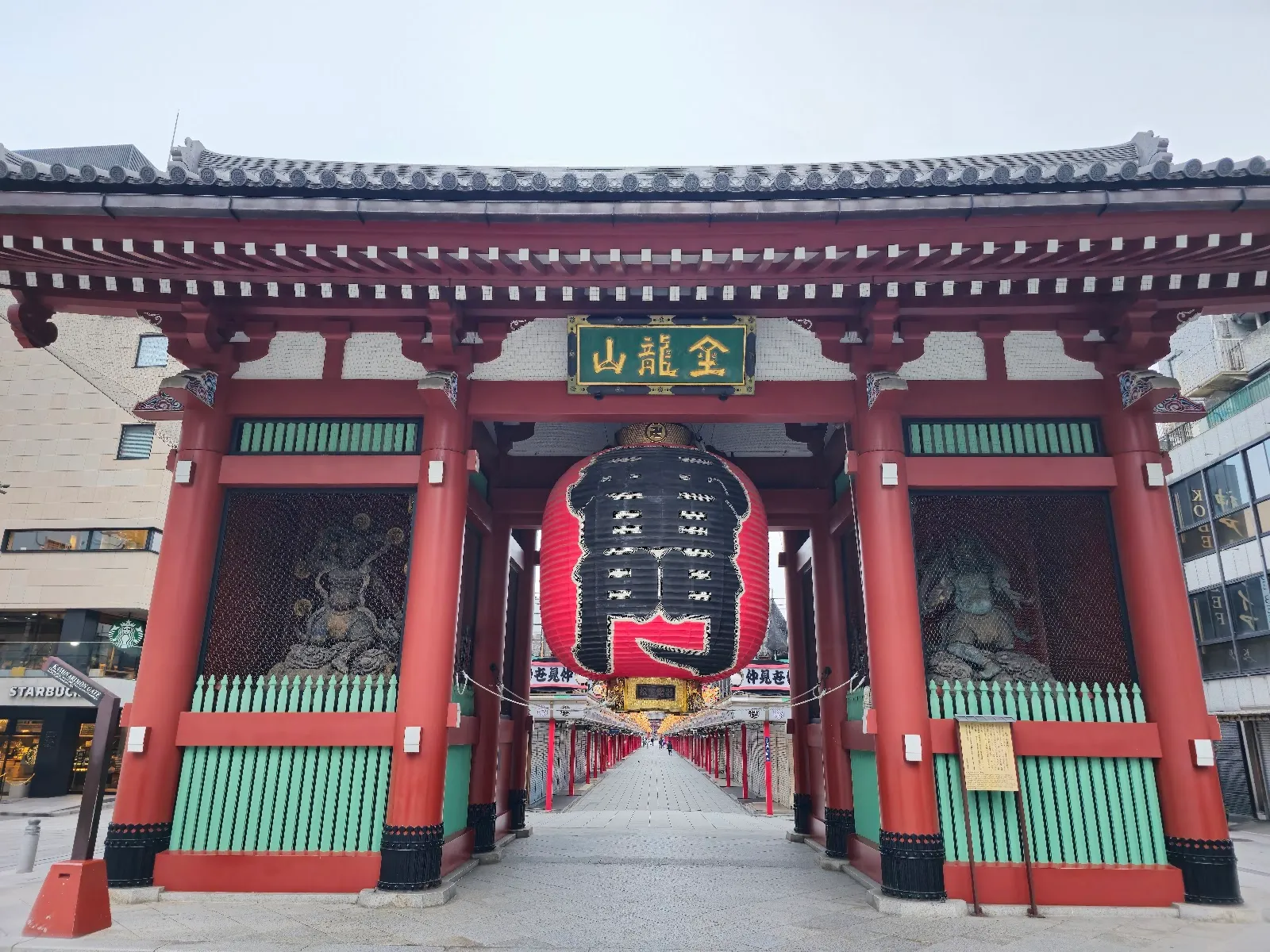
Statues of the wind and thunder gods stand in the side bays of the gate, one on each side behind a grille. The red lantern in the middle is the photo everyone takes. Stand just inside the gate and shoot back toward the street to get it without the crowd, then look straight up: the underside of the lantern is carved with a dragon that most people walk beneath without noticing.
The gate stands on Kaminarimon-dōri, where rickshaw pullers tout rides and tour buses unload. Before 8am there are neither. By 10am on a weekend you can expect to queue for a clear shot, so if you only make one early start in Tokyo, this is a good place to spend it.
The gate is younger than it looks. After the fire of the 1860s the site stood empty for almost a century, until the founder of the electronics maker now called Panasonic paid for the present gate in 1960. The lantern has been replaced several times since. If you want to follow local custom, bow slightly as you pass under it and keep to one side of the path, because the middle is traditionally left for the deity.
Nakamise-dōri: eat here, skip the souvenirs
About 250 meters (820 feet) of stalls run from the gate to the temple. Shops set their own hours. Early in the morning the street is shuttered and empty, and the painted shutters, which show scenes from Asakusa's festivals, are worth the walk on their own.
The souvenirs repeat every few doors, so spend your money on food: rice crackers grilled while you wait, ningyō-yaki cakes filled with red bean paste, and sweet potato and matcha sweets that change with the season.
It is polite to eat at the stall rather than while walking. Most stalls have a spot to one side where you can stand and finish, and a bin for the wrapper, which matters because there are almost no public bins on the grounds. At midday Nakamise squeezes the crowd into one stream. If it is shoulder to shoulder, use the lanes that run parallel to it on either side.
Hōzōmon, the incense burner and the main hall
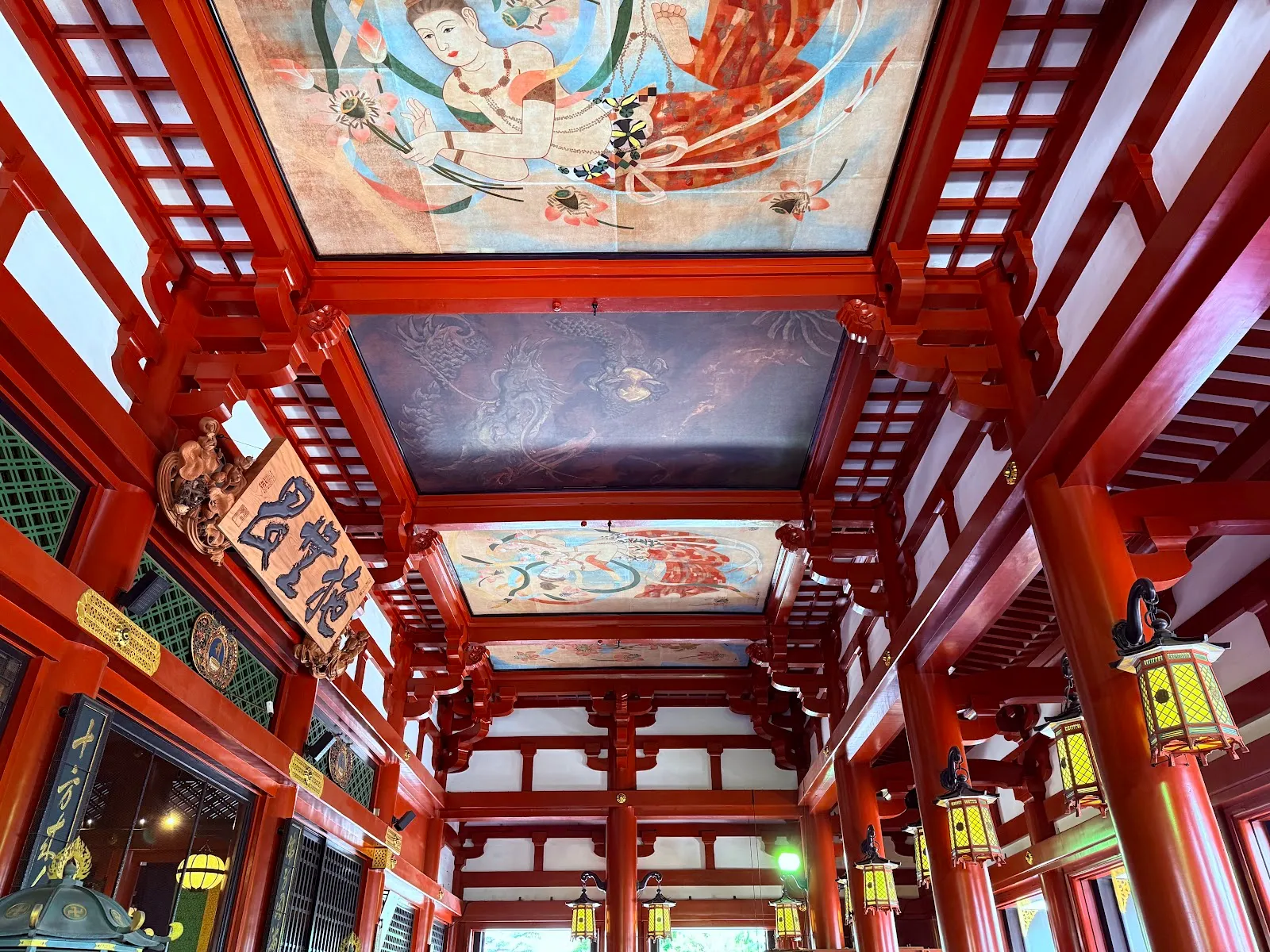
Past Nakamise you go through Hōzōmon, the second gate, where a pair of giant straw sandals hangs on the back wall, and into the main courtyard. In front of the main hall stands a large bronze burner. People buy a bundle of incense for a small coin, light it, add it to the burner and waft the smoke toward whatever part of the body they want to heal. Head and shoulders are the popular choices. Nearby is a water basin where you rinse your hands before you go up the steps.
Inside, drop a coin in the offering box, bow and pray quietly. Photos of the inner altar are not allowed. The main hall is open 6am to 5pm, and from 6:30am October to March. The grounds never close.
The five-story pagoda stands to the left of the courtyard as you face the hall. It is not open to visitors, but the view of it beside Hōzōmon from the steps of the main hall is the best in the complex. To the right of the hall, Asakusa Shrine is a smaller, quieter building with its own gate, and a good place to sit for five minutes once you have seen the main hall.
Drawing an omikuji
Put the fee in the box, shake the metal canister until a stick falls out, and read the number on the stick. It is written in kanji, and so are the numbers on the wooden drawers beside the canisters, so match the characters rather than looking for Arabic numerals. Take one slip from the matching drawer and put the stick back in the canister. The slip gives a short verse, a verdict from great blessing down to bad fortune, and brief answers on wishes, illness, travel, lost things and marriage, with an English translation printed alongside.
If your fortune is a bad one, fold it and tie it to the rack so the bad luck stays at the temple. A good one goes in your wallet. Bad fortunes come up here more often than at most temples and shrines, which is why the racks are always full.
After dark
The main hall closes at 5pm, but the grounds stay open. From sunset until around 11pm the main hall, the pagoda, Hōzōmon and Kaminarimon are lit, and the courtyard is close to empty on weeknights. The pagoda glows against the dark, you can stand in the middle of the courtyard without walking into anyone, and the shutters on Nakamise are down once the shops have closed.
What you miss at night is the interior of the main hall and the snack stalls, which keep their own hours. Do both in the morning, then come back after dinner for the lighting.
Getting there and the crowded dates
Asakusa Station is served by the Tokyo Metro Ginza line, the Toei Asakusa line and Tobu trains. From Ginza line exit 1, Kaminarimon is a 2-minute walk; from the Asakusa line or Tobu platforms allow 5. The Tsukuba Express has a separate Asakusa Station about 10 minutes west. From Ueno the Ginza line takes about 5 minutes, and from Shinjuku or Shibuya allow 35 to 45 minutes with one change.
The time of day matters more than the day of the week. Before 8am and after dark are the two good windows; 10am to 4pm is busy every day and very busy at weekends. The first three days of January bring some of the biggest crowds of the year for New Year prayers, and the Sanja Matsuri at Asakusa Shrine, usually on the third weekend of May, fills every lane around the temple. Both are worth seeing if crowds are what you came for, and worth avoiding if you want to see the buildings.
Preguntas frecuentes
Is Sensō-ji free to visit?
The temple grounds are free to enter.
How long should I spend at Sensō-ji?
Allow around two to three hours to walk through Nakamise Street, explore the grounds and browse the stalls.
When is the best time to visit Sensō-ji?
Early morning or evening is a good choice for a quieter visit. The buildings are illuminated after dark.
What can you do at Sensō-ji?
Walk through Kaminarimon Gate and Nakamise Street, see the main hall and five-story pagoda, pray or reflect, and draw an omikuji fortune.