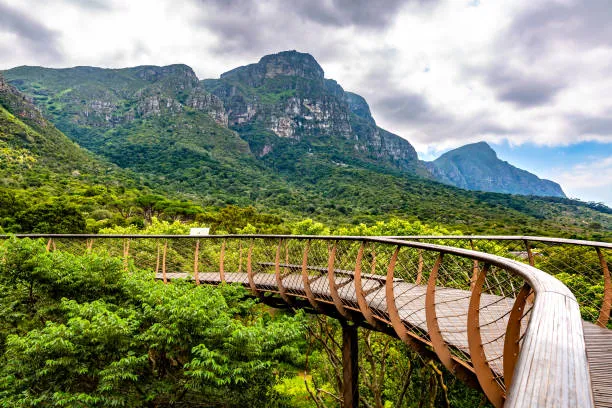
Kirstenbosch National Botanical Garden lies on the eastern slopes of Table Mountain, about 13 km from central Cape Town. Founded in 1913, it was the first botanical garden in the world devoted to a country's own plants. Paths lead through themed gardens, a sculpture garden, forest and fynbos. The Boomslang canopy walkway rises through the trees with views over the garden and the Cape Flats. Wide lawns suit picnics, and two restaurants serve meals. Walking routes range from gentle to steep, so allow at least a few hours.
Founded in 1913 for southern Africa's own plants
Kirstenbosch opened in 1913 to promote, conserve and display the flora of southern Africa. It was the first botanical garden in the world devoted to a country's indigenous plants. Harold Pearson, a botanist, became its first director and worked on the garden for years.
The land lies on the lower slopes of Table Mountain. It was once part of a large estate owned by Cecil Rhodes, and earlier belonged to the Dutch East India Company and was used as a vineyard. The estate was later given to the nation. Today the garden is run by the South African National Biodiversity Institute (SANBI).
The garden belongs to the Cape Floral Region, a UNESCO World Heritage Site. Much of what grows here is fynbos, the fine-leaved shrubland found only in South Africa's Western Cape. Proteas, the national flower, are part of that vegetation.
Gardens and collections to look for
The estate covers 528 hectares. Only a small part is laid out as cultivated garden, and the rest is natural forest, fynbos and mountain slope. A map helps, because the themed areas are spread out.
The fragrance garden and the Braille trail are made for touch and smell. A kopje, a small hill, is planted with pelargoniums. There are also a medicinal garden, a section of useful plants, a Protea garden and the cycad amphitheatre, where life-size dinosaur models stand among the ancient plants. The sculpture garden shows stone and other artworks set among the plantings. A nursery sells plants if you want to take a piece of the garden home.
Gate 1, the main entrance at the Newlands end, has the information centre, a souvenir shop and the conservatory.
The Boomslang canopy walkway
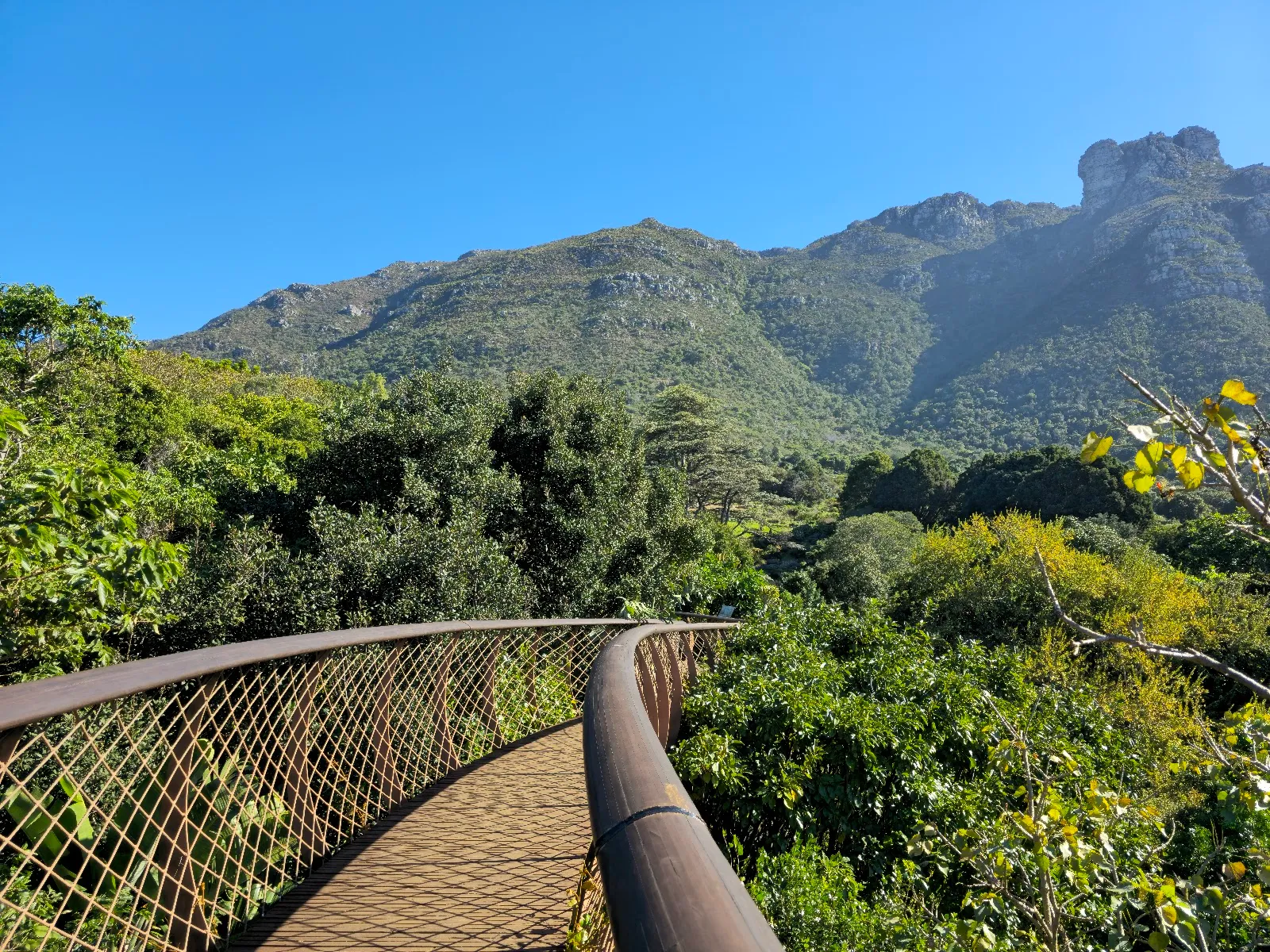
The Tree Canopy Walkway was added for the garden's centenary in 2013. Most people call it the Boomslang, the Afrikaans word for tree snake, after its curving shape. It is a steel and timber bridge about 130 metres long that rises through the arboretum.
From the walkway you look down on the garden and out to the Cape Flats beyond. It is also a good place to watch birds at close range.
Trails, waterfalls and wildlife
Beyond the lawns, the garden joins a wider nature reserve that borders Table Mountain National Park. Skeleton Gorge, a hiking route, starts from here. The Yellowwood Trail leads to a waterfall that runs year-round and is at its best after the winter rains. The contour path enters the garden near the Big Rock, through dense forest, and has many steep steps up and down. A six-kilometre route runs between Constantia Nek and Kirstenbosch, with a stop at the Tea Room for breakfast.
The garden is also a place for wildlife. Birds are everywhere, and mongooses, lizards and tortoises cross the stone paths. Binoculars are useful. Guided walks, including family-focused ones, are offered at times, and some routes are paved and gentle.
The entrance, parking area and restrooms are wheelchair accessible.
Picnics, meals and summer events
There are two places to eat: the Kirstenbosch Tea Room, popular for breakfast, and the Moyo Restaurant. Both sell pre-packed picnic baskets, or you can bring your own and settle on a lawn under a shady tree. Dogs are allowed on the designated dog-walking paths.
Sunday afternoon concerts take place outdoors from November to March, and are a Cape Town tradition. Summer sunset concerts and open-air movie nights are also held on the lawns. The garden also hosts art exhibitions and festivals during the year.
FAQ
Is there an entry fee at Kirstenbosch?
Yes, the garden charges a modest entrance fee. Buying tickets in advance is recommended.
How long do you need at Kirstenbosch?
Allow at least a few hours. With a picnic or a longer trail such as Skeleton Gorge, it can fill a whole day.
Can you bring a picnic?
Yes. Bring a basket and blanket, but no chairs, tables or umbrellas. You can also order a basket from the Tea Room or Moyo Restaurant. There are no rubbish bins, so take your litter with you.
When are the concerts?
Outdoor concerts take place on Sunday afternoons from November to March. Summer sunset concerts are also held, so check the programme before you go.
When is the best time to see the flowers?
August to November is the recommended window for the fynbos in bloom. The garden is open all year, and the Yellowwood Trail waterfall is at its best after the winter rains.
Is Kirstenbosch suitable for children?
Yes. There are wide lawns to run on, dinosaur models, the canopy walkway and a Braille trail. The entrance, parking and restrooms are wheelchair accessible.