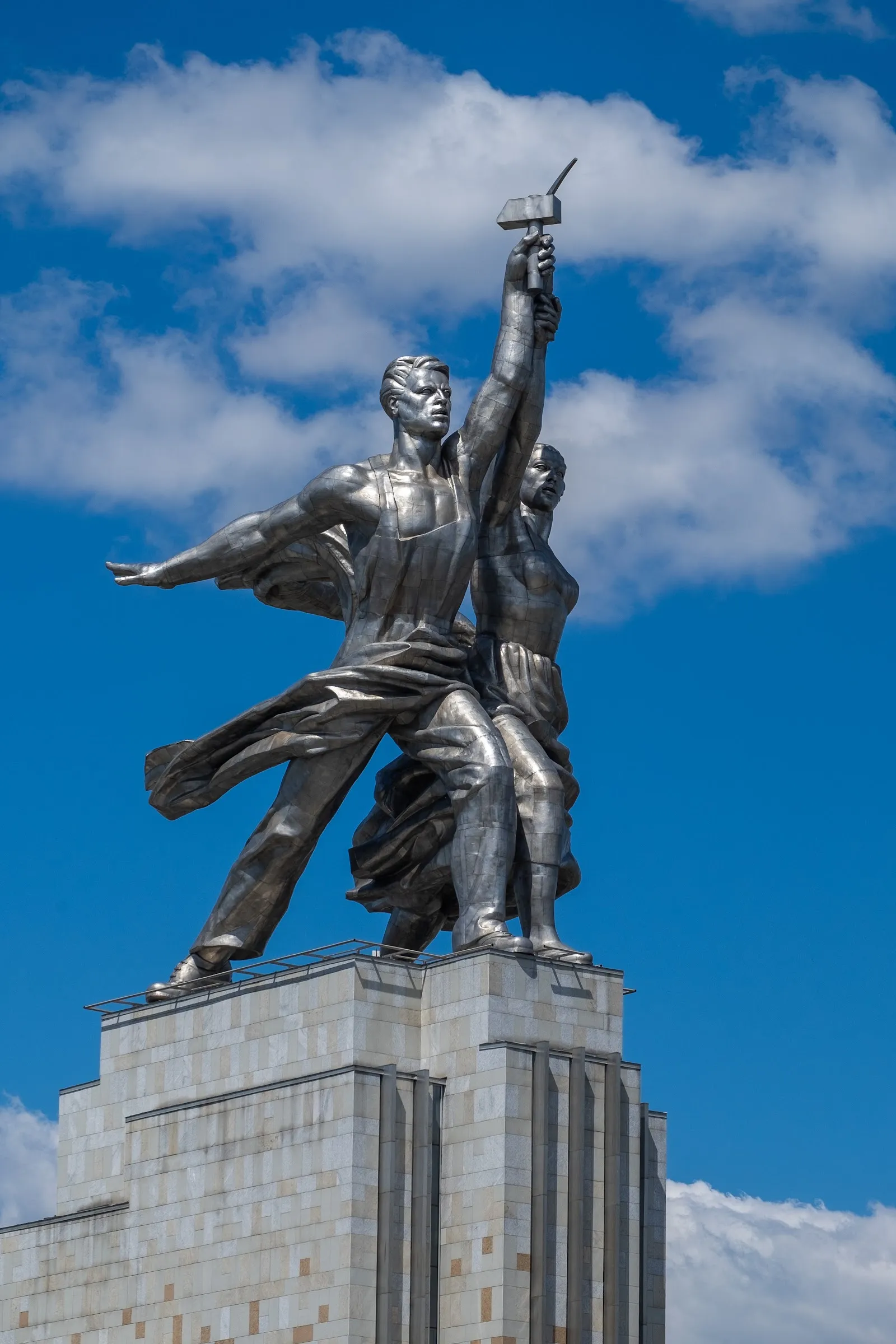
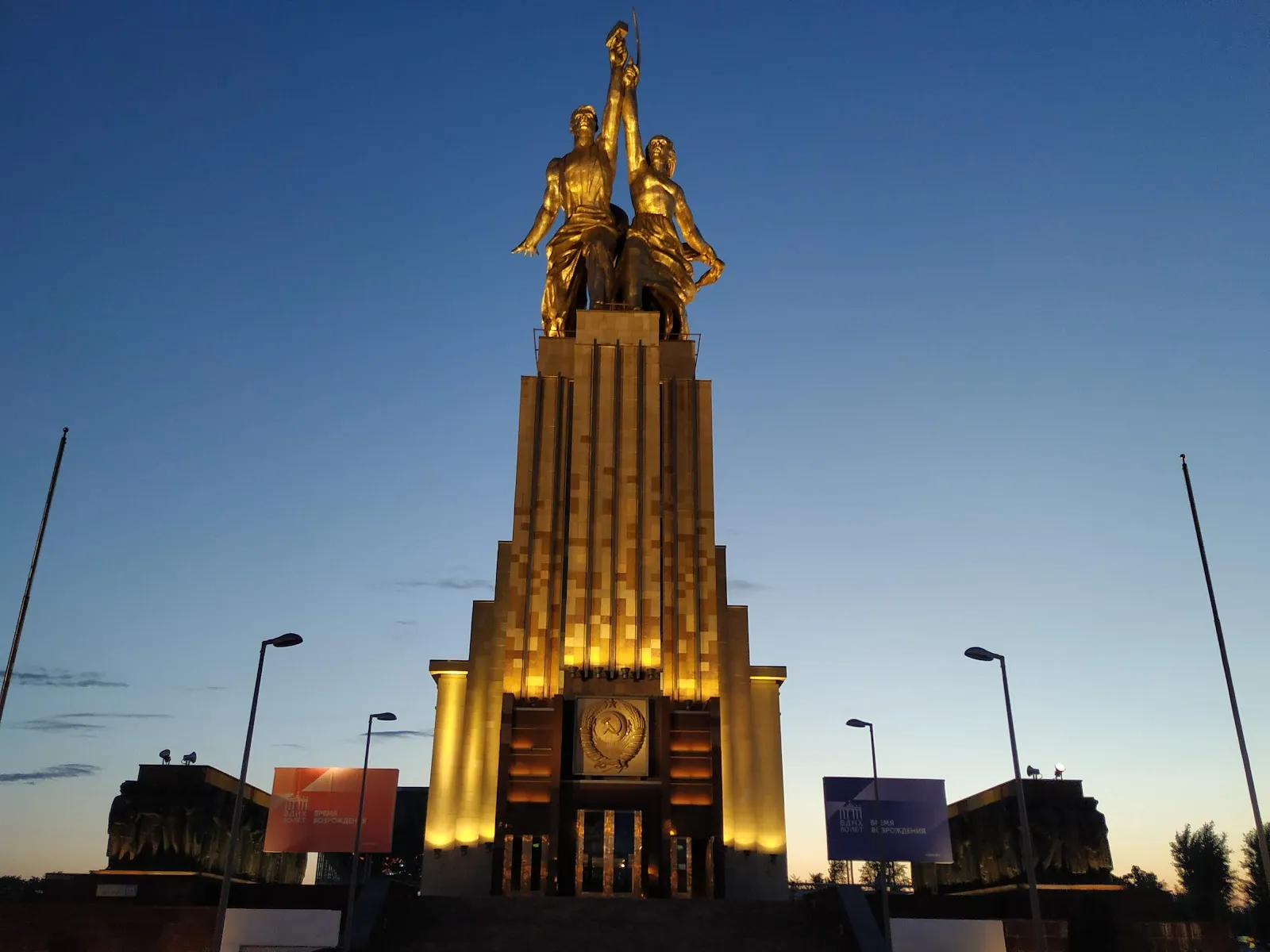
Worker and Kolkhoz Woman is a monumental stainless steel sculpture on Prospekt Mira in Moscow, near VDNKh and the Museum of Cosmonautics. Vera Mukhina created it for the 1937 World’s Fair in Paris, where it stood beside the Eiffel Tower. The 24.5-metre work shows a male worker and a female collective farm worker raising a hammer and sickle, an image of industrial and agricultural unity. Visit by day to take in its scale, or after dark to see it illuminated; the nearby attractions make an easy combination.
A sculpture made for the 1937 Paris World’s Fair
Vera Mukhina created Worker and Kolkhoz Woman for the Soviet pavilion at the 1937 World’s Fair in Paris. The sculpture was displayed beside the Eiffel Tower before being moved to Moscow. Its original setting links the monument to an international exhibition, while its figures and symbols express a Soviet vision of industrial and agricultural work.
The work is made from stainless steel and stands 24.5 metres high. Its two figures, a male worker and a female collective farm worker, raise a hammer and sickle above their heads. The joined gesture gives the sculpture its central image of unity between industry and agriculture.
Reading the figures and symbols
The scale is part of the work’s impact: the figures rise high above the surrounding area, and their raised arms draw the eye toward the hammer and sickle. The polished metal gives the monument a distinct appearance in daylight; after dark, illumination changes how it reads against the sky.
The sculpture is associated with socialist realism and is often understood as an image of Soviet power. Its political meaning is part of what visitors encounter, whether they admire its design or approach it as a monument to a particular historical period. Looking closely at the figures helps explain how the artwork combines human forms with state symbolism.
Adding the monument to a Moscow visit
The sculpture stands near VDNKh, the Exhibition of Achievements of National Economy, and the Museum of Cosmonautics. Visiting these nearby sites together gives the monument a wider context within a day in the area. You can see the sculpture from outside and appreciate its size from a distance as well as up close.
A night visit is a good choice if you want to see the lighting; the statue also merits a stop in daylight. If you are planning to enter the associated exhibition space, check ticket arrangements in advance. The entrance and parking are listed as wheelchair accessible.
FAQ
How tall is Worker and Kolkhoz Woman?
The stainless steel sculpture is 24.5 metres high.
Who created Worker and Kolkhoz Woman?
Sculptor Vera Mukhina created it for the 1937 World’s Fair in Paris.
What does the sculpture depict?
A male worker and a female collective farm worker raise a hammer and sickle, symbolizing unity between industrial and agricultural sectors.
What is near Worker and Kolkhoz Woman?
The monument is near VDNKh and the Museum of Cosmonautics.
When is a good time to see the sculpture?
Visit after dark to see it illuminated, or by day to view its scale in daylight.