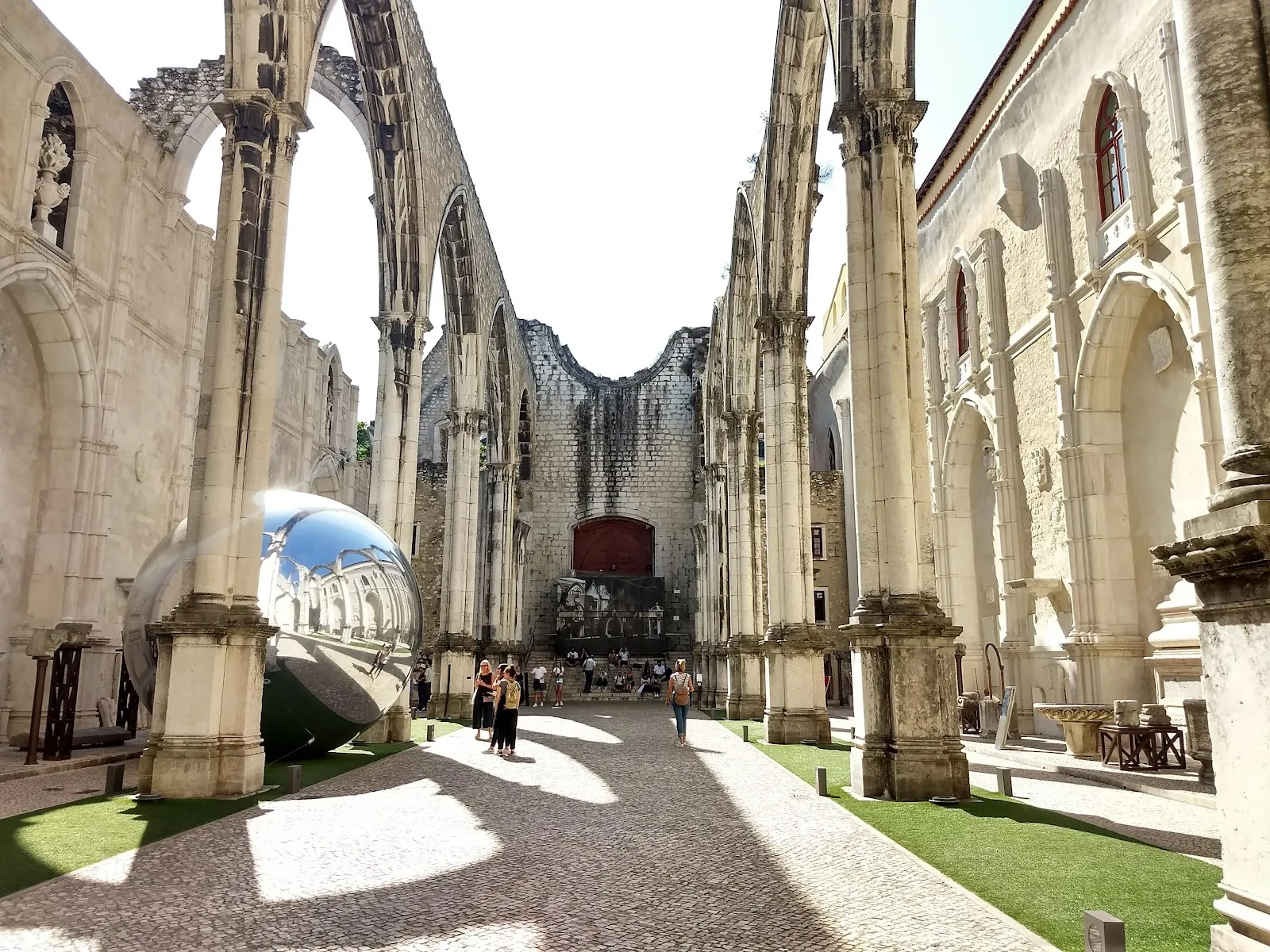
Inside the remains of the Carmo Convent in Lisbon’s Chiado district, this archaeological museum brings the city’s past into a roofless Gothic church damaged in the 1755 earthquake. Look for objects from prehistoric, Roman, Islamic and medieval periods, including stone tools, mosaics, tombs and sculpture. The open nave, with its exposed arches and pillars, is as much a reason to visit as the collection. An informative film about the site’s history is available in English and Portuguese.
A church damaged in the 1755 earthquake
The museum occupies the remains of the Carmo Convent, in Lisbon’s Chiado district. The former Gothic church was badly damaged in the 1755 earthquake, and its exposed pillars and pointed arches preserve the shape of the nave beneath the open sky. The ruins give the museum a distinctive setting: archaeological objects sit within a structure whose damaged stonework is part of Lisbon’s history.
The Portuguese Archaeologists Association founded the museum in 1864. Its collections cover a wide span, from prehistoric periods through the 18th century, and include material from Roman and Islamic cultures as well as medieval Gothic sculpture and sacred art.
Objects from different periods
The collection includes prehistoric stone tools, Roman mosaics and Visigothic pieces, alongside medieval tombs, tombstones and architectural fragments. These objects offer a route through several periods of the region’s past within the former church’s nave and apse.
Other notable items include 4th-century sarcophagi, fragments of columns decorated with griffins and 16th-century painted tile panels. The museum also has two Peruvian mummies from the 16th century. Together, the varied displays range from archaeological finds to works connected with religious and funerary settings.
Taking in the ruins
Look up at the arches and pillars to see how the church’s roofless sections meet the sky. The remains of the nave and apse frame the exhibits, while weathered stone contrasts with the display cases. The open structure is a central part of the visit, not simply a backdrop to the objects.
A short film inside the museum explains the site’s history in English and Portuguese. Set aside time for both the displays and the church interior, then pause in the ruins to take in the architecture. Late afternoon brings a chance to see Lisbon’s rooftops through the arches.
FAQ
Is the Carmo Archaeological Museum closed on Sundays?
Yes. It is closed on Sundays.
How long should you spend at the museum?
Allow at least an hour to explore the exhibits and the convent ruins.
What can you see at the museum?
The collection includes prehistoric tools, Roman mosaics, Visigothic objects, medieval tombs, 4th-century sarcophagi, tile panels and two 16th-century Peruvian mummies.
Is there a film about the museum’s history?
Yes. An informative film is available in English and Portuguese.


