
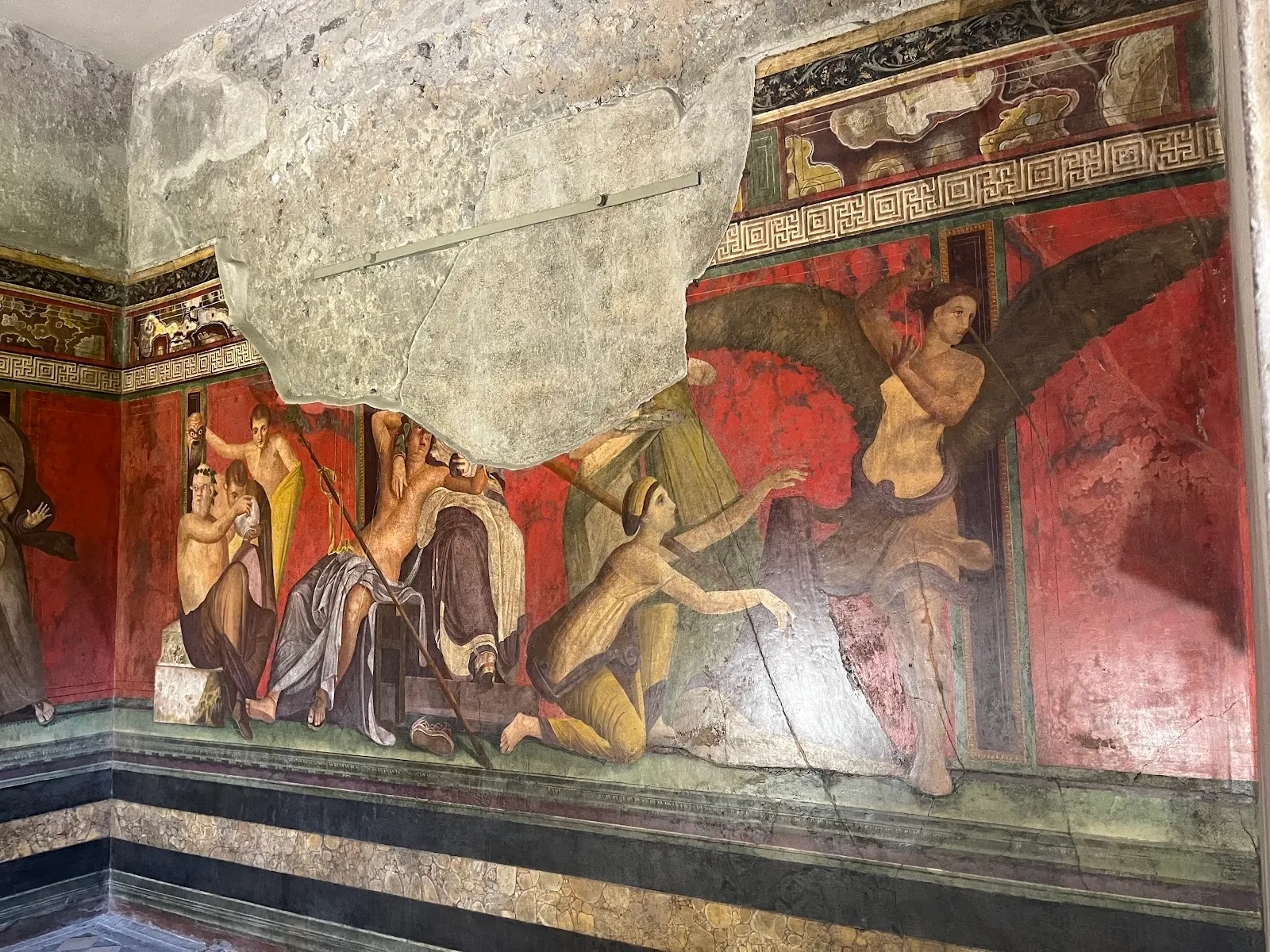
The Villa of the Mysteries is a Roman villa just outside Pompeii's ancient walls, on the road that leads down toward the harbor. Its dining room holds some of the best-preserved wall paintings on the site, with red panels and life-size figures that show a young bride being initiated into the cult of Dionysus. What the scenes mean is still debated. The villa is a short walk from the main ruins and feels calmer than the central streets. Allow time for the walk and take your time in front of the frescoes.
Discovery and owners
The villa was uncovered between 1909 and 1910. It was most likely owned by the Istacidii family, one of the most powerful in Pompeii during the reign of Augustus. The building dates from the first century BC. It stands in the western residential area, outside the city walls, overlooking the sea.
The villa was renovated several times before the eruption of Vesuvius in AD 79.
A house with a working farm
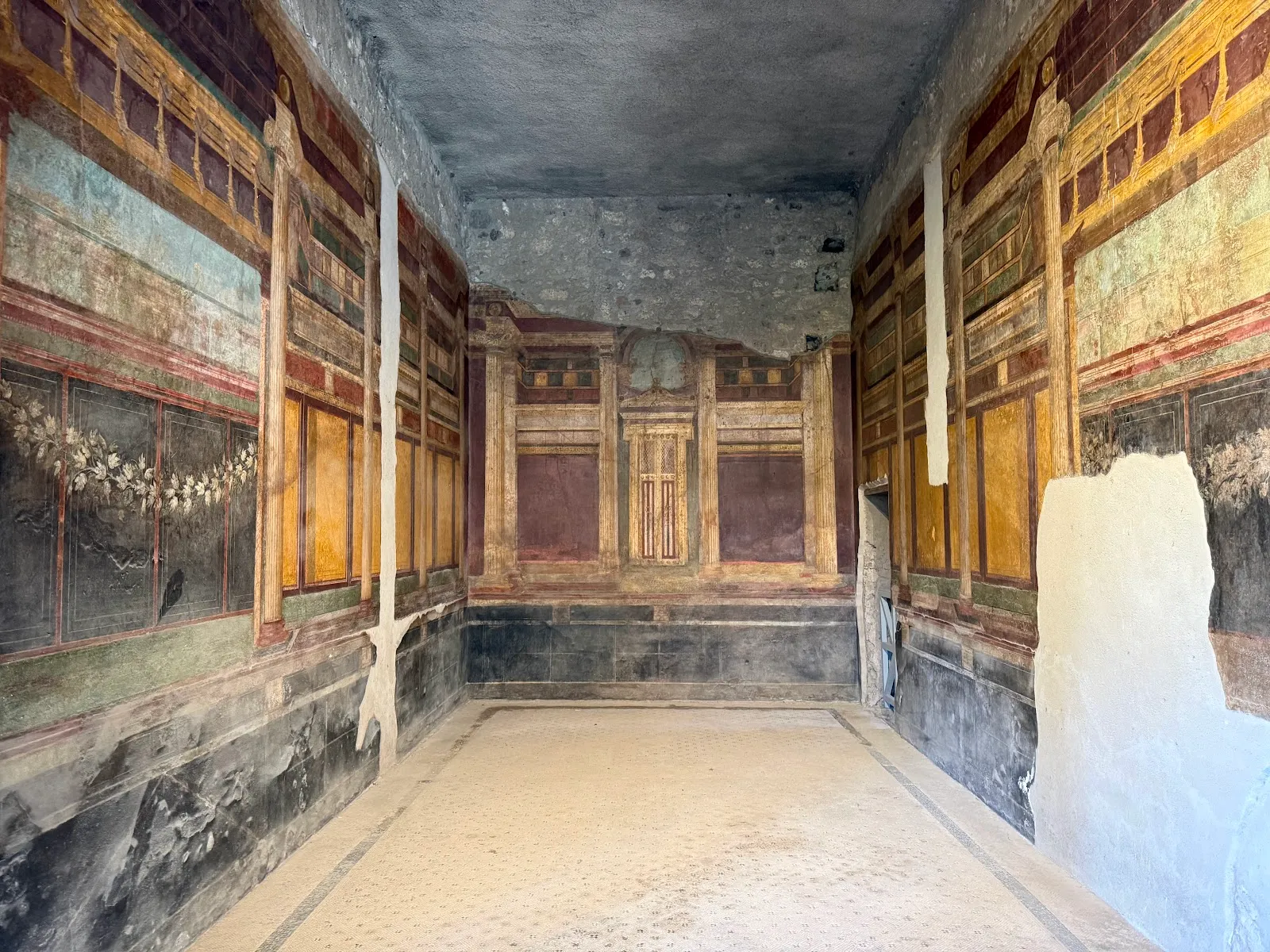
At the time of the eruption, the villa operated as a farm. Its rooms included several kitchens, a grape pressing room, courtyards and altars.
The layout shows how the owners grew grapes and made wine. Special wine presses are on display, which helps explain the house's agricultural side as well as its luxury.
The dining room frescoes
The finest paintings are in the triclinium, the dining room, where a continuous fresco covers three walls. The series runs to seven scenes on a red background: a reading of rituals, Silenus playing the lyre, a satyr and a nymph, Silenus offering wine to a satyr, a Bacchic rite, a Cupid holding a mirror, and an initiate seated on a throne.
The figures are life-size. One panel has 29 of them, and scientists do not yet know exactly what that panel represents.
Dionysus was the Greek god of wine, known to the Romans as Bacchus. Mystery rites were secret, closed to outsiders, so the exact meaning of the scenes remains open to interpretation.
Restoration and what is open
Recent restoration work has opened more spaces in the villa, and further areas are expected to open in the coming years. The frescoes are kept protected to preserve them, which is why the main painting is viewed from the doorway rather than from inside the room.
Getting there and entrances
Circumvesuviana trains from Naples or Sorrento stop at Pompei Scavi-Villa dei Misteri, a short walk from the site. From Sorrento the trip takes about half an hour. For Piazza Anfiteatro, get off at Pompei Santuario instead.
The excavations have three entrances: Porta Marina (via Villa dei Misteri), Piazza Esedra and Piazza Anfiteatro. Porta Marina is the only entrance with the authorized audio guide service. It is a couple of minutes' walk from the station, and small cafes and restaurants line the road outside. For people with limited mobility, Piazza Anfiteatro is the easiest entrance.
FAQ
Is there an extra fee to see the Villa of the Mysteries?
Yes. The villa carries an additional fee, so buy a Pompeii PLUS ticket for entry and buy it in advance to avoid long queues.
How do I get to the Villa of the Mysteries from Naples?
Take the Circumvesuviana train from Naples or Sorrento to the Pompei Scavi-Villa dei Misteri station. The site is a short walk from the station. From Sorrento the trip takes about half an hour.
Which entrance is closest to the villa?
Porta Marina, via Villa dei Misteri, is a couple of minutes' walk from the station. It is also the only entrance with the authorized audio guide service.
Is the site wheelchair accessible?
The site has a wheelchair accessible entrance. For people with limited mobility, Piazza Anfiteatro is the easiest entrance.
Can you walk inside the room with the main fresco?
No. The main painting is protected, so you view it from the doorway. The frescoes are in excellent condition.


