
Borobudur is a Buddhist monument in Magelang Regency, Central Java, built in the 8th and 9th centuries under the Sailendra dynasty. It rises in tiers around a hill, with square terraces below, three round platforms above and a large stupa at the top. About two million stone blocks went into it, and the walls carry thousands of carved relief panels. Visitors walk up through the levels, following the carvings and the Buddha statues in the stupas. Rice fields and volcanic hills surround the site. It is a sacred place, so dress modestly and keep your voice low.
Built in the 8th and 9th centuries
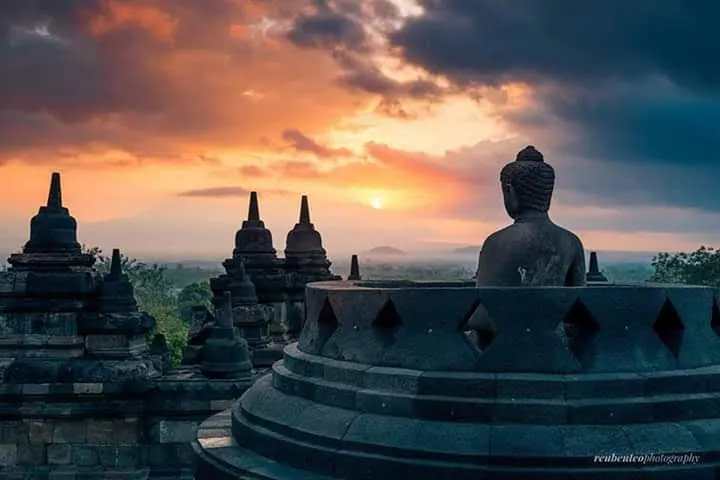
Borobudur was raised during the reign of the Sailendra dynasty, which ruled the Mataram Kingdom. Construction is believed to have taken around 75 years. The monument stands in the Kedu Valley, in the south of Central Java, and is built entirely from andesite stone blocks, about two million of them.
No written record has been found that says who commissioned the temple or why, so parts of its story remain open. It is generally understood as a Buddhist religious site, associated with Mahayana Buddhism. Hinduism and Buddhism existed side by side in Java at this time, and the Hindu temple of Prambanan was built in the same period.
Terraces, stupas and reliefs
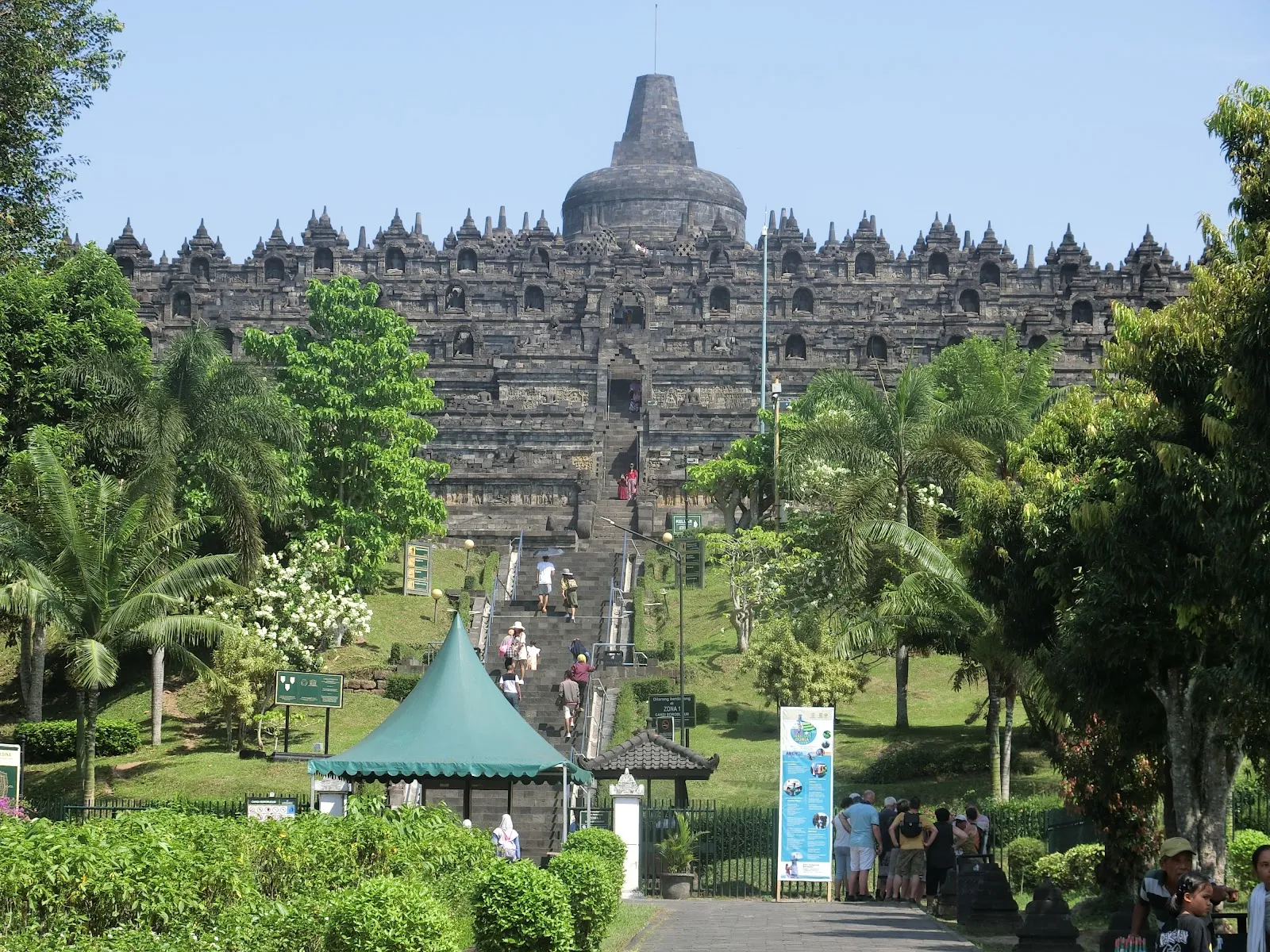
The main structure is a stupa built in tiers around a natural hill. At the base is a pyramid of five concentric square terraces. Above it, three circular platforms form the trunk of a cone, and one large stupa crowns the top. Seen from a distance, the whole monument looks like a mountain of stone.
The circular platforms carry 72 stupas, and each one holds a statue of the Buddha. The monument is said to have had 504 Buddha statues in its original form. The walkways that lead up are lined with 2,672 relief panels. They show scenes from the Buddha's life and traditional Buddhist parables, and the layout as a whole depicts the path to enlightenment. Walking up slowly, level by level, is the natural way to follow them.
The grounds around the monument are trimmed lawns edged with tropical hardwoods, with rice fields and hills beyond.
Abandonment, rediscovery and restoration
Borobudur was abandoned after the Hindu kingdoms of Java declined and the Javanese converted to Islam. For centuries it lay under layers of volcanic ash and dense vegetation. It was brought to the attention of the outside world in 1814, when the British governor Thomas Stamford Raffles took an interest in the history of Java.
The monument has been restored several times since. The Indonesian government and UNESCO carried out major work in 1975 and 1982, and Borobudur was named a UNESCO World Heritage Site in 1991.
Sunrise, sunset and tickets
Sunrise is the most popular way to see the temple. The special sunrise ticket allows entry around 4:30 am, before the normal opening time. The first 45 minutes after the sun comes up are the time when golden light and morning mist over the hills are at their best. Many travellers go on a sunrise tour from Yogyakarta, often booked through a hotel, and some of these tours also stop at Prambanan. Others rent a scooter and leave around 4 am.
A sunset programme, run by InJourney Destination Management, lets visitors watch the sun go down from the top of the temple with the Menoreh Hills as a backdrop.
Temple tickets are sold online and should be bought in advance. A combined Borobudur and Prambanan ticket is valid for two days. Students and schoolchildren need a student ID or a letter from the school to get the student rate. The monument closes on special occasions such as Vesak Day.
Around the temple
The Borobudur compound includes two more monuments, Mendut Temple and Pawon Temple. Markets near the temple sell batik, wood carvings, sculptures, souvenirs, jewellery and clothing, as well as local coffee and fresh fruit.
A short distance away, Bukit Rhema, known as the Chicken Church, sits in the green hills. It was designed to resemble a dove, as a symbol of peace. Several tourist villages around the temple also let visitors get to know local culture.
FAQ
Do I need to book Borobudur tickets in advance?
Yes. Entry to the temple structure requires a ticket bought in advance, and it can be bought online. The ticket includes an audio guide.
Can I see Borobudur at sunrise?
Yes, with a special sunrise ticket that gives entry around 4:30 am, before normal opening. Many travellers join a sunrise tour from Yogyakarta, or ride there by scooter.
Does the Borobudur and Prambanan combined ticket cover sunrise?
No. The combined ticket is valid for two days and does not include the sunrise or sunset surcharge.
What should I wear at Borobudur?
Wear comfortable clothes that are modest, since the temple is a sacred place. Add sunscreen, a hat or an umbrella, because most of the monument has little shade.
Is Borobudur wheelchair accessible?
The entrance, restrooms and parking lot are wheelchair accessible. Parking is paid.
