
Arunachaleswarar Temple, also called Annamalaiyar Temple, sits at the foot of Arunachala Hill in Tiruvannamalai, Tamil Nadu. Shiva is worshipped here as the Agni Lingam, the element of fire, and the temple is one of the five Pancha Bhoota Sthalas. Four tall white gopurams mark the entrances, and the eastern Raja Gopuram rises 13 storeys. Inside the large complex are a Thousand Pillared Hall, sacred tanks and shrines to Arunachaleswarar and Apitakuchamba. Pilgrims often pair a darshan with the 14 km Girivalam walk around the hill.
The fire temple of Shiva
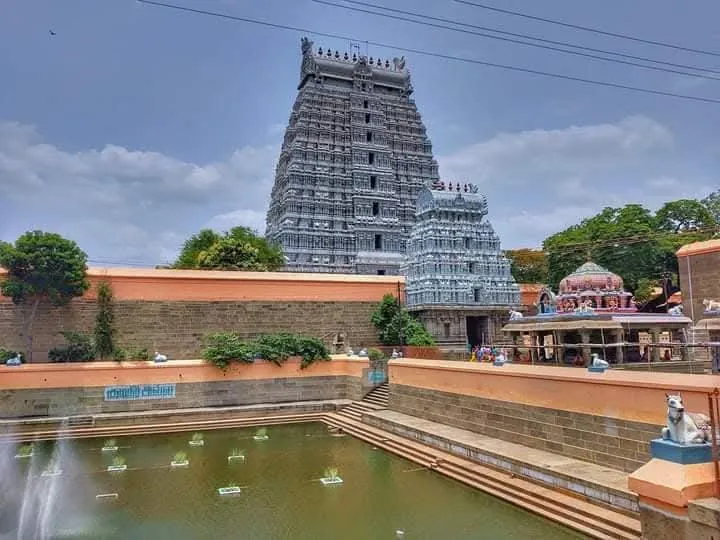
Annamalaiyar Temple, also known as Arunachaleswarar Temple, stands at the base of the Annamalai hills in Tiruvannamalai. It is dedicated to Shiva, who is worshipped here as the Agni Lingam, the form that represents fire. That makes it one of the Pancha Bhoota Sthalas, the five temples linked to the elements of land, water, air, sky and fire.
According to Hindu tradition, Shiva appeared on this spot as a boundless pillar of fire to settle a dispute between Brahma and Vishnu over who was supreme. The primary deities of the temple are Arunachaleswarar, who is Shiva, and the goddess Apitakuchamba, also known as Unnamalai Amman.
The temple is also important in Tamil Saiva literature. It is praised by the Nayanar poet-saints and is regarded as the birthplace of Manikkavasagar's Tiruvempavai hymns.
From the Chola period to the Nayak gopurams
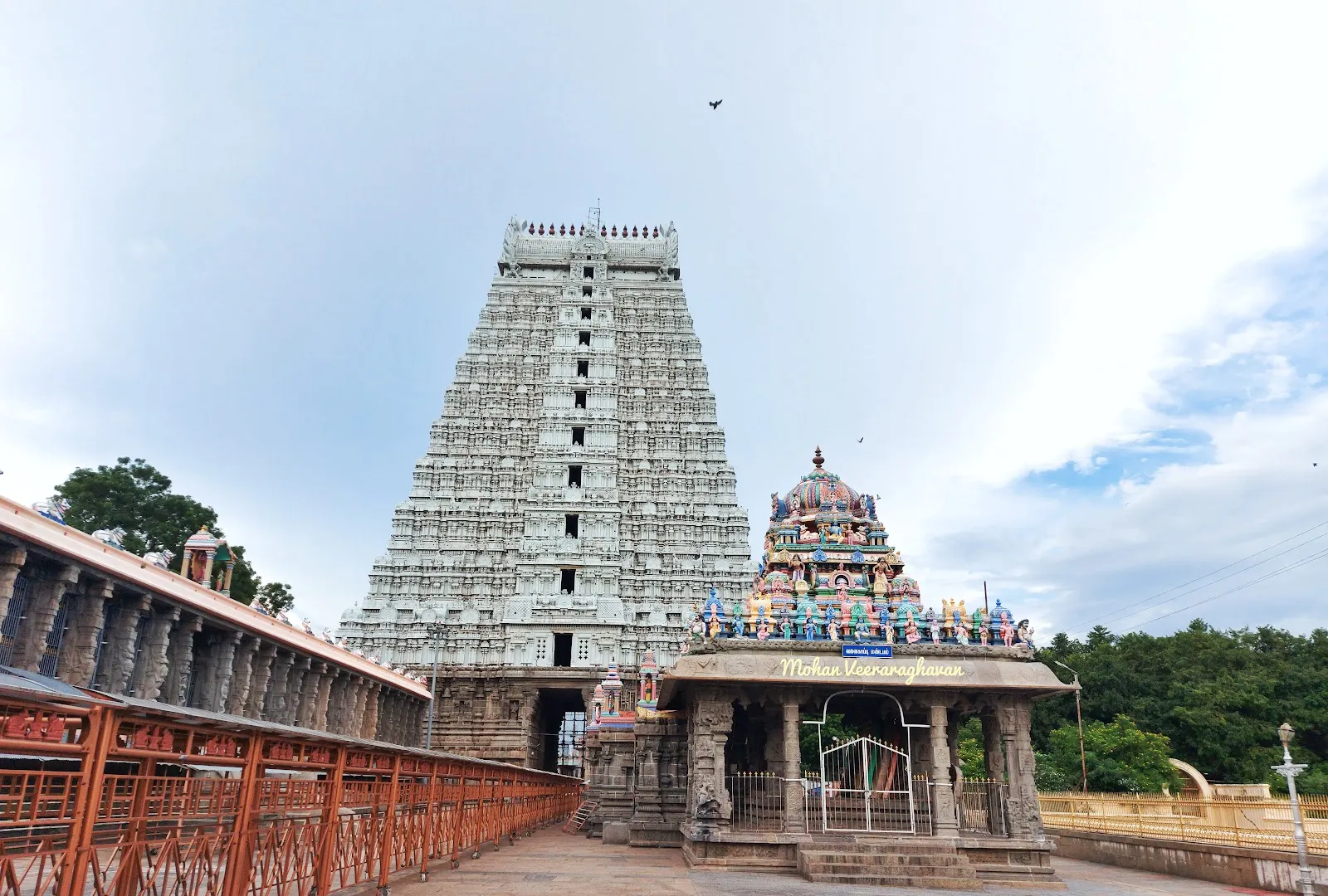
The oldest parts of the temple date to the 9th century, in the time of the Chola dynasty, although the site was a place of worship before that. The complex was enlarged over the following centuries. The Vijayanagara kings made additions in the 15th century, and the Nayak rulers added towering gopurams and pillared halls.
The complex covers about 10 hectares, or roughly 25 acres, which places it among the largest temple complexes in India. Dravidian architecture is visible everywhere, from carved towers to the many shrines and halls inside the walls.
Gopurams, halls and tanks
Four large unpainted white gopurams mark the entrances. The main one is the eastern Raja Gopuram, built in the 17th century and 13 storeys high. Its passageway is carved with dancers, dwarves and elephants. The Raja Gopuram is the usual entrance, and visitors who have completed darshan are sometimes directed to leave through the South Gopuram.
Inside, the Thousand Pillared Hall is one of the main sights. The complex also has sacred tanks, and a golden kalasam crowns the summit of the sanctum tower. Many smaller shrines and halls are decorated with carving, so allow time to walk slowly rather than head straight for the sanctum.
Girivalam and Karthikai Deepam
Girivalam, also called Giri Pradakshina, is the walk around Arunachala Hill. The path is about 14 km. A regular long-distance walker can finish it in around three and a half hours, and pilgrims often start in the early morning. The route runs through both paved and tarred sections, with patches of shade, and along it people hand out food as annadanam.
The town draws very large numbers of devotees for Girivalam on the full moon day each month and for the Karthikai Deepam festival. At Karthikai Deepam a large beacon is lit on top of the 2,668-foot hill, a tradition linked to the Chola period. During festivals the temple is filled with lamps and the scent of burning ghee. During Mahashivaratri, the temple management has kept the large crowds in order.
On full moon days the queue at the Raja Gopuram can already be long by mid-afternoon, with darshan taking three to four hours. A common plan is to visit the temple on an ordinary day, then walk Girivalam the next morning.
Getting there and practical details
The temple is about 2 km from Tiruvannamalai bus station. Vehicle access close to the temple is restricted, and parking is some distance away, so many visitors take an auto-rickshaw from their hotel. There is free and paid parking, a restroom, and a wheelchair accessible entrance, restroom and parking area. The temple opens early in the morning and stays open into the evening.
Other places visitors often add to a stay are Ramanashrama and the Seshadri Swami ashram, which are close to the town and the hill.
FAQ
What is Arunachaleswarar Temple known for?
It is a Shiva temple where the deity is worshipped as the Agni Lingam, the element of fire. It is one of the five Pancha Bhoota Sthalas and is known for its tall gopurams and the Girivalam walk around Arunachala Hill.
Are mobile phones allowed inside the temple?
Phones are not permitted inside the temple premises, so leave yours at your hotel before you go.
How long is the Girivalam walk?
The Girivalam path around Arunachala Hill is about 14 km. A regular long-distance walker can complete it in around three and a half hours.
When is the best time to visit?
Early morning on a weekday or another non-peak day means shorter queues. Full moon days and weekends are much busier, and darshan on a full moon day can take three to four hours.
Can you drive up to the temple?
Vehicle access near the temple is restricted, and the nearest parking can be almost 2 km away. An auto-rickshaw from your hotel is easier.
Is the temple wheelchair accessible?
The temple has a wheelchair accessible entrance, restroom and parking area.


