
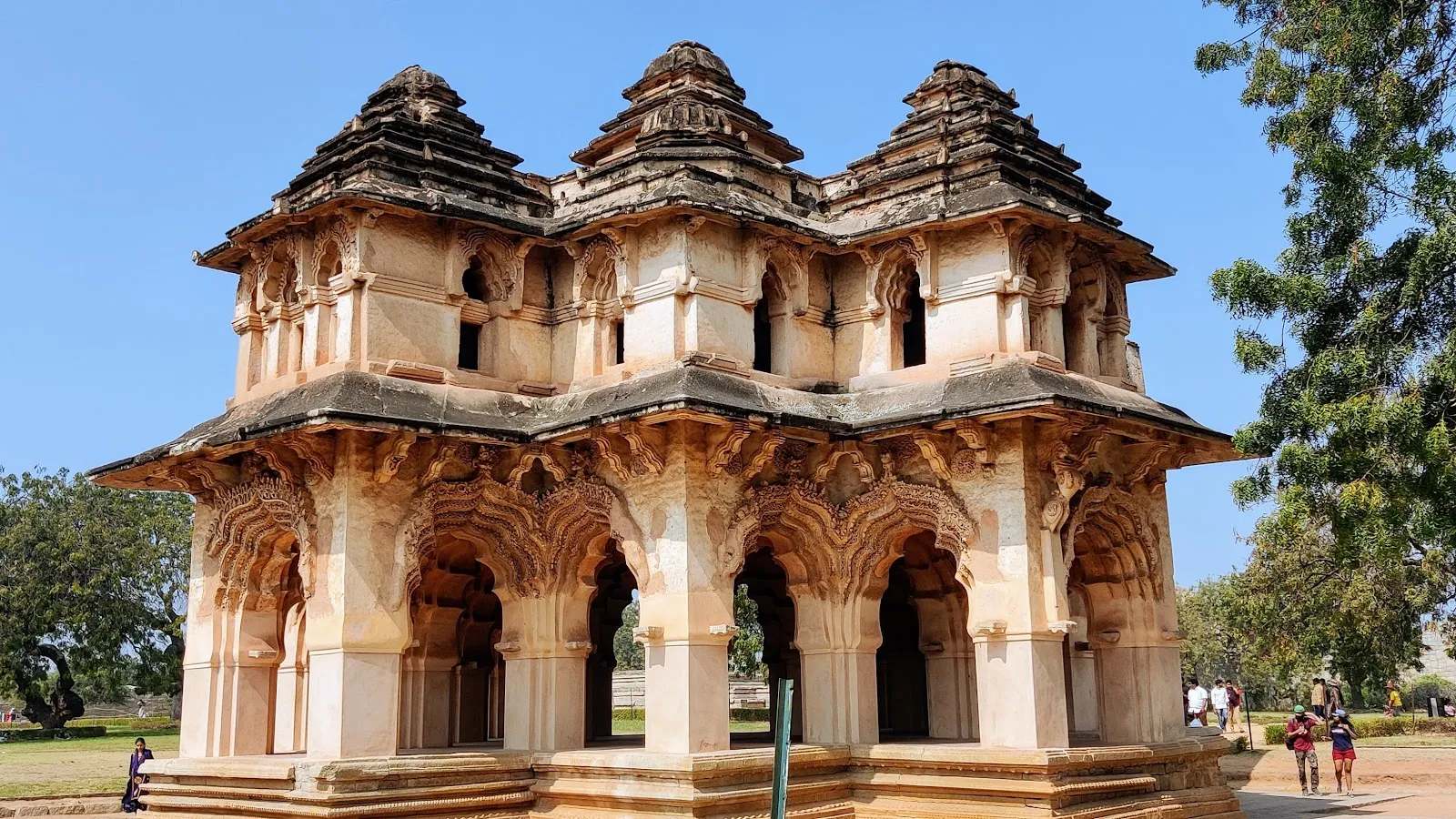
Lotus Mahal is a two-story pavilion inside the Zenana Enclosure, in the Hampi ruins of the Vijayanagara Empire. Its arches and central dome are shaped like lotus petals and a bud, and the design mixes Hindu and Islamic styles. It is one of the few buildings in Hampi that remained largely intact after the city's downfall, so its carvings and proportions are easy to study. Walk the lawns around it, look at the symmetry and the carved arches, then continue to the Elephant Stables, which are close by.
Architecture and the lotus design
The building has two stories. Open pavilions sit at ground level, and balconies run along the upper floor. Its cusped arches are set out in a geometric pattern, and the petals they suggest open toward the sun, which is where the name comes from. The central dome is shaped like a lotus bud.
The design brings Hindu and Islamic elements together. Hindu motifs appear in the carvings, and the arches follow Islamic forms. Twenty-four pillars support the structure. On some of the arches, look for the carved makara torana, a sea creature from Hindu mythology that is also the vehicle of the goddess Ganga. Stucco moldings and carved walls decorate the building.
Built to stay cool
The building was designed to keep its interior cool. Traces of water pipes can be seen between the arches and along the edges of the roof, which suggests water once ran through the structure. A water tank was placed on top, and the open arches let air move through the rooms.
These features show how the builders dealt with the heat of the region, which matters on a visit in the middle of the day.
The Zenana Enclosure and its use
Lotus Mahal sits inside the Zenana Enclosure, the walled compound where the women of the royal family lived. Only lady guards and maids were allowed inside. The building is also known as Kamal Mahal and Chitragani Mahal.
Its exact use is not settled. Some accounts describe it as a summer retreat or leisure pavilion for the queens. Others suggest it was a social space for the royal women, or a place for dance performances. One account links it to one of the wives of Krishnadevaraya. Most other buildings in the enclosure are in ruins, while Lotus Mahal remains largely whole.
What else is nearby
The Elephant Stables stand in the same enclosure. A watch tower, the treasury building and the Jal Mahal are in the wider compound. The Queen's Bath is in the Royal Enclosure, and the Hazara Rama Temple is about 500 meters away.
Plan these sites as one walk. The Vijaya Vittala Temple is also included on the combined ticket, so it fits the same day.
Visiting the monument
The interior is closed to visitors, so you see the building from outside. Walk around it to study the carved arches from several angles. Gardens and lawns surround the monument, and the grounds offer a quiet place to sit.
The site is very large, so allow time to walk between monuments. Parts of the site are wheelchair accessible, with an accessible entrance and parking lot. Parking includes both free and paid areas.
FAQ
Is there an entry fee?
Yes. Tickets for the ruins are bought at the entrance to the Elephant Stables and Lotus Mahal, and one ticket also covers the Vijaya Vittala Temple and the archaeological museum. One account lists 600 rupees for foreign visitors, so check the current price at the gate.
Can you go inside Lotus Mahal?
No. Entry to the interior is restricted, so you view the arches and carvings from outside.
How long do you need?
Plan 30 to 60 minutes for the monument. It is small enough to cover quickly, and it pairs well with the Elephant Stables and the Royal Enclosure.
When is the best time to visit?
Early morning or late afternoon, for softer light and less heat. One source gives October to March as the cooler months.
Is Lotus Mahal wheelchair accessible?
To some extent. The entrance and the parking lot are wheelchair accessible.


